.
Bob Taylor’s last Western
 Robert Taylor’s last big-screen Western was a very far cry from his first, nearly thirty years before, Stand Up and Fight, which we reviewed the other day. In Stand Up he had been a handsome young hero who bested the bad guys and won the fair maid. Three years after that he had been young Billy Bonney in the 1941 version of Billy the Kid. Now, in Return of the Gunfighter, he was 56 and looked older. He was obliged to have a father-daughter relationship with the female lead (she calls him Tio Ben, then Padre) and he plays an aging gunfighter, free after five years in Yuma, tired of fighting and even tired of life.
It was a Return in more ways than one because for his last Western Taylor was back at MGM. And in some ways it harked back to some of Taylor’s earlier Westerns, as he played a man in black, a man ‘with a past’, a rather somber figure hinting at inner hurt.
Return was directed by James Neilson, not, I fear, the most outstanding of Western directors. Known mostly as a director of TV shows, he did some feature films with Disney but he only made three big-screen Westerns, Disney production The Adventures of Bullwhip Griffin the same year as Return, and, earlier, he had taken over on Night Passage when Anthony Mann and Jaqmes Stewart had a bust-up, the result being one of Stewart’s weakest Westerns.
.
.

That’s Neilson, right, on the set of Night Passage
.
Still, Return of the Gunfighter is actually pretty good. Taylor was believable as the grizzled gunman longing to hang up his irons (but there’s always some punk wanting to take him on) and his by now craggy face somehow suited the part. And it was co-written by Burt Kennedy so that was a definite plus. It benefits from Lyle Bettger as the smoothie/tough bad guy, and Michael Pate as a gun-thug, though neither was any longer in his first flush of youth. In a way it reminds me of an Audie Murphy Western, or, if it had been a decade earlier, a Budd Boetticher/Randolph Scott one. That’s not a bad thing!
There had to be a handsome young co-star, who could pair off with the girl (Taylor being too old for that) and they cast Chad Everett, not an actor I knew well but he had been a deputy in ABC’s short-lived The Dakotas in 1962 and had played with Taylor in the non-Western Johnny Tiger the year before Return. He’s OK, I guess.
.
.
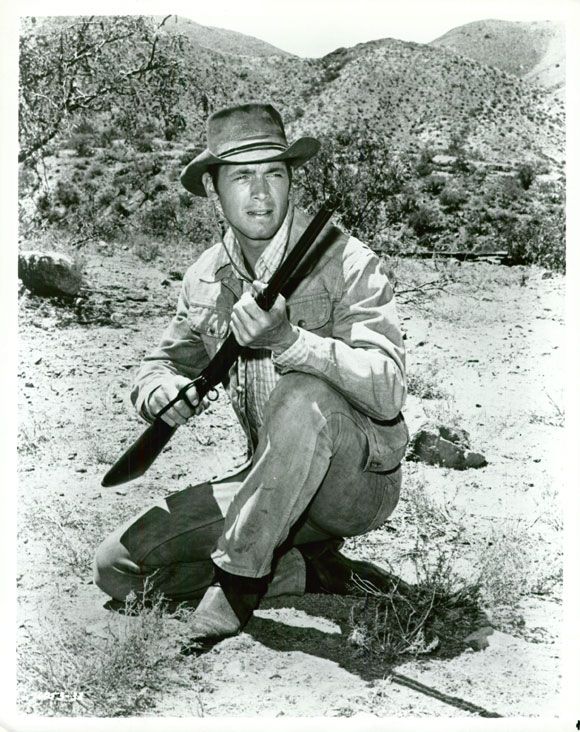
Everett gets the girl
.
It opens with garish spaghetti-influenced titles and jangly music (interesting to see the reverse engineering process going on as Italian Westerns started influencing proper ones). We see Buck Wyatt (Taylor) in a saloon, playing cards in a crooked game, with his opponents’ accomplice signaling what cards Wyatt has, just as had happened in his first Western – was it perhaps a deliberate reference? What was certainly a deliberate reference is Taylor’s character’s name; he had been Buck Wyatt in the great Westward the Women in 1951.
.
.

Rich rancher villain Bettger
.
After he is obliged to shoot the crooked gambler, an uncredited young Mexican gunfighter arrives (classic spaghetti close-up of his eyes over the batwing doors) to ask Wyatt’s help for his cousins, the Domingos, a New Mexico family about to be illegally evicted from their home. Wyatt and Luis Domingo (Rodolfo Hoyos Jr) had fought together for Juarez back in the day. Sadly, this young Mexican is then written out; dramatically, he should have helped in the fight. Anyway, Wyatt rides off to the farm near Lordsburg but finds only two graves. He is too late. Evil Clay Sutton (Bettger) and his henchmen Butch Cassidy (John Crawford) and Sundance (John Davis Chandler) have murdered them. But their daughter, the fair Anisa (Ana Martín, in a 60s bouffant hairdo) has escaped.
.
.

Chandler is psychotic killer
.
Blond Chandler specialized in playing psychotic villains like Sundance and you may remember his evil bounty hunter in The Outlaw Josey Wales, his Norris in Pat Garrett & Billy the Kid or his Jimmy Hammond in Ride the High Country. Here he is an evil thug who takes pleasure in killing, and is rather the boss of Butch. As it’s 1878 and he is killed in a quick-draw showdown by Wyatt, it does
rather play fast and loose with history but that’s Hollywood Westerns for you. Butch and Sundance have featured in many Westerns, set in all sorts of periods, and have met many deaths.
rather play fast and loose with history but that’s Hollywood Westerns for you. Butch and Sundance have featured in many Westerns, set in all sorts of periods, and have met many deaths.
There’s a crooked marshal in Lordsburg (Mort Mills) who is in rancher Sutton’s pocket. He is also blond. In fact all the villains are Nazi-blond and contrast with hero Taylor’s dark mien and the good-guy Mexicans.
.
.
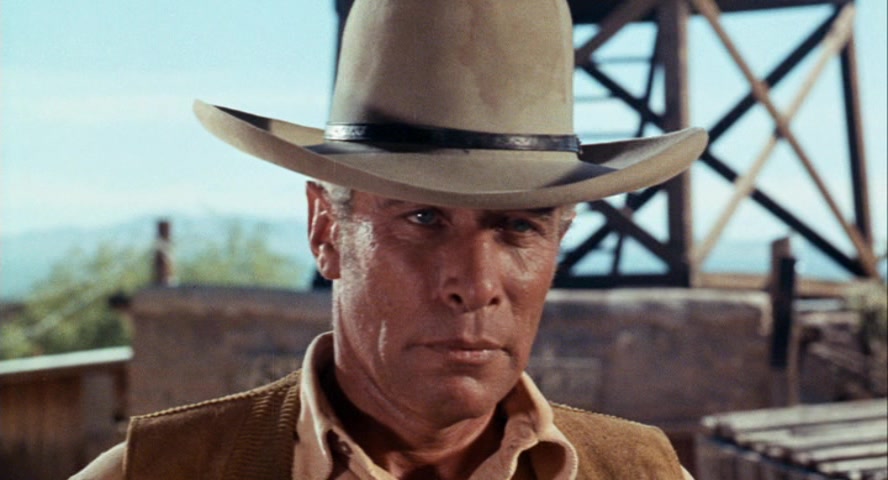
Crooked lawman in rancher’s pay
.
There’s a sub-plot of three Boone brothers who are gunning for Lee Sutton (Everett) because he shot a fourth, over a girl. They are Boyd ‘Red’ Morgan, Henry Mills and Michael Pate, but they are soon dispatched by Wyatt and Lee working in tandem, and again, dramatically, one wonders even what they were doing in the plot. Australian Pate usually played Indian chiefs but occasionally he moonlighted as a gunfighter, as, for example, in A Lawless Street where he was gunning for Marshal Randolph Scott.
.
.
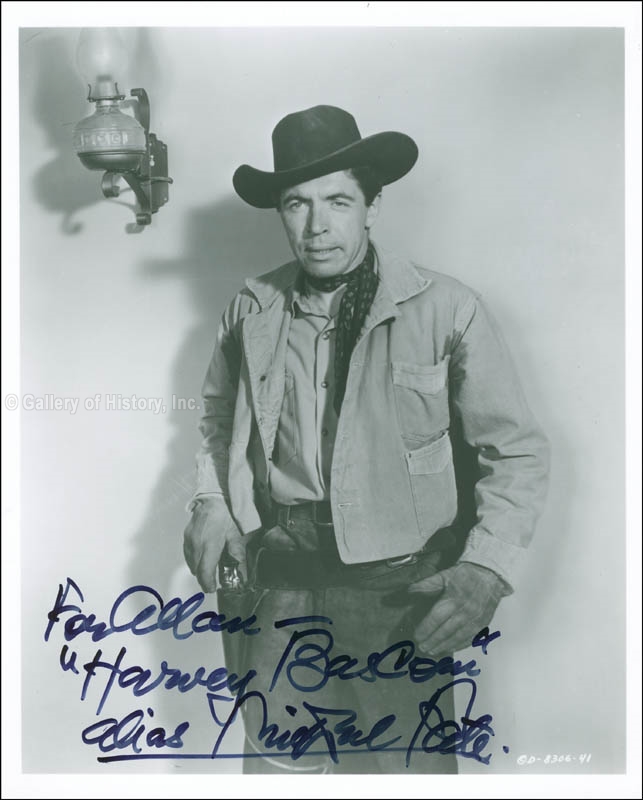
Pate not always an Indian
.
It was set in New Mexico but shot in Arizona, around Old Tucson, and in fact Lordsburg looks really nice, a convincing New Mexico town. We also see the stage to Lordsburg rolling along a couple of times.
.
.
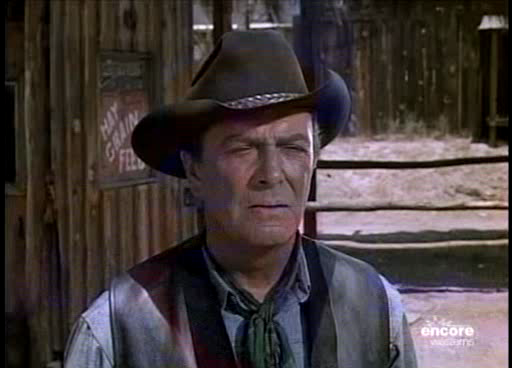
Taylor rides again but for the last time
.
The final shoot-out is quite well done, after which young Lee gets the girl and Wyatt walks off sadly, alone. It was the last time Robert Taylor did so. He would appear on the small screen, in two episodes of Hondo later the same year which were then cobbled together to form a TV movie, Hondo and the Apaches, and of course for the last three years of his life (he died from lung cancer aged only 57) as host of Death Valley Days, also appearing in a couple of episodes. But Return of the Gunfighter was his big-screen Western swansong. I always liked Taylor as Western lead, and Return of the Gunfighter, though no great Western, was by no means his worst. The late 60s ‘end-of-the-West’ tone suited his older self and an aging dinosaur gunfighter was a suitable role for him.
4 Responses
It's almost impossible to believe that the Taylor of 1939 and 1967 are even the same man.
Yes, he aged 'hard'. I'm sure the chain-smoking contributed.
Jeff
I agree the 60 ciggies a day #RobertTaylor caused him to age quickly… added 10 yrs on to him. So sad…. I wish he lived longer. He is my favorite along with #ClaytonMoore. They looked alike… wish they did a movie together.. could have played brothers.
It is rather a good surprise as 1960s american westerns are often mixed bag.
Even if the plot is based upon classic western tropes, and has globally a slow pace accelerating the more it gets closer to the end though, it offers a couple of unexpected twists.
Beside of Robert Taylor, all the more touching since we know he is riding close to the end of the trail, there is a great cast.
The villains are the best film’s asset.
Lyle Bettger has never been so good, alternatively suave and sweet or out of control, vicious and violent. Michael Pate has an impressive presence, in spite of limited lines. John Davis Chandler is almost over the top. Mort Mills’ face always makes me think of an Easter Island moai. Rodolfo Hoyos Jr unfortunately plays for about 3 minutes only. Indispensable Willis Bouchey is the two-faced judge. Barry Atwater (tons of TV) is the hieratic newspaper editor whose office is very nicely decorated.
I am surprised that Jeff did not say a word about the “crooked gambler” firmly played by one of his favourite, Harry Lauter, to whom he has devoted a whole article. In the lovely saloon, we can spot a corrida poster.
Chad Everett is maybe too cute with his ultra white teeth but he is quite good as the young gun.
I do have some reservations though about Ana Martin, Miss Mexico 1963, born 14 May 1946, but after all she is almost a child, a dove surrounded by raptors.
Even if the church is easily recognizable, Old Tucson location is very well used. and Sabino Canyon, an other familiar western spot northeast of Tucson, provides a few nicely shot outdoor backdrops with some water and lots of huge saguaros.
An other strength, the photography is excellent thanks to experienced Ellsworth Fredericks, the uncredited cameraman of The Treasure of the Sierra Madre.
He also shot the same year The Last Challenge (last Richard Thorpe film and starring Glenn Ford and 20 years younger Angie Dickinson like what the age difference is not always a problem) having much in common with The Return, including Chad Everett.
Fredericks (1904-1993) who served as a major in the U.S. Army in 1943-44 had been the official cinematographer of Franklin Roosevelt.
Prolific in television, known for Invasion of the Body Snatchers and Sayonara (for which he was nomined (both in 1956) and Seven Days in May (1964), he filmed (and was often involved uncredited in) many westerns such as Friendly Persuasion, Seven Angry Men, Charro, Canyon River, Trooper Hook, At Gunpoint, Shotgun, to name a few.
Indeed, we can ramble on the names, from Wyatt to Sundance and Cassidy, not forgetting Lordsburg.
Much better than expected. Maybe the last but surely not the least of Robert Taylor’s westerns.