.
.
Explosive fun
.
.
 Two 60s Westerns which have quite a bit in common are Rio Conchos and 100 Rifles.
.
Rio Conchos was football star Jim Brown’s debut and by the time of 100 Rifles he was getting top billing, even above Burt Reynolds and Raquel Welch. Brown is sometimes called the greatest player in NFL history and his burly physique made directors have him remove his shirt whenever possible. This turned out to be quite often. To be brutally frank, he wasn’t much of an actor but if you needed a big black man in an action film (The Dirty Dozen, say) or indeed any of the many blaxploitation movies of the 70s, Brown was your man.
.
.
Conchos was directed by Gordon Douglas, who churned out a lot of standard stuff but also occasionally came up with something interesting and fun. Conchos is in the interesting-fun class. Rifles was directed by Tom Gries, who also produced a lot of routine material but occasionally came up with a little gem – the excellent Western Will Penny being the obvious example and probably his finest work.
Conchos was directed by Gordon Douglas, who churned out a lot of standard stuff but also occasionally came up with something interesting and fun. Conchos is in the interesting-fun class. Rifles was directed by Tom Gries, who also produced a lot of routine material but occasionally came up with a little gem – the excellent Western Will Penny being the obvious example and probably his finest work.
.
.
Both Conchos and Rifles were Fox Westerns with a Hollywood post-spaghetti look and feel about them, from the Rio Conchos cynical hero Richard Boone ready to slaughter Indians at any opportunity to the trendy pink credit titles of 100 Rifles. And loads of gunshots and corpses.
.
.
Both Conchos and Rifles were Fox Westerns with a Hollywood post-spaghetti look and feel about them, from the Rio Conchos cynical hero Richard Boone ready to slaughter Indians at any opportunity to the trendy pink credit titles of 100 Rifles. And loads of gunshots and corpses.
.
.
Both plots centre around a shipment of repeater rifles that risks going to the Indians and being used to attack the Army. In the case of Rio Conchos, it is 1867 and the guns are destined for crazed Confederate officer Edmond O’Brien who wants to arm the Apaches with them and crush the bluecoats. In Rio Conchos we are in Mexico in maybe 1910 or ’11 and the sadistic ruler of the state of Sonora, General Verdugo (Argentine Fernando Lamas, who had provided the stock Mexican in countless movies for a quarter of a century by then; he is satisfactorily evil here with his twin pearl-handled .45 automatics) has to prevent the rifles going to the Yaqui Indians whom he is trying to exterminate.
.
Both plots centre around a shipment of repeater rifles that risks going to the Indians and being
 used to attack the Army. In the case of Rio Conchos, it is 1867 and the guns are destined for crazed Confederate officer Edmond O’Brien who wants to arm the Apaches with them and crush the bluecoats. In Rio Conchos we are in Mexico in maybe 1910 or ’11 and the sadistic ruler of the state of Sonora, General Verdugo (Argentine Fernando Lamas, who had provided the stock Mexican in countless movies for a quarter of a century by then; he is satisfactorily evil here with his twin pearl-handled .45 automatics) has to prevent the rifles going to the Yaqui Indians whom he is trying to exterminate.
.
.
Both movies have big, explosive finales. Both have something to recommend them, even if Rio Conchos was considered a pretty pulp Western at the time and The New York Times said of 100 Rifles, “‘This picture has a message: watch out.’ So proclaim the ads for 100 Rifles. Wise moviegoers can do even better by ducking it altogether.”
.
Both movies have big, explosive finales. Both have something to recommend them, even if Rio Conchos was considered a pretty pulp Western at the time and The New York Times said of 100 Rifles, “‘This picture has a message: watch out.’ So proclaim the ads for 100 Rifles. Wise moviegoers can do even better by ducking it altogether.”
.
.
In both movies the Indians look like Apaches. Why did all movies have to show Indians in red headbands and long breechclouts holding Winchesters, regardless of their tribe? In Rio Conchos they are Apaches, so fair enough, but in 100 Rifles they are Yaquis. It is true, of course, that it was a really cool look so you can’t blame the costume department. The Indian leaders were rarely real Indians, of course. Rodolfo Acosta, a Mexican character actor, is Bloodshirt in the first and Raquel Welch is the Yaqui leader in the second, so a certain amount of, er, suspension of belief is required.
.
In both movies the Indians look like Apaches. Why did all movies have to show Indians in red headbands and long breechclouts holding Winchesters, regardless of their tribe? In Rio Conchos they are Apaches, so fair enough, but in 100 Rifles they are Yaquis. It is true, of course, that it was a really cool look so you can’t blame the costume department. The Indian leaders were rarely real Indians, of course. Rodolfo Acosta, a Mexican character actor, is Bloodshirt in the first and Raquel Welch is the Yaqui leader in the second, so a certain amount of, er, suspension of belief is required.
.
.
100 Rifles came out in the same year as The Wild Bunch. Is it a coincidence that both have stereotype German officers advising the wicked Mexican general and both generals ride about in a big open De Dion Bouton? Jim jumps over the automobile on his horse, Monte Walsh-style, to symbolize that cars aren’t properly Western and the horse is superior.
.
100 Rifles came out in the same year as The Wild Bunch. Is it a coincidence that both have stereotype German officers advising the wicked Mexican general and both generals ride about in a big open De Dion Bouton? Jim jumps over the automobile on his horse, Monte Walsh-style, to symbolize that cars aren’t properly Western and the horse is superior.
.
.
Both these movies are big, noisy and a lot of fun. Not art works, just Westerns. Rio Conchos ends in a wagon wreck with mucho fireworks. Rifles goes one better with that ultimate studio must-have, a train wreck. No expense spared. Cast of thousands. Hundreds, anyway.
.
Both these movies are big, noisy and a lot of fun. Not art works, just Westerns. Rio Conchos ends in a wagon wreck with mucho fireworks. Rifles goes one better with that ultimate studio must-have, a train wreck. No expense spared. Cast of thousands. Hundreds, anyway.
.
.
 In Rio Conchos, a slightly overweight Boone, the year after Have Gun – Will Travel finished, is ‘Lassiter’, a bit cheeky but hey. He was an
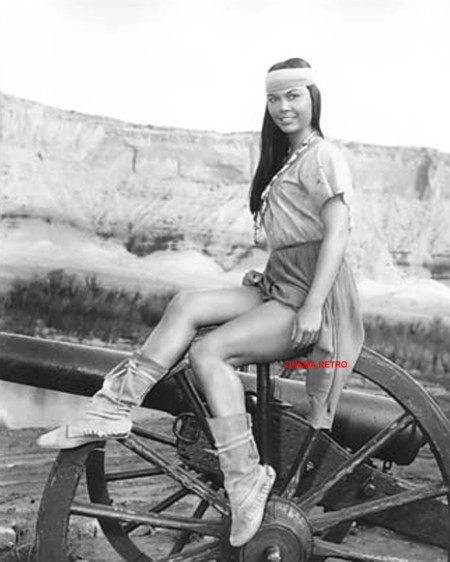
  excellent tough Westerner. In 100 Rifles, Burt Reynolds gives us all his usual good/bad guy charm. Boone and Reynolds in these movies are both bad men who rather reluctantly find themselves on the side of the angels. Burt gets Raquel to fight alongside but Richard has to put up with the rather odd-looking Wende Wagner (left, in the dreadful publicity still). But they both get Jim to help anyway. Those shoulders do come in handy.
 In Rio Conchos, a slightly overweight Boone, the year after Have Gun – Will Travel finished, is ‘Lassiter’, a bit cheeky but hey. He was an
  excellent tough Westerner. In 100 Rifles, Burt Reynolds gives us all his usual good/bad guy charm. Boone and Reynolds in these movies are both bad men who rather reluctantly find themselves on the side of the angels. Burt gets Raquel to fight alongside but Richard has to put up with the rather odd-looking Wende Wagner (left, in the dreadful publicity still). But they both get Jim to help anyway. Those shoulders do come in handy.
.
Both movies are worth a look, pards.
.
.
.
.
.
8 Responses
Excellent article… which reminds me that there is a still sealed DVD of Rio Conchos on my shelf that really should be viewed at long last!
Enjoy!
Rio Conchos gives Richard Boone a chance to shine as a lead in a western and I loved the movie and his performance. It will always be in my top ten western favorites of all time. Very violent and grim. No hokey side romance that studios felt the need to shoehorn into just about all their movies. No cornball comedy shenanigans either. That's why I prefer westerns like this one over classics like The Searchers.
What it does have is good action along with a cool, one on one shoot out between two main characters. And an ending that just literally explodes with carnage. The death of the baby was sad, but probably more realistic when you look at the rough weather and climate that humans endured back then. Richard Boone committing a mercy killing was intense, as well as him maniacally laughing at an Indian being burned alive. I'm no expert on spaghetti westerns, but could this movie be argued as evidence that American westerns were already heading down that grim path? It did come out a couple years before the Dollars trilogy. Stuart Whitman is a bit of a stiff but adequate, and Jim Brown was wisely limited in what he was given to do. Edmund O'Brian could have had some more scenes, but other then that, there's not too much to complain about in this one.
It's a shame to me that this movie isn't more well known. Richard Boone wasn't in nearly enough westerns as a lead, but he did have a lot of his time occupied by doing Have Gun Will Travel during his golden film years.
I agree that boone was excellent in Westerns, big-screen and small.
Jeff
Just Finished watching as part of a double bill of my own making with The Comancheros, I rated them both as good, But would give this one the edge.
Boone and O Brien were terrific.
I thought the young lady gave a pretty good performance too.
Ah, I see on Imdb that the screenplays for both movies were written by the same person.
Just noticed there is a little mistake at in the paragraph beginning with
“Both plots centre around a shipment of repeater rifles” as ot is written further
“In Rio Conchos we are in Mexico in maybe 1910 or ’11 and the sadistic ruler of the state of Sonora, General Verdugo”… but obviously it is in 100 Rifles. Maybe Bud and RR could correct it ?
Just watched Rio Conchos, based on Clair Huffaker’s novel “Guns of Rio Conchos” published in 1958.
Its cinematography is superb due to the know how of Joseph MacDonald (My Darling Clementine, Yellow Sky, Viva Zapata…) very well supported by the gorgeous natural beauty of Moab surroundings in Utah : Arches National Park with the snowy La Sal Mountains in the backdrop and the Professor Valley where flows the Colorado river and towered by many landmarks, towers and mesas.
We cannot agree with Jeff when he says the film has “a Hollywood post-spaghetti look and feel about them” since the spaghetti Invasion had not started yet in the US in 1964 where A Fistful of Dollars was to be released in 1967 only (the very first spaghetti dates from 1963).
The gun collectors will have noticed that the half magazine Winchesters in Rio Conchos did not exist yet in 1867 and never equipped the US Army anyway.
Besides, even if the pace could have been more steady (pyrotechnics does mean action automatically), and the story seen many times (before and after it), Rio Conchos is pretty enjoyable especially thanks to Richard Boone who has the most developed part by far (sometimes his voice and tone made me think of Tommy Lee Jones) and Edmond O’Brien as the megalomaniac lord of war in a too short role. All the others are very limited. Brown is barely sketched as his his relationship with ex-confederate Boone. Stuart Whitman is pretty neutral almost even bland (he is not blond though). I did not instantly recognize Anthony Franciosa I must say, a little too much over the top in my opinion but unfortunately that’s the way the Mexicans are (too) usually shown in westerns… Excellent Timothy Carey as a bar tender, well known Rodolfo Acosta, House Peters (O’Brien’s aide) are not existing very much (and long).
It is also very unlikely that an Apache woman would have helped a White man (quite the opposition…) but the script was needing a deus ex machina…
In spite of having many points in common as expressed by Jeff, each film would deserve its specific text but this one is 15 years old.
I must look after 100 Rifles now.
With 100 Rifles you should not get bored a second at least for the first hour.
Then it is becoming weaker and ponderous and you have to wait about the last quarter starting with the assault on the train (it’s not Lawrence of Arabia though) to reignite interest until an important surprise on which the film could have almost ended. But there is an epilogue with a kind of political agenda, often the case with a “mexican” western.
A little too long, the film has almost all the typical features of the south of the border revolutionary westerns (see specific Jeff in depth article) with train, car, machine guns and Gatlin, lots of shoot-out and explosions, tequila-drunken Indians, German military adviser, psychopath mexican commander, dust and cavalcades and tons of Mexicans and Indians just good enough to be slaughtered in every possible way (always this possible parralel with Vietnam).
The script written by Clair Huffaker (an other common point with Rio Conchos) is inspired by The Californio, a novel by Robert MacLeod, pen-name for for Scotsman William Knox (1928-1999) who wrote a handful of western books. Among them The Appaloosa adapted in 1966 by Sidney J. Furie and starring Marlon Brando.
Jerry Goldsmith is an other common point between both films. His score for 100 sounds better in my opinion.
The film begins with a chase-capture-escape classic formula. Reynolds starts like a caricatural mexican (a classic flaw) but is better and better.
Jim Brown who carries a Colt New Service is a law enforcer formerly a buffalo soldier trailing Reynolds who has robbed a bank in Phoenix.
Brown has probably the most interesting part, much more developed than in Rio Conchos. Firstly focused on his mission to bring back Reynolds, he will finally fight along the Yaquis after a child he has befriended is killed.
There is a good alchemy between Brown, Reynolds and Welch who is a magnificent Soldadera or Adelita, if you know the corrido (song). Many mexican women fought beside of the men during the Revolution and several became even colonel so Raquel is quite credible as the Yaquis’ chief and, sorry Jeff, but “certain amount of, er, suspension of belief is – NOT – required.” (At least for this question as the plot is quite improbable in many ways indeed).
But their relationship on the set were not so smooth according to the medias of the time.
Nevertheless, in a time when Hollywood was reluctant and just beginning to address racial issues, Jim and Raquel are breaking some taboos just during the Civil rights struggle in the US (Although she is playing a Mexican (even Indian…) and not White in this film, probably easier to swallow by the racist spectators…
By the way, there are some interesting hints of racism between Brown and Reynolds, the first calling the second “half breed” anytime. They are even chained together, reminding Stanley Kramer’s The Defiant Ones (1958) starring Sidney Poitier and Tony Curtis.
There are always interesting or unusual weapons in westerns set in Mexico even anachronic (here some Garand…)
Fernando Lamas, the too cartoonish General Verdugo, is wearing a pair of superb nickel-plated Colt 1900 or 1902 automatic pistols with pearl grips. (Not the far more common 1911). The famous 100 rifles are US Krag-Jørgensen Model 1896. The firing squads are equipped with French Berthier 1907-1915…
Talking of weapons, and Raquel Welch being such a big draw, the production was probably eager to use all her advantages. In various states of undress all the film long, she does not take a bath (Reynolds does…) but a (very sensitive) shower…
My main regret is that the german advisor is not shot at the end like in The Wild Bunch. And the railroad representative, manipulating Reynolds, will finally take advantage of the situation unlike in The Professionals, the power of business and capitalism you know…
For budget reasons, it was shot in Spain, mostly in Andalusia on various locations around Almeria where at the same moment Leone was shooting Once Upon A Time in the West. The Tabernas desert and the same railroad track are used in a lot of spaghettis. Tom Gries knew Almeria quite well since he had film there a few episodes of Rat Patrol, a WWII TV serie in which played Hans Gudegast (impersonating the German advisor).
The church ruins scene was shot far up north at el Monasterio de Santa María la Real de Valdeiglesias about 75 km West of Madrid, much better preserved today not far from Villamanta playing Nogales in the film with its station.
If you like entertaining westerns set in Old Mexico with just a touch of spaghetti and a zest of crypto-feminism, you should not be disappointed.
Excellent points. I never got around to the Blu of ‘100 Rifles’ but for those interested the Fox DVD has excellent picture and sound. Actually I was astonished how good it looked.