.
From Hell to New Mexico
.
.
 Henry Hathaway made only one really great Western. It was, of course, True Grit (Paramount, 1969). But he made several very good ones, and we would mention in this category The Sons of Katie Elder, Garden of Evil and, in this class, From Hell to Texas.
.
In fact Hathaway was something of a specialist in the genre. He started as a child actor in Westerns and the first films he directed were all cowboy movies.
.
Why the title From Hell to Texas it is difficult to know, as Texas doesn’t come into it. It’s set in New Mexico, between Santa Fe and Socorro (or Socorrer, as they all call it), well over 300 miles from the nearest bit of Texas. Never mind.
.
It’s a ‘small’ film, by which I mean it has a modest cast and has a confined plot (Robert Buckner and Wendell Mayes screenplay from a Charles O Locke novel) about few people. It is also an economical story with a spare, hard plot. It could have been by Luke Short (it’s that good). It is also extremely well directed and finely acted. Hathaway did an excellent job of reduction and Johnny Ehrin also edited tightly and effectively.
.
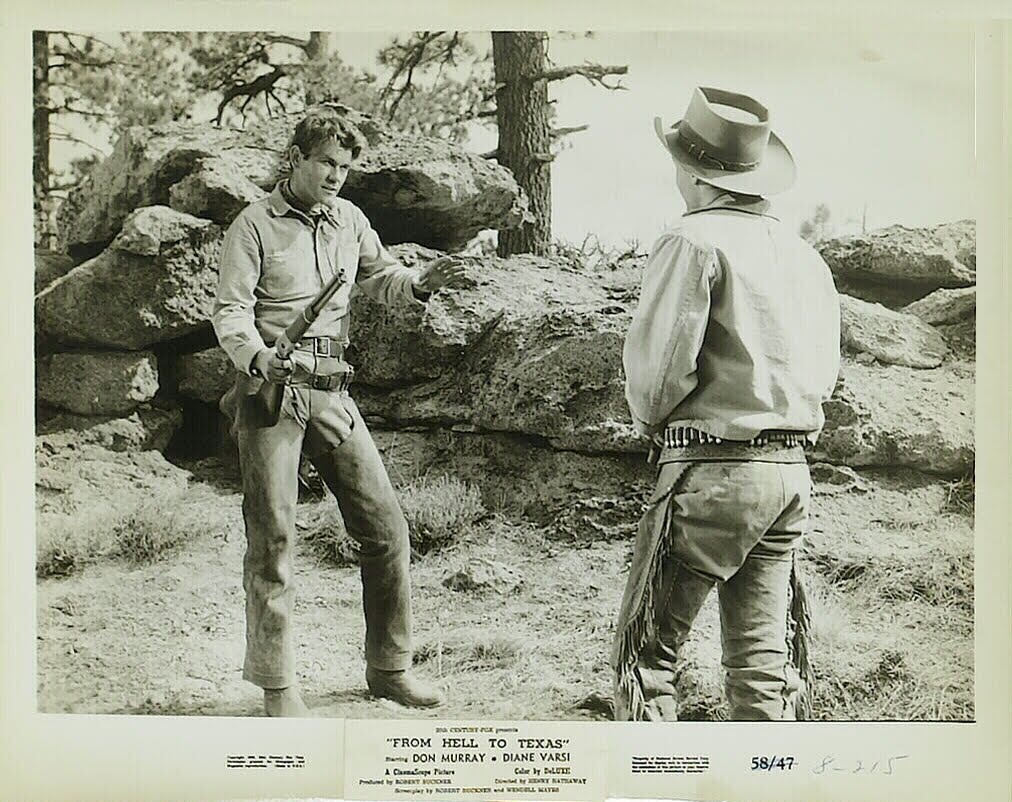
The acting is top notch. You wouldn’t automatically put Don Murray in the highest league of Western actors. He probably came to the Western genre just too late. Up till then he had been a TV and low-budget movie character actor. He was later Wild Bill Hickok in the 1966 remake of The Plainsman and he was also in The Hard Ride and played second to Alan Ladd in the ho-hum One Foot in Hell (he seemed to like Hell) – but that’s it really. Still, in From Hell to Texas he is very good indeed. He underplays and succeeds in projecting in a convincing way as a young, rather naive but still courageous loner.
.
RG Armstrong, always good, is here very fine. Apart from his curiously dudish double gunbelt, which makes him look like Hopalong Cassidy having strayed accidentally onto the set of The Wild Bunch, he is severe, hard as nails, single-minded and hated but, when it comes down to it, just. It could have been RG’s finest role, though it would be difficult to better his Bob Ollinger in Pat Garrett & Billy the Kid. Or his uxoricidal preacher in Ride the High Country.
.
Dennis Hopper, 22, plays RG’s youngest son, in only his sixth (I think) movie. He had the right to be in as many Westerns as he wanted, having been born in Dodge City. Jay C Flippen is excellent as the salty Indian trader Leffertfinger. But the best of the supporting cast is certainly Chill Wills as the rancher Amos Bradley who befriends Don and whose tomboy daughter Nita (Diane Varsi, not bad) will fall for Don and, eventually, vice versa. Harry Carey Jr has a smallish part too. So high class acting all round.
.
According to IMDb, the filming locations of this film were different from those of True Grit and the Alabama Hills up at Lone Pine, Cal are mentioned. Yet the scenery looked mighty like that which Hopper covered again a decade later for Hathaway, when he came up against Rooster Cogburn in that cabin on the river. And several bits looked very like Colorado to me. Wherever they are, they are splendid and I just love the Wilfrid (or Wilfred, he seemed to alternate) Cline photography. Visually, this film is lovely and some of the night scenes and long-shadowed early morning or dusk ones are actually beautiful.
.
.
This is really a high-quality Western. Recommended.
.
.
.
2 Responses
This is 1 of my favorite westerns! Being mexican/italian, and raised on a Angus Cattle Ranch in Nevada, I LOVE Mexican/American Blended westerns. The other one I love is the TV series “The High Chapparal” ! I tend to live in the past as I am a throwback! Now after almost relocating to Mexico, I Moved to the Philippines instead, and I make and sell Mexican Food here!
A cast of truly outstanding Western actors elevates a good film to near greatness. RG Armstrong is wonderful in the role of a cattle baron who is obsessed with killing a young man he incorrectly believes killed one of his sons in a scuffle over a girl. But although Armstrong’s Hunter Boyd has blood in his eyes, he also has a code of honor that includes allowing his quarry–Don Murray’s Tod Lohman–a four-hour head start in his efforts to escapt Boyd’s clutches.
Chill Wills is terrific as an affable, big-hearted rancher who takes a shine to Lohman and does what he can to help him evade Boyd and his goons. And there are charming domestic scenes of Wills’ Amos Bradley, his Mexican wife and their brood of chatty young daughters. Watch these, incidentally, and you’ll be craving tamales, tacos and chiles (Chilles?) rellenos.
John Larch, as always, makes his mark. This time he’s a Boyd gunman who loses his life in a duel in the rocks with Lohman.
Dennis Hopper is there in a role that suits him–a neurotic, petulent and vaguely effeminate kid trying to earn his spurs in the Old West. Boyd’s only surviving son, he doesn’t do anything right in this story.
And then there’s Jay Flippen who makes a strong impression as a brave and rather pugnacious Indian trader who aids Lohman in a moment of peril. Tim Robbins is, I dare say, a latter-day Jay Flippen.
There’s a very interesting philosophical tension in this picture. Lohman, a pacifist from Iowa who nevertheless possesses tremendous talent with the artillery, steadfastly refuses to defend himself and does everything possible to avoid bloodshed. He is a soft-hearted idealist in a brutal environment, and he is frequently aided in his efforts to escape Boyd by folk he randomly encounters. This phenomenon perplexes Boyd who at one point asks a priest why people are willing to do this. The padre responds, “You ask a difficult question. You wish me to explain the human heart.”
Nevertheless, the film’s conclusion produces something of a volte face. In the ultimate showdown between Lohman, Boyd and his men, Tom Boyd (Hopper) catches on fire after shooting on oil lamp, and staggers into the street. Lohman, braving gunfire from the elder Boyd, douses the flames and saves, to all appearances, Tom Boyd’s life.
In the next scene Hunter Boyd says to Lohman, “This story will be told for a very long time in 12 different ways, none of them favorable to me. If you’ll grant that I spared your life for saving my son, I’ll gladly go to hell for all the rest of it.”
Lohman’s reply: “I’ll grant you that, and I have no doubt you will.”
Boyd appears almost thunderstruck by the response. Ultimately, the God-fearing pacifist reveals an Old Testament heart of iron. His refusal to grant Boyd absolution is, in its own way, the most violent act of the film.