.
.
It has its admirers
.
.
High Plains Drifter was the fourth Western that Clint Eastwood starred in after the Dollars European ones (if we exclude El Magnifico Extranjero, which was really a couple of Rawhide episodes illegally cobbled together) and the first Western to be directed by him.
.
.

.
Although it came out the year after the quite good Joe Kidd, it has much more a flavor of the Leone movies. It starts with a nameless stranger, billed as The Stranger, riding into a town to the sound of exaggerated over-dubbed clip-clopping, seeing a coffin-maker at work and then shooting three importunate thugs. Sound familiar? Yes, it’s Fistful all over again. Let’s call it a quotation.
We are supposed then to sympathize with this man raping a woman in a stable and have to watch a man being whipped to death twice, in flashback.
So far, so bad.
.
.
Very bad, in fact.
In fact everyone is bad in this movie. The baddies are just more bad. The ‘hero’ is no better; he just has super-human homicidal skills. A spaghetti, in fact.
Other Italian western (small w) ingredients are there too: there is pretty awful woo-woo music (Dee Barton). Every gunshot ricochets with absurd whining, Leone style. It’s a spaghetti. And just when we had watched Joe Kidd the year before and thought Clint was growing out of that! We are about to get up and leave the movie theater, regretting the admission price we have paid and wasted when, just in the nick of time, it gets better.
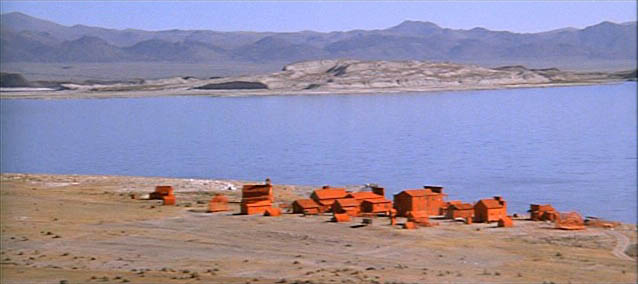
One of the main reasons for that is the excellent Bruce Surtees photography. Surtees was one of the best ever Western cinematographers. He has such a talent, especially for the outdoors (where Westerns are best). This one was filmed at Mono Lake, California and in the Inyo National Forest – beautiful. Each shot is a work of art. His last Western was to be his masterpiece, another Eastwooder: Pale Rider.
.
.
.
The supporting acting is competent-to-good, especially from Verna Bloom, Mitchell Ryan and Billy Curtis as the put-upon midget who is promoted sheriff (a slight nod to Destry?)
There is now a slight surreal tinge to the plot as the stranger decides to paint the town red. We know the expression but he takes it literally. We are more interested.
Not for the only time as far as Eastwood Westerns go, there is a quasi-mystical aspect to the tale. The Stranger rides in on a pale horse and his name his death alright; he’s def read Revelation 6:8. When the man whipped to death in the flashback (Clint’s stuntman Buddy van Horn) had appealed to the townspeople for help and was refused, he said “Damn you all to hell.” When he has had the town painted red, The Stranger crosses out the town’s name, Lago, on the sign board and rebaptizes it, yes, Hell. The symbolism is all that heavy-handed, I fear. Still, you do get the message.
.
.

.
There is also a nod to High Noon as Stacey Bridges and his heavies are getting out of jail and the first stop on their revenge quest is Lago, the town they blame for their imprisonment. The Stranger’s aim is, however, as much to humiliate the townsfolk as to kill the bad guys. In fact he doesn’t care that much about the bad guys at all.
Variety said it was “a nervously-humorous, self-conscious near satire on the prototype Clint Eastwood formula of the avenging mysterious stranger” but in fact it isn’t, really. It was just Eastwood saying, “I can do Leone too.” Of course this doesn’t help much if you don’t rate Leone highly in the first place, like yours truly. Time Out thought it was “Eastwood’s fond adieu to the worlds of Sergio Leone and Don Siegel; and indeed he cuts the operatic excess of the former with the punchy economy of the latter.” Again, I can’t agree. It’s really just an American spaghetti with a sauce of weirdness.
.
Two of the gravestones in the cemetery bear the name Sergio Leone and Don Siegel.
.
.
All in all I think it’s an unsatisfactory movie and nowhere near as good as Joe Kidd but it has its admirers and it is probably superior to the low-grade Siegel-directed Two Mules for Sister Sara of three years before. It made a lot at the box office. It’s interesting – even ‘important’ – as Eastwood’s Western directorial debut, and it’s visually good, as any Surtees Western is. So it’s worth a look. But that’s it.
‘Nuff said, I reckon.
.
10 Responses
Satirical or not, High Plains Drifter epitomizes Eastwood's role as the "strong silent type," and provides worthwhile insight as to how demonstrating in action is superior to explaining with words. Steve Jobs ("janitors have to explain, vice presidents do not") embodied it in real life. The Stranger's interaction with the hotel clerk at about a half hour in is classic.
It's a mistake to underestimate this film. It defines a genre.
When criticizing the film, much is said about the so called 'rape'. These days, the critics seem to not understand that everyone in the town is culpable for the murder of the sheriff, and therefore 'cursed' for there sins. That's why the woman enjoyed it, and even her husband condoned it. Eastwood was the 'avenging angel'. Even John Wayne didn't like it (because it wasn't a traditional Western – love the 'Duke' BTW), but it WAS a great movie…
As I said in the review, this movie has its admirers. I'm not one of them, but each to his own. Thanks for your comments.
Jeff
Well, the rape scene was definitely different. That's for sure. I liked the movie. It has a nice eerie, and macabre style about it. On repeated viewings it does seem a bit one dimensional though. I think a lack of stronger antagonists hurts it. I'd probably give it 3 guns but find the 2 guns understandable as your critique of its weaknesses is very valid.
Don’t like this film as much as many, but I do like it more than you Jeff and I think it’s a little better than JOE KIDD and PALE RIDER (the latter is to me not an homage but kind of a ripoff of SHANE). It has its moments, has humor and I also like the scenes with Billy Curtis. It’s interesting, but I guess I don’t really like my Westerns this weird and never cared much for Horror/Westerns until BONE TOMAHAWK.
Fair enough, tho myself I’d put PALE RIDER in the excellent class.
Like the other commenters, I cannot hold with Jeff’s peremptory dismissal of HPD. I supposed it’s the great Pasta Divide that separates us. His contempt for spaghettis and anything associated with them is total. If it smacks of De Cecco, Jeff abominates it. He has his reasons, but what he loathes, I love. I cotton to the bizarre in Westerns just so long as it’s not grotesque or overly disturbing. This is a hallmark of the spaghettis, and it’s there in HPD, too. Clint riding out of the heat shimmer to the odd sound of that synthesizer is a great and strange way to start the film, and is a great way to end it, too. There is the social inversion of Clint annointing the lowly midget as the sheriff and the mayor. There is, of course, the red-painted town, which is surely one of the most striking visuals in all of the Western genre. And finally we have an avenging ghost of sorts, albeit one of surpassingly corporeal characteristics. No diaphonous specter is Clint, as the good folk of Lago will soon find out.
Another common feature of the Spaghettis and HPD that I admire is humor. William O’Connell as the nervous barber is good for a couple of guffaws as is the midget donning Eastwoodian atire–complete with a cheroot–and aping his manner.
The bizarre, gothic elements and the fine humor, it all adds up to a fascinating and satisfying film for me. All the more so that the repellent people of Lago all get their comeuppance. And maybe that’s what it’s all about–in the end we cannot escape our sins.
I really like HPD too. I find it a film I can always return to.
Although I’m not as vociferously anti-Spaghetti as Jeff (there’s a few I really like, and others I don’t mind, though there were certainly plenty of awful ones), I’m largely with him on HPD. It’s interesting but it doesn’t really gel as a cinematic experience for me, the one or two viewings I’ve given it in the past were enough for me. My (as far as I know) minority opinion on Clint’s Westerns as director is that Pale Rider is the most satisfying of the lot and certainly the one I’ve returned to the most.
As Jeff often remarked, life would be dull if we all agreed on everything, especially about Westerns!
High Plain Drifter is maybe one of the best spaghetti western or, all things considered, the hyphen between spaghetti and american western. Because of Eastwood own history (homage to Leone, Clint’s sado-masochism, cynism. anti-racism, etc) because of its global treatment, because of the characters unshaved and sweating, because of the violence (not sure if Jeff has ever written about the whip – highly connected to slavery and sadism – on westerns…) etc.
But it is also deeply american.
The script was inspired by the 1964 murder of Kitty Genovese, killed with most of the witnesses doing nothing to help.
The city and business people are only thinking of protecting their interest by having their honest and moral sheriff murdered by hired vile outlaws. Then afraid of further retaliation, they are offering the Stranger everything including their women. Just thinking of getting rid of him later…
The initial screenplay was written by Ernest Tidyman (The French Connection and Shaft – both book and movie -). Dean Riesner (Coogan’s Bluff, Play Misty for me – 1st Eastwood film as director -, Dirty Harry) did an uncredited rewrite. Originally The Stranger was sheriff Duncan’s avenging brother, but Eastwood had that cut because he preferred the ghost idea.
Uncomfortable, disturbing and baroque are probably the best adjective to qualify it.