.
.
Frontier woman
.
.
.
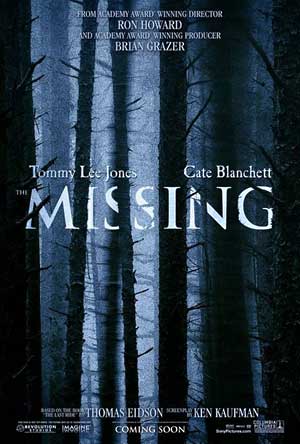
This film, directed by Ron Howard and starring Cate Blanchett and Tommy Lee Jones, has a lot going for it. Fabulous New Mexico scenery in winter for one thing (photography of Santa Fe locations by Salvatore Totino) and good acting, especially by Eric Schweig – Buffalo Hump from Dead Man’s Walk – as the truly fearsome Indian chief.
.
.
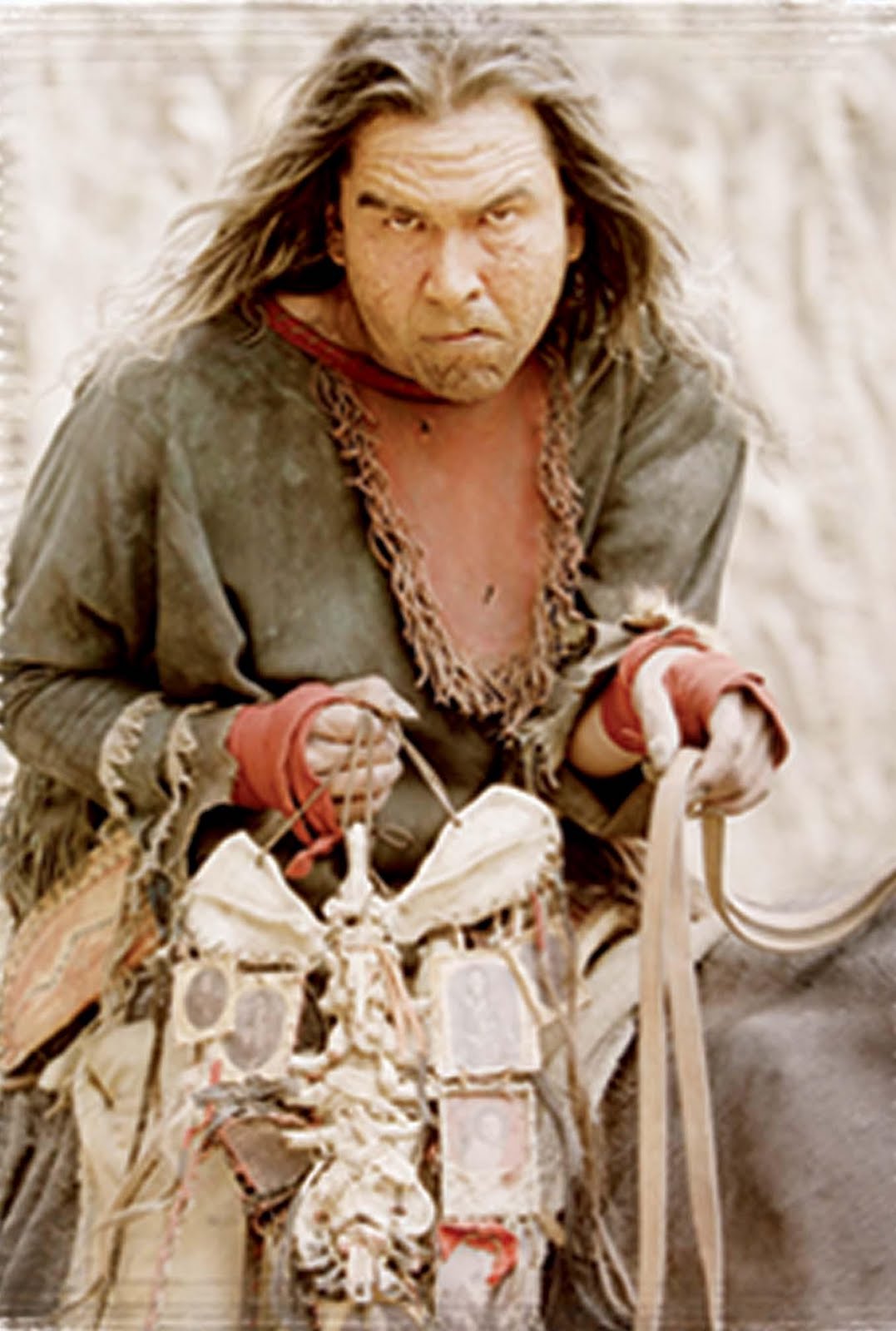
Eric Schweig
.
Ron Howard has had an interesting Western career. As a juvenile actor he was on TV a lot then was one of the kids in The Spikes Gang in 1974 and two years later was excellent as the impressionable teenage son of Lauren Bacall when John Wayne rode into town as JB Books, The Shootist. He directed and wrote the vaguely Western Far and Away with Tom Cruise and Nicole Kidman in 1992, then helmed The Missing. He produced the 2004 The Alamo and recently Cowboys & Aliens, which disappointed in terms of box-office receipts but was a actually a lot of fun. (In a non-Western capacity he was nominated for an Oscar for Frost/Nixon and won one for A Beautiful Mind.)
.
.

Ron Howard
.
The Missing is a pursuit Western and quite traditional in theme: a child is kidnapped by Indians and courageous and determined relatives set out in pursuit. The Searchers, anyone? The captivity narrative is at least as old as Fenimore Cooper. But The Missing has the difference that the daring rescue is carried out by a gun-totin’ mother (Cate) determined to get her captured daughter back. If the movie has a message, it’s that women were durn tough on the frontier in them days and shouldn’t be portrayed in Westerns as either angels or prostitutes, which is how they are, we know, so often shown. Cate doctors the local people, can ride as well as anyone and she can shoot faster’n skin a deer.
Such women were the bedrock of the frontier and there were a hundred of them for every one saloon gal or angelic schoolma’am.
.
.
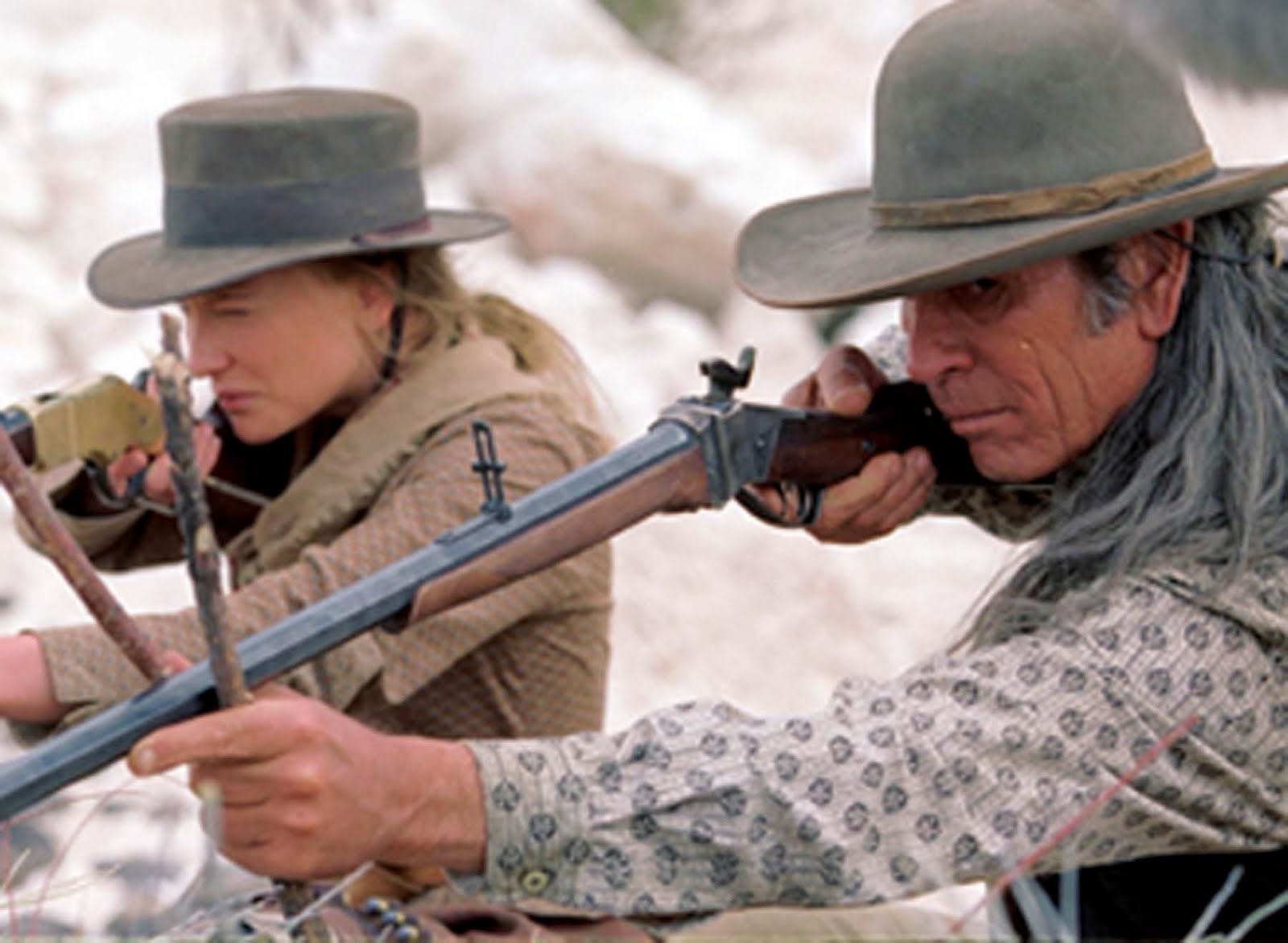
Tommy Lee has a Sharps 1874 Buffalo
.
Tommy Lee and Cate (father and daughter but estranged) set off after the brutal renegades into the desert with another young daughter – not a wise move, and indeed the girl duly gets them into life-threatening scrapes in no time at all (which is probably why the writer – Ken Kaufman from a Thomas Eidson novel – put her there). But the child is brave and comes through, of course.
The costumes, props and sets are first class and we really get a feel of how hard life must have been in the West hardly more than a hundred years ago. Another message is that of parental neglect and the pain it can cause. The treatment of that theme here is more intense than it is in Wayne’s commercial vehicle Cahill, US Marshal, say, but it’s the same theme.
Tommy Lee is outstanding, as he so often was in this genre. He is a kind of Ethan figure in a way, though with far more sympathy for Indians – he is more than half one himself. So perhaps more like Paul Newman in Hombre. But he is like Ethan in the sense that he is a utterly determined to recover the girl. He is a wily, weathered frontiersman with highly-developed survival (and homicidal) skills. And he speaks good Spanish and Chiricahua Apache (TLJ and Eric Schweig learned some of the latter for the movie).
.
.
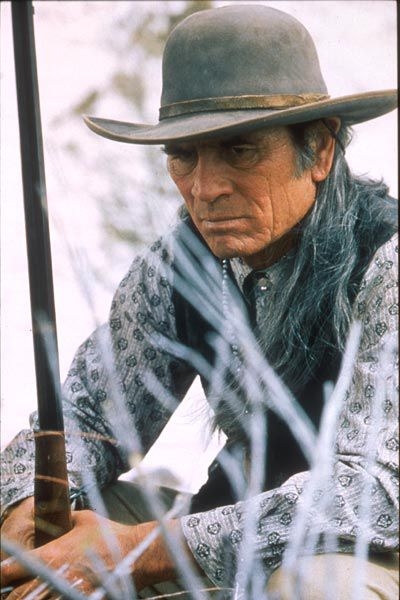
More than half Indian
.
Val Kilmer does a cameo as a cavalry lieutenant as he lives nearby and supports the New Mexico Film Investment Program.
The film contains the politest “get off my land” I have ever heard. Well-mannered young man: “Maggie asked you to leave. And it’s time you did so, sir. Round about now” (said while pointing a Winchester rifle).
.
.

Mother and daughter
.
It’s a good, exciting film. The violence is pretty savage and the whole movie is hard and pitiless. The only thing that spoils it in my view is the silly mumbo-jumbo, with witches putting curses on people and incantations to ward off evil spirits. It’s worse than a Western Exorcist. Unfortunately, the movie got nominated for an award for science fiction, fantasy and horror films, though happily did not win.
But all in all, well done, Ron. You’ve come a long way from that kid in The Spikes Gang.
.
8 Responses
Thanks for the fine review of what is a very good Western. I guess as long as Tommy Lee is still around the Western will not die out entirely. It may border on sacrilege, but I prefer his Westerns to those of Mr. Eastwood.
Thanks!
Tommy Lee Jones certainly makes interesting and fine Westerns.
I see he has directed and written from a Glendon Swarthout novel another movie, coming out this year, The Homesman.
http://www.imdb.com/title/tt2398231/combined
I am curious!
Jeff
Don’t get me wrong, I think this is a good solid Western with wonderful performances but, like you Jeff, the mumbo jumbo witch doctor stuff almost ruined for me. If only they could have made Schweig’s medicine man more realistic, it would’ve made this film outstanding instead of merely good.
Yes.
I don’t regard depictions of superstitious rituals as demeaning to Indians. They were no more prone to fatuous beliefs than any other people. Exactly the same.
The great Shawnee war captain Tecumseh was in the shadow of his younger brother Tenskwatawa. (That means “Open Door”. He founded a religion of that name after a vision. Before he found God his name was Lalawethika, or “Rattle” as in “Noisemaker”.) The Open Door was oddly Judeo-Christian whereby the Master of Life would deliver his chosen their former lands. The hard-pressed prairie Indians were receptive to his message of hope. Tenskwatawa was never certain how this Destiny would Manifest itself. Tecumseh sought to unite all tribes in war against the Whites. He was off recruiting when Tenskwatawa, against instructions to refuse battle, lost the Battle of Tippecanoe in 1811. And that was about that.
Quanah Parker undertook the Second Battle of Adobe Walls to drive buffalo hunters from Comanche hunting grounds in Texas. Parker recruited Kiowa, Arapaho and Cheyenne to the effort, but in the offing got saddled with a medicine man who wanted to throw magic at the defenders. Parker’s morning attack had gotten through the adobe enclosure, but couldn’t flush the buffalo hunters from their sod houses. The white men had .50 calibre Sharp’s rifles that could drop a buffalo at half a mile. Parker and his warriors regrouped at a “safe” distance to plot their next move. The medicine man cast a spell of invincibility over the host—whereupon Parker got nicked in the shoulder by a slug and the shaman’s horse was shot from under him. And that was about that.
The campaign that climaxed at Little Big Horn was three-pronged. The southern approach was repulsed a week before Custer was slaughtered. Crazy Horse had a falling out with Sitting Bull about whether valor or medicine decided battles. They never renewed the fight against Custer’s remnants. The third prong of the campaign arrived, not to ambush, but the deserted encampment of the great rendezvous.
Obviously, the god of favorites can’t stand up to the god of physics and materiel. But the latter is the god of power, and people want to believe in a god of justice especially for their people.
Jeff did not write any text about religion in westerns. He did write this Preachers article forgetting to mention the Indian ones…
https://jeffarnoldswest.com/2020/05/preachers/
The Ghost Dance and Wovoka (played by Wes Studi in Bury My Heart at Wounded Knee in 2007) might have been mentioned there too.
There is an extended version of the film that add various bits and bobs to the film around seventeen minutes. I don’t think it supersedes the theatrical but it is fascinating nevertheless.
Yes, I’d like to see that.