.
.
Book and film leave you with a hard knot of coldness in your stomach
.
.
Set in West Texas (as was the Coen brothers’ first movie, Blood Simple) in 1980 – a piece of dialogue about a coin situates it exactly in that year – No Country for Old Men tells, faithfully, Cormac McCarthy’s story of a drugs deal gone wrong which develops into a complex pursuit-Western noir. It’s a stunningly good book. I remember I bought it in 2005 the day it came out in Borders in Flagstaff, AZ and I read it while staying at the Plaza Hotel in Las Vegas, NM. Little did I know that the very same hotel (called the ‘Eagle’ and on the Mexican border) would figure in the movie only two years later. It’s a great hotel, by the way, and I recommend it.
.
.
The hero (of a kind), Llewelyn Moss, excellently played by Josh Brolin, is a tough, independent cowboy. He’s a trailer-park rube but he manages some pretty Western maneuvers and he goes his own way.
.
.

The ordinary guy who is out of his depth
.
.
Ed Tom Bell, the decent country sheriff who is after him, as much to protect him as jail him, is marvelously interpreted by the actor who dominates, Tommy Lee Jones. Mr Jones is a Texas man and a rancher and was the perfect choice. The role moves seamlessly on from his wonderful Pete in The Three Burials of Melquiades Estrada of two years before. He is an actor capable of great subtlety, as this part required.
.
.
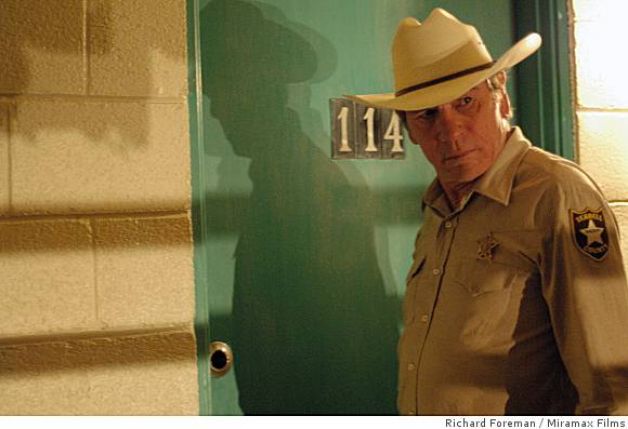
World-weary, wry, out of time
.
As Anton Chigurh, the enigmatic, scary hitman after Llewellyn, with his sinister air cylinder, Spanish actor Javier Bardem, in his 70s haircut, is superb. He is creepy and chilling. When he was approached by the Coens, he said “I don’t drive, I speak bad English, and I hate violence.” The Coens responded, “That’s why we called you.”
.
.

When he learned about the haircut he had to wear, Javier Bardem said he wouldn’t get laid for months afterwards. The Coens high-fived their success, for the hairstyle adds wonderfully to the weirdo effect.
.
Curiously for the narrative and unusually for a Western, these three principals never meet. On one level you’ve just got a druggy crime story with an amoral bad guy, a decent cop and a dumb redneck – the ugly, the good and the bad, you might say – and you root for Llewelyn, the ordinary guy doing his best but out of his depth. But with writers and directors as sensitive as the Coens and with a base novel as truly great as Mr McCarthy’s, this film goes far beyond that. Book and film leave you with a hard knot of coldness in your stomach.
.
.
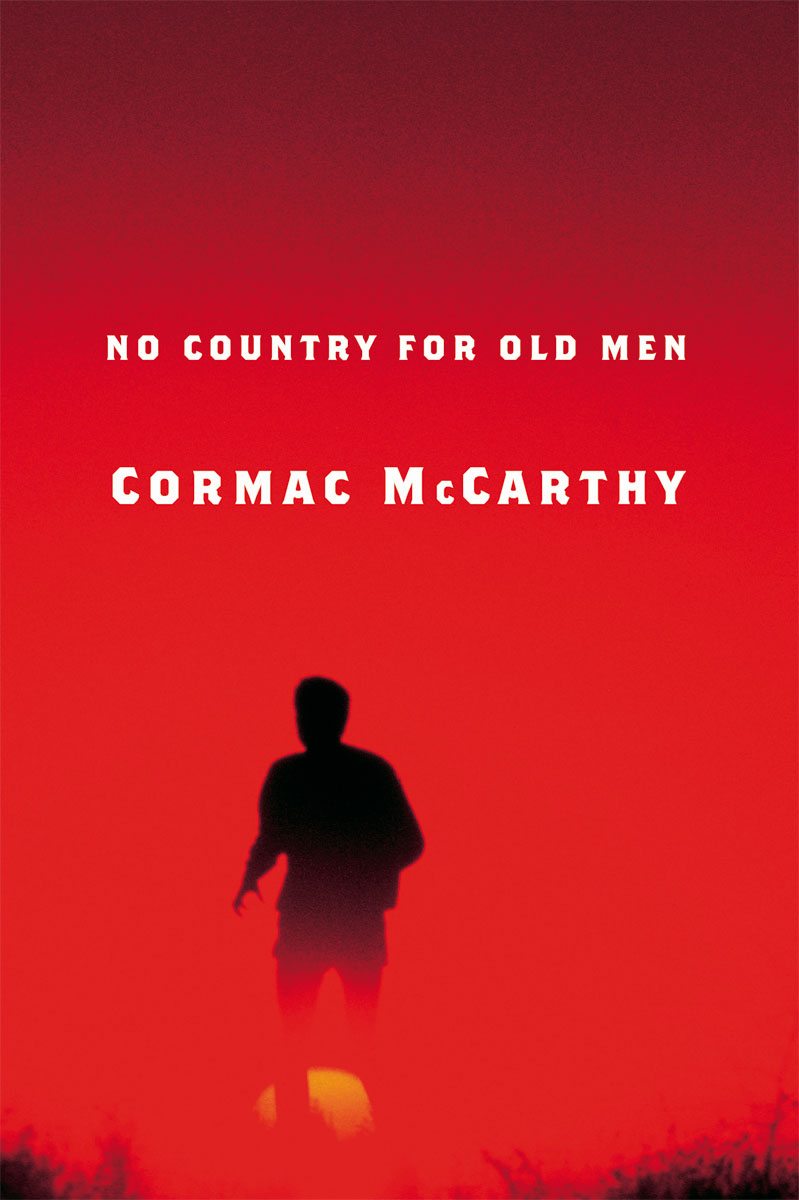
The greatest living American novelist

.
The West Texas country of the title (a lot shot in New Mexico) is harshly beautiful and there are wide exteriors finely photographed by Oscar-nominated Roger Deakins (who did outstanding work on The Assassination of Jesse James by the Coward Robert Ford the same year). He paints with light.
Carter Burwell’s lean, low-key music is subtle and sparsely used, underlining the aridity of the landscape and theme.
Of the support actors, all are top class. As Moss’s wife, Kelly MacDonald, a Glaswegian, has a completely convincing West Texas accent (it comes as a real surprise to hear her real voice). The great Barry Corbin is Bell’s aged mentor, and a scene where Sheriff Bell visits with him is reminiscent (deliberately or not, I don’t know) of Gary Cooper talking to his elderly predecessor Lon Chaney Jr in High Noon. Woody Harrelson, who was so fine as Big Boy Matson in The Hi-Lo Country, is the hitman sent after the hitman. In the novel, Sheriff Bell says of the dope-dealers, Here a while back in San Antonio they shot and killed a federal judge. (No quotation marks. It’s McCarthy). In 1979, Federal Judge John H Wood Jr was in fact shot and killed in San Antonio, Texas. Free-lance contract killer Charles Harrelson, Woody’s father, was convicted of the crime. I suppose this was deliberately Coenesque casting, clever, apt, slightly creepy.
.
.

Woody Harrelson, son of a hitman, as the hitman sent after the hitman
.
There are the scariest motel scenes since Psycho.
In some ways it’s a kind of Texas Fargo, with small town folk swept up into major crime, but really it’s an anti-Fargo, hot and southern, not snowy and northern, with chilling, inexorable, lethal criminals rather than comically inept hitmen.There’s a fine portrayal of courage when Ed Tom Bell enters a darkened motel room at night, fearing that the killer is within. He demonstrates that true courage is not the absence of fear but being afraid and doing it anyway.
This is a dark film and the humor (for there is humor) is appropriately black. Actually, the America they show is no damn country for anyone. As is to be expected from the Coen brothers, the direction, writing and editing are outstanding. The picture won four Oscars (best picture, best direction, best writing and best supporting actor for Bardem) and was nominated for four more.
The movie is very violent but it is essentially about violence. From Ed Tom Bell’s opening speech on, there is a lack of comprehension how anyone can be so violent and evil and why. It is also about aging and the passing of time, as the title suggests. WB Yeats in Sailing to Byzantium put it poetically, That is no country for old men. Sheriff Bell says, “It starts when you begin to overlook bad manners. Anytime you quit hearin’ ‘sir’ and ‘ma’am’, the end is pretty much in sight.” He sounds kinda like your grandpappy and you nod tolerantly at the old boy. But we very soon realize that it’s gone way past that. Chigurh’s depredations are beyond all hope for decency, and Ed Tom Bell comes to understand that. Later, Bell and his old El Paso counterpart (Rodger Boyce) put it more earthily: “It’s just goddam beyond everything.”
.
.

The Messieurs Coen
.
10 Responses
popcornflix movies – For the love of god, do not let the reviews from those who gave this a 1/10 discourage you from seeing this memorable film. They're just angry because they didn't understand the movie and think it's overrated. If anything it's underrated. I wasn't a fan of Joel and Ethan Coen before this film and even after I'm still not a huge fan. I am, however, a huge fan of the writer of the novel No Country For Old Men and this movie is very faithful to the novel and the Coen's captured the essence of the novel almost perfectly. This is a great action film with some of the most realistic shootouts I've seen in film. It's suspense and even humorous at times. Again, don't let those bad reviews decide for you that you already dislike this movie. The story this movie and book tells is worth it.
See more:
fifty shades darker full movie 2016
jurassic world fallen kingdom full movie
ant-man and the wasp full movie watch
solo a star wars story full movie watch online free
Fantastic book and film. Another view: http://www.mardecortesbaja.com/2011/05/11/no-country-for-old-men/
Javier Bardem’ s Chigurh is probably one of the scariest western villains (here an euphemism…) with Jack Palance’s Wilson, Lee Marvin’s Valance and Bruce Dern whatever his role…
No Country definitely one of the best Coens film, borrowing to ɓoth of the american major genres, noir and western. And happily enough, almost no music.
I’m not sure where Arnold gets the idea that Llewellyn Moss is “a dumb redneck.” In point of fact, he’s a very shrewd and crafty operator who knows plenty of tricks about staying alive when people of extraordinary lethality are trying to kill you. The fact that Moss manages to seriously wound the deathless and diabolical Anton Chigurh is a testament to just how savvy he is.
Incidentally, I had my own very fey experience with this film that gibes tangentially with Arnold’s. Hence, about a year after No Country was released, my wife and I went on vacation in Las Vegas, New Mexico. We stayed at the historica Plaza Hotel on the town square. After checking in, I began porting our luggage upstairs to our room. As I ascended the stairs I experienced the most overwhelming sensation of deja vu. And yet I had never been in Las Vegas before in my life.
Then it dawned on me. I spun around and returned to the reception desk. I asked the concierge, “Could you tell me, was No Country…” but before I could get the words out he said, “Yep. Several scenes from No Country for Old Men were filmed in this hotel and 75 percent of the film was shot in and around Las Vegas.”
Well, I’ll be a sumbitch. I began ascending the stairs again, halfway expecting the croaky voice of Chigurh to murmur, “Hello, Joe. Let’s go to your room.” And indeed, we stayed in the very room in which Chigurh blew Carson Wells away.
GOOD NIGHT ! ! ! ! MAN, that is some wacky stuff ! ! ! !
Thanks for sharing ! ! !
“Dumb redneck” is surely too harsh. To pick up an other Coens’ film title, I would say he is a simple man, an ordinary man, a John Doe completely overwhelmed by what he has triggered, suddenly caught in a spiral that will led him to his fate. This is a classic theme of the Coens’ films that it is found in many other films noirs.
And yes, the Plaza hotel Las Vegas NM is a very atmospheric place, even if I was there years before the film.
Great story!
The deterministic philosophical stance of No Country for Old Men is enunciated in the film’s first five minutes. In Sheriff Ed Tom Bell’s opening narration, he states, “The crime you see now, it’s hard to even take its measure. It’s not that I’m afraid of it. I always knew you had to be willing to die to do this job. But I don’t want to push my chips forward and meet something I don’t understand. A man would have to put his soul at hazard. He’d have to say, ‘OK, I’ll be part of this world.'”
Shortly thereafter a deputy is on the telephone describing to his sheriff a compressed air contraption possessed by a strange character he’s brought to the police station. He concludes the conversation by stating, “Well, you can look at it when you get in. Yessir. I got it under control.” Immediately thereafter, Anton Chigurh, the film’s villain, strangles the deputy to death with a pair of handcuffs.
Bell’s statement is significant because it suggests the workings of implacable forces that are becoming more diabolical over time. The crime you see now, in contrast to crime in the past, is particularly heinous and inexplicable. And the “world” Bell refers to is the United States of 1980. To his mind, malefic phenomena, which he cannot combat because he does not understand, are gathering and manifesting.
The deputy’s assertion, on the other hand, is imbued with irony and hubris. In contrast to the diffident Bell, he imagines that he is the master of his fate. The monster is manacled and about to be locked in a dungeon, and all is right with the world. Within the next minute, he dies a horrifying death. The illusion of control is shattered in the most immediate and conclusive way possible.
From this point on, the film develops the theme of fate’s inescapability, both via oppressive metaphysical forces and through unique black swan incidents. We are simultaneously in the clutches of the former and brutalized by the latter. And there seems to be very little we can do about it.
Two of the lines that are most important in cementing the picture’s philosophical disposition are delivered by relatively minor characters. Late in the film Llewellyn Moss, an everyman who is trying to escape the fate that he activated when he decided to take two-million dollars of drug money from a dead dope runner, meets a flirtatious floozie at a swimming pool of a cheap motel. She tries to coax him into drinking beer with her. He demurs, saying he’s waiting for his wife. She responds by saying, “Oh, so that’s why you keep looking out your window.” Moss replies, “That’s half of it.” “And what’s the other half?” “Just waiting for whatever’s coming.” And then the girl’s money line, “Yeah, but nobody ever sees that.” Moments later Moss and the girl are slain by Mexicans looking to recover the drug money.
Again, in no uncertain terms, a diabolus ex machina imposes itself and demolishes the fantasy that we have any control over what happens to us.
Several hours after arriving at the scene of Moss’ murder, Sheriff Bell has coffee and conversation in a cafe with the sheriff of El Paso. The two are commiserating over the lamentable state of Texas (and America) at that time. The El Paso sheriff asserts that the horrors that are a part of daily life are not isolated incidents but are instead part of broad and sinister trends. “Oh, it’s the tide. It’s the dismal tide. It’s not the one thing.”
The two sheriffs are old men caught in the grip of monstrous forces that have transformed their country into something they cannot recognize and do not understand. The horrendous acts they witness cannot be written off merely as the doings of deranged individuals; they are the result of powers far greater and therefore more irresistible than the machinations of puny human beings in isolation.
The linchpin of this film’s fatalism, however, is Chigurh. He is a murderous madman who conceives himself as a disinterested and amoral instrument of fate. Chigurh’s purpose, as he sees it, is to deliver the telos of life’s causal chain to those he encounters. At times he simply murders them under the justification that the “rule” they followed in life brought them into Chigurh’s path and they were therefore fated to die at his hands. In other instances, he transfer’s fate’s agency to a coin flip. If Chigurh’s interlocuter guesses the coin flip correctly, he lives. If not, he dies. The notion that Chigurh is merely an impersonal dispenser of fateful justice is, of course, a sophistry, but the intellectual incoherence is simply a symptom of his madness. Chigurh enjoys killing and has confected a twisted philosophical argument to create a patina of philosophical respectability to obscure the reality of his sadistic lunacy.
But the intentionality of Chigurh’s murderousness, disguised as the remorselessness of necessity, does not undermine the film’s larger argument about the reality and finality of fate. For, you see, even the supposed instrument of fate is subject to fate’s impingement. We see this in the scene where Chigurh, serenely sailing through an intersection after having murdered Moss’s wife, is struck by a drunk or drowsy driver who failed to stop at a stop sign. Even fate is not immune to the inevitability of fate.
As the above indicates–and it is only scratching the surface–No Country for Old Men is a film of rare philosophical depth and insight. One need not be convinced by the film’s philosophical positions to nevertheless respect the intelligence and talent behind them. But this picture is tremendous in every other respect, too. The acting, even from bit players, is well-nigh perfect and is truly authentic to the film’s West Texas setting. As a West Texan myself, I can attest to the accuracy of the verbal idioms and the accents, although “sunsabitches” should have been “sumbitches” and “Mexicans” should have been pronounced “Messkins.”
The screenplay, thanks in no small measure to Cormac McCarthy’s source novel, is consistently trenchant, ingratiating, and occasionally highly amusing.
And the film packs an emotional wallop. There is a real sense of wistfulness for what of the past has been lost, not to mention lingering ache for departed loved ones. Indeed, while No Country for Old Men is a fascinating filmic treatment of fate, it is equally a poignant dilation on the persistence of grief and loss.
Great stuff! This is such a profound, tremendous film (and novel).
Thank you. And yes, the novel may well be as great as the film–which is my favorite movie of all time. In fact, the novel is so brilliant that directly after I finished reading it, I began reading it again. That’s the only time I’ve ever done that.