.
Good noir Western
.
.
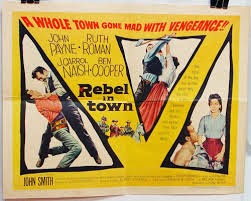
Rebel in Town was the last of the Western movies John Payne starred in before devoting his time to The Restless Gun TV show. It was perhaps his best.
It’s a good noir psychowestern which is well directed and well acted, notably by Payne himself, with excellent support, especially from Ruth Roman who is outstanding.
.
.
.
It was directed by Alfred L Werker for Bel-Air Productions, released by United Artists. Werker did the 1939 Sherlock Holmes, which was very well received, as well as the police thriller He Walked by Night. As far as Westerns are concerned, he directed ten silents including the 1927 Jesse James and the 1928 Kit Carson. He then did a lot of talkie oaters, and Rebel in Town was his last. It was well done: tense, visually interesting and quite powerful.
The screenplay was by Danny Arnold, who only wrote two Westerns but they were both good (this one and another Bel-Air production, Fort Yuma) and it’s a pity he didn’t do more. He made of the Rebel script an interesting study in character development containing an accessible (but not dumbed-down) discussion of important themes.
It was unique among Payne Westerns in that it was shot – by Gordon Avil, who did the 1930 Billy the Kid – in black & white. Payne normally insisted that all his movies be in color, and by 1955 that was the norm, but in fact the black & white suits the intense, claustrophobic noirish style of the film. There is little location shooting; it’s mostly done in town and at the Willoughby farm.
.
.

.
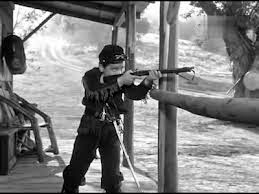
For the Willoughby family, John and Nora (Payne and Roman) with a feisty young son, Petey (Bobby Clark, Casey Jones Jr in Casey Jones), are at the center of this tale. John is an ex-Union captain and his son is also obsessed with the Union army but the boy’s mother just wants to forget the war and settle down to farming. The little boy consoles his father amusingly, saying, “You know how women are.” Then one day, the kid’s birthday, five ex-Confederate soldiers, a father and four sons, now renegade robbers, send two of their number into town and the lad sneaks up on the Rebels and fires his cap gun at them. One of the Rebs instinctively turns and fires, killing the child. The boy’s body hurtles brutally across the street in the way that George Stevens had pioneered for the death of Stonewall Torrey in Shane.
.
.
.
The death of the boy and his parents’ difficulty in coping with the tragedy (it even strains their formerly loving relationship) are compassionately and sensitively handled. The shot of John cheerfully bringing in a small saddle he has bought for the boy’s birthday party and letting it gradually drop from his hand as he hears the news, for example, is movingly done. The funeral of the child, the wife’s hearing the boy’s ghostly yahoos when they return home in black and the father’s gazing at the boy’s toy sword also. Top class writing and direction – and acting.
The renegade Rebs are no mere two-dimensional bad guys either. They are not like Donald Pleasance’s over-the-top crazed father and homicidal sons in Will Penny; they are more like their forebears, Charles Kemper as Uncle Shiloh and his sadist white-trash sons Hank Worden and James Arness in John Ford’s Wagonmaster. Actually, they are even even better than that. These renegades are almost sympathetically drawn.
.
.

.
J Carrol Naish is the stolid, sage paterfamilias Bedloe Mason, and his sons are interestingly named Gray, Wesley, Frank and Cain. Gray, the good one, for the Confederate origin, I suppose; Wesley the bad one for John Wesly Hardin perhaps; Frank maybe for Frank James; and Cain, in a twist, the one whom his brother tries to kill. The most interesting of them is Frank because he is played by Ben Johnson although sadly he has almost nothing to say and is wasted by writer and director. He is nevertheless quietly powerful in the background. Amusingly, Cain Mason is played by Cain Mason.
.
.

.
The decent feet-on-the-ground town marshal Adam Russell is played by the solid James Griffith, whom you will certainly recognize as he was, in various oaters, William Quantrill, Bob Dalton, Pat Garrett, Abe Lincoln and Doc Holliday – what a Western CV! His thin face and beaky nose were distinctive.
.
.

.
There’s a fistfight under horse’s hooves that reminds you of High Noon and Night Passage.
Rebel in Town is actually a surprisingly good Western which, had it had, say, Anthony Mann behind the camera and James Stewart in front of itwould have been a classic. It talks of loss, the futility of revenge, and sacrifice.
.
6 Responses
Truly for-mi-da-ble ! John Payne is close to James Stewart in this one and I will award the film 4 revolvers if I were you – by the way most of them – the revolvers – do not look like SA 73 but closer to Army or Navy and some Henry or Henry-like Winchesters, matching the post Civil War times. JM
Yes, it's a candidate for Payne's best Western.
Not sure what the revolvers are but I'll take your word for it!!
Jeff
Well, tons of westerns are using weapons which are either anachronic or inacurrate. US cavalry equipped with Winchesters is one of the most frequent example. Cap and balls revolvers are scarce until recent times in the US westerns and their appearance is mostly due to spaghetti westerns – and Italian replicas – how many films taking place just after the Civil War are showing Colt peacemakers launched on the market in 1873 – see The Searchers or Vera Cruz for instance. Rebel in Town is one of the few exceptions. I suppose the studios prop departments were using what they have at their disposal, sometimes they sere using Colt 73 modified to look like Remington 58
In the very recent Hostiles some cavalrymen have Sharps carbines – or maybe Spencer – both models used in the West by the army – but at the time when the fim takes place, they more surely should have all Springfield ones.
Anyway as you often say, a western is not history… JM
Indeed, Western movies are full of the 'wrong' guns, so Jeff's rating-system revolvers are in keeping…
Just seen it (Amazon Prime, UK). Never heard of it. This has to be one of the greatest Westerns. Remarkable.
Ultimately, Rebel in Town is an account of people trying to figure out what is right and how to do right under difficult and highly emotional circumstances. An outlaw seeking water for horses “accidentally” guns down and kills a little boy on his birthday. The boy had snuck up behind the outlaw and fired his cap pistols. The edgy outlaw whirled and fired, alas, with real bullets. But, rather than own up to his terrible mistake, he and his two brothers flee the town and rendezvous with their father and another brother. The remainder of the picture details future interactions between the outlaw clan, the parents of the slain child, and the citizens of Kittrick Wells, the place where the killing occurred.
Should the outlaws flee or face up to the killing? Should the father take vengeance on any or all of the outlaws? Should all violence cease, as the mother of the boy argues? Should there be a trial or should there be vigilante justice? Should the outlaw family circle the wagons to protect their own or should they remand him to punitive custody?
All the characters in this engrossing and forceful western grapple with these moral dilemmas. The better among them–and the outlaws, with the exception of the killer, are essentially decent people–are driven almost to the edge of madness as they seek to do what’s right. The lone true villain–Wesley Mason–is a fiend, not so much because he mistakenly killed the boy and fled the scene, but because he has no interest in doing what is metaphysically right. On the contrary, he couldn’t care less about right and wrong. His only principle is naked self interest. And in that overweening egocentrism, he attempts to kill his idealistic (and naive) little brother, not once but twice.
This is a very fine western. John Payne and Ruth Roman as the parents of the little boy are perfect. J. Carroll Naish is excellent as the grizzled and frazzled patriarch of the Mason outlaws who seeks, against the circumstances, to lead his life as a dignified and honorable gentleman. And there’s Ben Johnson as one of the Masons. He doesn’t get many lines as the most loyal son of father Bedloe Mason, but bulks large nevertheless.
The script is direct, intelligent and unpretentious. Difficult issues are parsed, but in the manner of regular folk, not windy theorizers. In short, this is an Adult Western in the truest sense of the term.