Ho-hum
Fred MacMurray was quite good in Westerns (though he didn’t care for them much) but this one was mediocre at best.
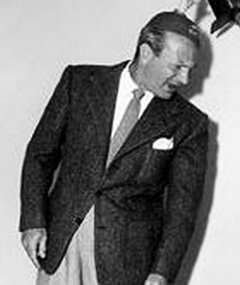 It was directed by Mr (Western) Average, Roy Rowland (left). He did nine big-screen Westerns, some, such as Many Rivers to Cross or the disappointing filming of a fine novel Bugles in the Afternoon, less than wonderful. About his best was The Outriders with Joel McCrea. He ended with a spaghetti. The pacing of The Moonlighter is iffy and had the picture had, say, Raoul Walsh at the helm (or anyone good, really) it might have been better.
.
.
Probably not, though, because it suffered from a great handicap in the shape of Barbara Stanwyck. She would do Westerns, dammit. Starting as a very improbable Annie Oakley in 1935, she was a barely-credible chirpy Irish colleen in Union Pacific in 1939 with Joel McCrea and went on from there. She was just about convincing (though unsympathetic) as a domineering cattle baroness (The Violent Men, Cattle Queen of Montana, Forty Guns) and of course continued bossing around in The Big Valley on TV but in most other Western parts she just wasn’t very suited. Fine actress that she undoubtedly was, in Westerns she was just wrong. She was good, very good, I’d say, in Trooper Hook, again with McCrea, and also impressive, yet again with Joel, in the semi-Western The Great Man’s Lady. In this one she is completely ridiculous as a woman deputy in 1950s pants, hair, and cosmetics hunting down rustler Fred MacMurray.
.
.

Not good
.
Fred and she teamed up quite often, notably in Double Indemnity in 1944. This was their only Western together, though. Phew.
It was 1953, so it was shot in trendy 3D, as can be seen immediately from the (now) laughable opening titles. It was a ‘small’ Western largely set in town and probably unsuitable to 3D, especially in black & white. As with all these pictures, this one was seen in 2D by 99% of the movie-going public, and still is, of course.
.
.
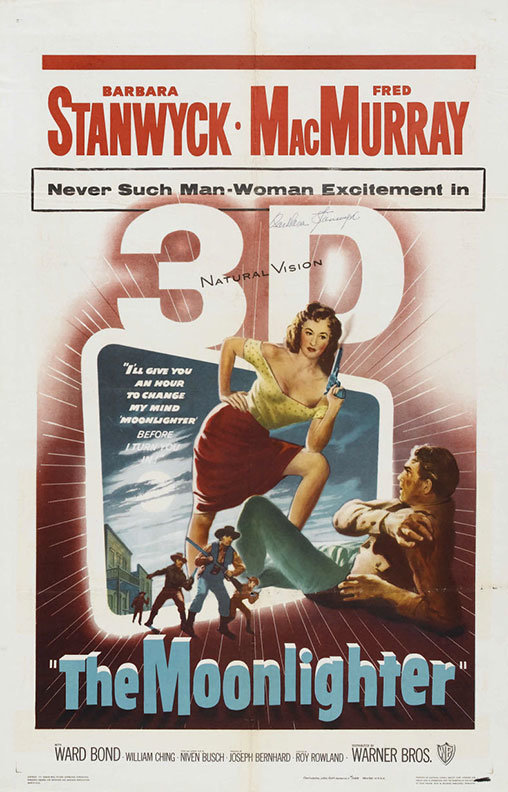
Hilariously bad poster
.
The first part isn’t bad, with rustler Fred in a cell awaiting trial but expecting to be lynched. It’s quite dark and it’s a stinging indictment of the lynch culture. Of course the mob gets the wrong man and strings up a harmless hobo. Jack Elam is a leading lyncher and prepares the noose with glee. Always good to see Jack. But Fred comes back to get his revenge, and Jack is the first to go, hoist by his own rope – One-Reel Jack strikes again.
.
.
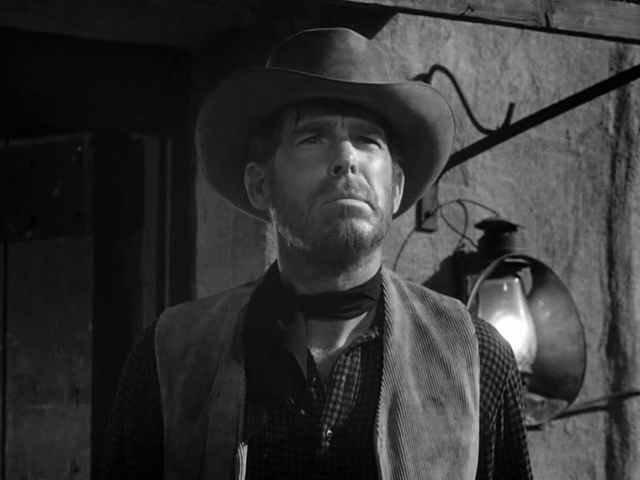
Fred good in Westerns but deserved better than this
.
But this first reel is OK because Stanwyck hasn’t appeared yet. Plus, we get Sheriff John Dierkes and good old Burt Mustin as the turnkey (in quite a big part, but strangely uncredited). Once la Stanwyck arrives – she seems to be some kind of detective – it all goes downhill because the story becomes a rather weak love triangle. It turns out that before going off rustlin’, Fred used to love her but now she is going with Fred’s younger and rather weaker brother, bank teller Tom (William Ching). While getting his revenge on the lynchers (he was lynching them, essentially) Fred got wounded, and so he now returns home to his saintly ma (Myra Marsh) for medical attention. And of course that’s where Barbara lives, and the old passion rekindles, and that brings conflict between the brothers. Yawn.
.
.
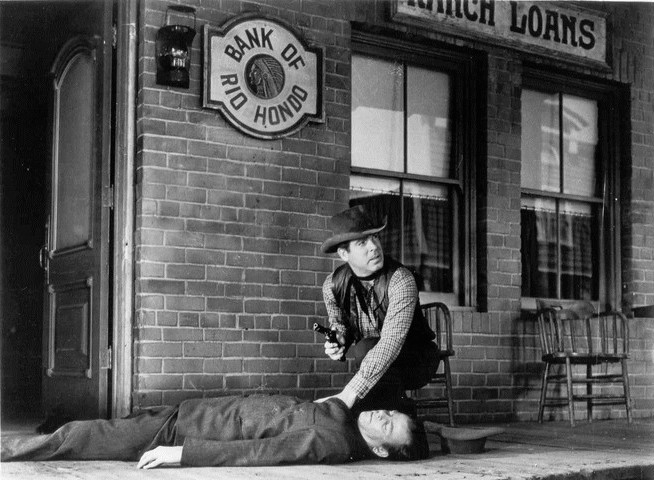
Some of the action is OK, such as when brother Tom is killed with the bank president’s derringer
.
Amazingly, this trite stuff was written by Niven Busch. Now Mr Busch had penned such classy Westerns as The Westerner and Pursued. I don’t know how he churned out this one. Not his usual style at all.
.
.

Niven. Really?
.
Now Ward Bond turns up. Tom thinks he’s law or a Pinkerton looking for Fred but in fact he’s an old partner-in-crime of Fred, and together they plan a bank heist at Tom’s bank, with Tom, who has just been fired, coming in on it. This turns Barbara against Fred and she gets sworn in as a deputy in order to hunt him down. Probable, huh.
.
.
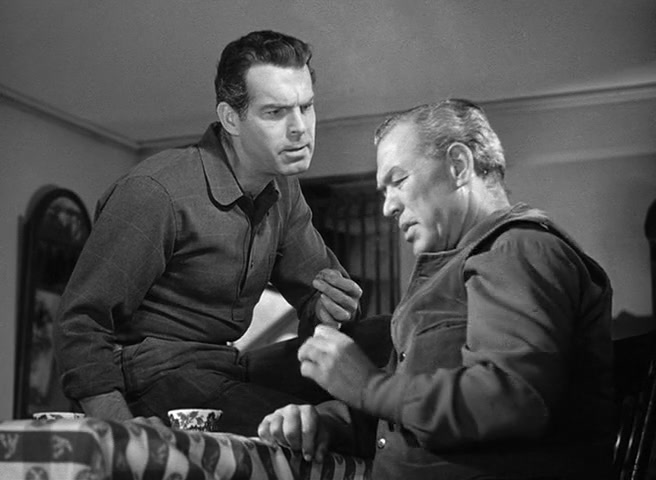
Fred and Ward plan the bank job
.
The good bit is that they do rob the bank and then get away in an early automobile (the bank president’s car, in fact). Cars in Westerns are usually a symbol of the new age and a sign that the Old West is dying (think Ride the High Country, The Wild Bunch, The Ballad of Cable Hogue, The Shootist). Sometimes they are shown to be new-fangled, unreliable, and no good against the good old horse (The Last Hard Men, the second Monte Walsh, In Old Oklahoma). In this picture, though, it’s just a good getaway vehicle, even if once clear of town they abandon it and take to their horses.
.
.
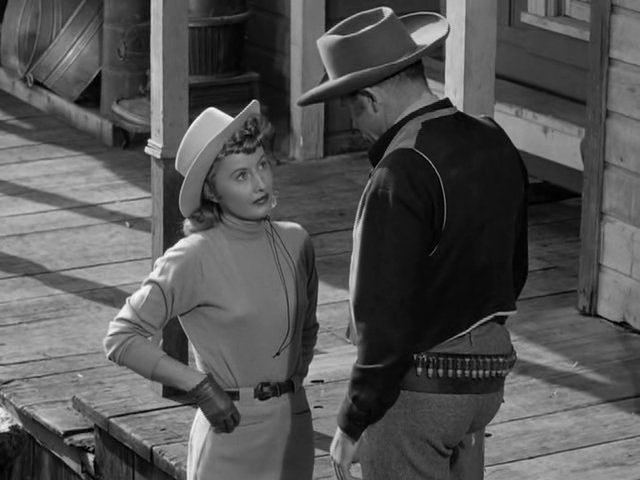
She is sworn in as a deputy. Dig the authentic Western clothes.
.
There’s another good bit with a waterfall. Bert Glennon was at the camera. And yet another good bit with the dog Hank. But a few good bits do not a great Western make. It has a rather contrived happy ending. All in all, dear e-pards, I fear it isn’t a top oater. And certainly not up to the standard of some other Fred oaters, like At Gunpoint or Day of the Badman. Nor of course was it a patch on other Westerns of that great year 1953 such as Shane, Hondo, or The Naked Spur.
.
.
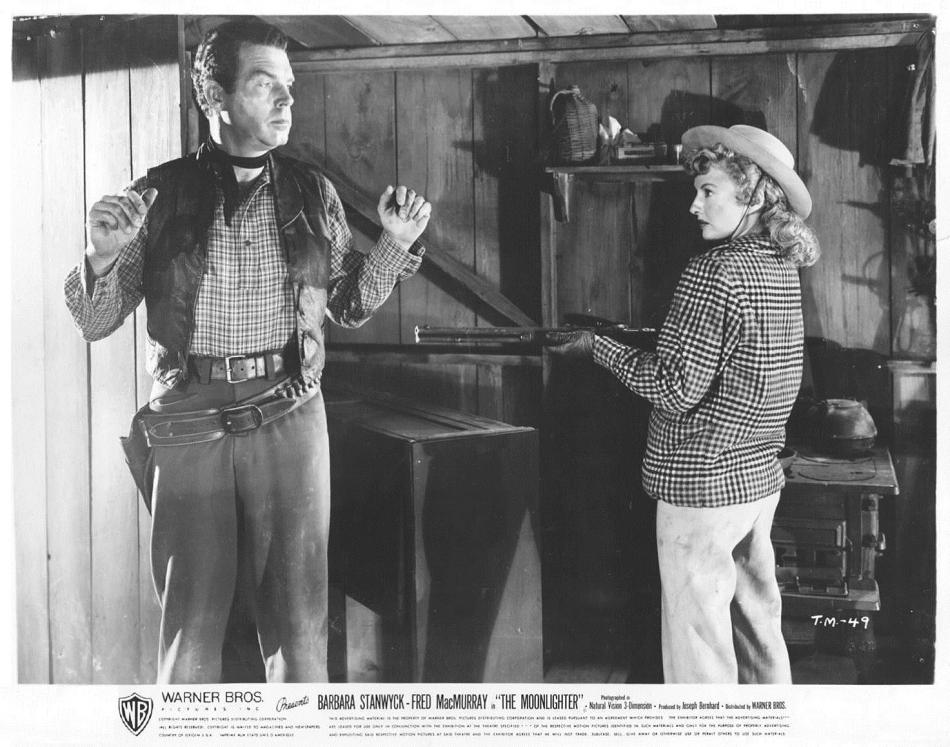
The deputy makes her arrest
.
You could watch it, I guess, but don’t expect too much.
5 Responses
This comment has been removed by a blog administrator.
I actually thought it was okay until lame, sappy, rather abrupt ending. It starts off rather well with a suspenseful, wrongful lynching and has some pretty good action – decent Bond/MacMurray brawl, rifle shootout and mountain rescue. I disagree with Jeff about Stanwyck too. Thought she was pretty good in Westerns (except maybe for the 2 ’50’s ones with ‘Queen’ in the title). But this ending does kinda ruin for me.
I agree. I never made a point of it with Jeff but Stanwyck is one of my all time favorites so many films and genres. I thought she was well suited for Westerns. She was a special talent. It shows in her early non Western films with Capra and Wellman. She is a tour de force in ‘Baby Face’. On her Westerns I especially like ‘Forty Guns’ in all its luridness. In ‘real’ life she loved Western history and wished to develop a series on women in the west.
She was also very good in The Violent Men directed by Rudolph Maté in 1955 with Glenn Ford, EG Robinson, Brian Keith and Richard Jaeckel.
It seems she liked very much managing a ranch, since after The Furies, The Violent Men and Forty Guns, her last western role was her Victoria Barkley in The Big Valley TV series.
Jeff was leading a resolute crusade against Stanwyck all his blog long. Forgetting that too often her westerns parts (and their scripts) were not in proportion with his talent. The only to find favor in his eyes is Trooper Hook. She is also superb in Forty Guns in my opinion. But Jeff did not like it or any Fuller’s films anyway.