.
‘The’ Western
We’ve been looking at Westerns from that marvelous year of 1953. There were so many good ones, and our reviews of the likes of The Naked Spur (released February ’53), Hondo (November) and Escape from Fort Bravo (December) illustrate this. Click the links for those reviews. But of course the biggest Western of the year, by far, both in terms of critical acclaim and box-office sales (it grossed $20m) was Shane.

Indeed, there are those who would put Shane at the very top, the greatest Western ever, or at least to rank with the all-time greats. It won an Oscar and was nominated for five more. The American Film Institute ranks it as the third greatest Western (beaten only by High Noon and The Searchers). Critics then and since have waxed lyrical over it.
Myself, I think Shane is very fine, but just short of a masterpiece.
I don’t know how many times I have watched it; a lot, anyway. And fundamentally, though I have appreciated this part or that part more, I haven’t changed my basic opinion of it: that it is a mighty example of the genre; that it deals with classic Western themes; that it has great merits (notably visually); but that it is fatally flawed by the casting.
Producer/director of Shane George Stevens had started in the film business as a cinematographer in 1923 and added directing from 1930 but he specialized in comedies and had no reputation for Westerns. In fact the biopic Annie Oakley (1935) with Barbara Stanwyck was his only Western as director, until he decided in the early 1950s to make ‘the’ Western movie, Shane. And, like William S Hart before him, he seems deliberately to have set out to make the definitive Western, whatever the cost. As Brian Garfield wrote in his fine 1982 Western Films: A Complete Guide, “Shane is a conscious retelling of the purest elements of the classic Western legend.” In this way it is a most American film.

Stevens chose as his starting point the 1949 novel by Jack Schaefer, Shane. Many consider this to be a children’s book and in many ways it is. Schaefer revised the first edition in 1954 (i.e. after the movie had come out), taking out all the damns and hells and making it suitable as a book to be read in school. In fact the first time I read Shane was in a lovely boys’ edition illustrated by Wendell Minor in the Illustrated American Classics series. And it makes a good book for children because it is short, it is written in a direct, straightforward style, it has a noble hero to be admired and the story is told from the point of view of a boy on a farm with whom juvenile readers can identify.

The 1984 “critical edition”, however, edited by James C Work, University of Nebraska Press, makes excellent adult reading because as well as the unexpurgated text of the novel you get a series of interesting essays about the book and about the author, as well as reviews of the famous film. For of course this novel is much more than a children’s book. It has become an iconic statement of the Western myth. It has appeared in more than seventy editions and thirty languages.

Marc Simmons says of the characters in the story in the Foreword to the critical edition: “[They were] cut from noble cloth. They were strong, hardworking, brave, self-disciplined, responsible, honest; ungalled by self-doubt or any sense of inferiority. In short, they possessed those virtues that, by the mid-twentieth century, were increasingly being dismissed as outdated or unattainable.”
The tone of this quotation is perhaps nostalgic, even reactionary, and that is one weakness of the novel (and, by extension, the film). It has a certain naivety about it, an overly bucolic sentimentality that the “boy’s eye view” cannot wholly excuse or disguise. Another way to say it would be that it now seems terribly dated.
But perhaps this describes the appeal of all Westerns, books, movies or in other guise. They described a simpler time, when justice was administered directly and when if might was right, it was tempered by qualities of decency and fairness in the dispensers of the frontier justice. Of course, this time never existed but it makes a satisfactory myth.
Shane is in many ways the summation of the myth of the gunfighter, that samurai-like knight errant of the plains, sometimes a lawman, sometimes a badman, sometimes a gun for hire, whose skill with a firearm and courage to deploy it are summed up in the aphorism from the film, “A gun is as good or as bad as the man using it”. It is a very American notion, at once popular and democratic yet at the same time quite ‘rightist’ and élitist. In an evil world, it seems to be saying, the only effective remedy is a good man with a gun. This notion still resonates today.
At any rate, that was the story Stevens chose. And in many ways it was well suited to his purpose because it was the archetypal treatment of that most Western of themes, the myth of the lone gunfighter as outsider who comes from nowhere, rights wrongs in a community and then rides off into the sunset.
By 1953, when the movie Shane came out, Westerns had followed a slightly different trail. Through the late 1940s the genre had got ‘psychological’. Westerns were noir, Westerns were black & white, Westerns were intense. Movies like Pursued (1947), Blood on the Moon (1948) or The Gunfighter (1950) were dark, powerful films with Freudian touches. In a way the culmination of this type of Western was High Noon (1952), which had none of the sweeping wide-open vistas we usually associate with Westerns. Like The Gunfighter, it was almost a theater play, observing the classical unities, a town-based story with many interiors in which the characters interacted passionately in the face of looming tension and tragedy.
Stevens wanted none of that. He wanted to return to the epic scale of the open range, and he wanted a story of nobility and conflict set in mighty mountainous locations, and shot in stunning color. His town, such as it was, was a muddy street with a small and very authentic sprinkling of shacks dwarfed by the Wyoming vastness. Civilization is frail here. There is no marshal or sheriff. Men must make their own law and seek their own justice. By the way, some of the town set was re-used for Will Penny in 1968.

And of course the plot is another of those classic Western tropes, the big cattle rancher versus the humble homesteader. Although it is not explicitly referred to, there is a sort of Johnson County War theme to the story. This was one of the oldest and most commonly treated Western plots of all – see, for instance, the John Ford/Harry Carey Western Straight Shooting from 1917. Usually (though there were exceptions) the ranchers were portrayed in Westerns as ruthless plutocrats, little kings who had carved out their domains by fighting hostile nature and wild Indians and who were damned if they were going to let sodbusters come in and plow up their cattle graze, whereas the homesteaders were decent farmers, symbols of economic progress and democracy, exercising their rights as Americans to settle on open land. That was certainly the approach of Stevens and his screenplay writer AB Guthrie Jr. A key scene in the film is the moonlight debate (on symbolic July 4th) when the two sides state their case.
Guthrie was himself a noted Western novelist (Shane was his first screenplay). He depicted a rugged, generally unromanticized West, often filled with authentic historical detail. He won the Pulitzer Prize for his 1950 book The Way West (made into a so-so movie in 1967) and was equally well known for The Big Sky (published in 1947, filmed the year before Shane).

Both Schaefer’s novel and Stevens’s film open with the arrival of the mononymous Shane. The book’s Shane is dark, tall and dressed in the fine clothes we might associate with a high-toned gambler. Stevens elected to have short, blond Alan Ladd (replacing original choice Montgomery Clift) in soft buckskins. Perhaps the clothes were meant to suggest a past as buffalo hunter or plainsman, and certainly the ‘lightness’ contrasts suitably strongly with bad guy Wilson’s black garb, but, with the fancy silver-decorated gunbelt, the costume comes across, as William K Everson says in his 1969 book A Pictorial History of the Western Film, as pretty. And here we come to what is, for me, the principal weakness of the movie Shane. The part called for a classic tall Westerner, with an air of strength and toughness about him, even sinister in some ways, at the very least Peck or Fonda but ideally Gary Cooper. Instead, we got a Hollywood Shane in costume, with a Beverly Hills tan and coiffed blond locks.

In his 2008 guide to Westerns Stagecoach to Tombstone, author Howard Hughes (no, not that one) says that Paramount was originally reticent about casting Ladd as Shane. “His films never grossed more than $2.5 million and the producers worried that they were putting a low ceiling on their film as a Ladd vehicle.” I don’t know if that’s right (Hughes doesn’t cite any source). If so, the doubts were unfounded. The picture took $9m in the US alone on first release.
Alan Ladd was certainly a very nice man and he could also be a good actor but he never suited Westerns, I think. He didn’t look convincing in them, and his clothes always looked like costumes. Before Shane filmed he had led in three Westerns (Whispering Smith, Branded and Red Mountain) but these had been pretty ordinary and Ladd didn’t seem quite suited. When in Whispering Smith he threatens, “I’ll give you forty-eight hours to run Barton out of Williams Canyon; if you don’t, I’m coming in after him,” you feel like saying, “Oh yeah, you and whose army?” Shane, probably Ladd’s most famous role, revived his Western career, indeed his career tout court, and made him a ‘famous’ Western star among the wider public. In fact on the back of the movie Ladd founded a company, Jaguar, to make Westerns. But he was always one of the weaker heroes in the saddle. Though Shane is by far Alan Ladd’s best Western, and he does surprisingly well in it considering, the movie never recovers from his performance.
Stevens didn’t think so. He is on record as saying that Ladd’s performance in the title role was one of the best ever by an American actor in a Western. Ladd excelled, Stevens thought, at conveying to the audience a large measure of reserve, dignity and decency. I think Stevens did have a point there. In fact Stevens was so impressed with Ladd’s work that he offered him a role in another classic but the actor turned it down because it would not give him star billing, so James Dean became Jett Rink in Giant instead. Ben Johnson also praised Ladd: “Alan did a wonderful job. I really liked Alan. He was a good actor – a very underrated actor.”
But not everyone agrees with this. They had to do 119 takes of the scene where Shane demonstrates shooting to Joey, which must have tried even the perfectionist director’s patience. The fancy gun-twirling that Shane does in the climactic showdown was actually performed by gunsmith-stuntman Rodd Redwing. For the fight with Calloway in Grafton’s saloon, they built a platform for Ladd to move about on and dug a pit for Ben Johnson, so that height difference between the actors would not be apparent. Actually, the fight is brilliantly staged. Johnson said that Stevens took seven days to do it! Other Ladd scenes were doubled by Henry Wills (later stunt coordinator on The Magnificent Seven). Well, that’s OK, most Western stars used stunt doubles.

Where Ladd shines, though, and he really does, is when displaying elegant manners and giving courteous compliments, best seen in his dancing gracefully with Marian, and Stevens was clearly going for an attempt at courtly love as the knight of the plains chastely woos the out-of-reach lady. The idea of Western heroes being aristocrats – or at least ‘nature’s aristocrats’ – was an old one. It went right back to Fenimore Cooper. The Virginian had it too.

But the film would have been so much better with an earthier, tougher, taller Westerner who gritted his teeth and did the decent thing.
In his review of Shane, Roger Ebert perceptively writes about the gunfighter:
“There is a little of the samurai in him, and the medieval knight. He has a code. And yet – there’s something else suggested by his behavior, his personality, his whole tone. Here is a man tough enough to handle any threat and handsome enough to win the heart of almost any woman. Why does he present himself as a weakling? Why is he without a woman? There must be a deep current of fear, enlivened by masochism. Is he afraid of women? Maybe. Does he deliberately lead men to think they can manhandle him, and then kill them? Manifestly. Does he do this out of bravery and courage, and because he believes in doing the right thing? That is the conventional answer. Does he also do it because it expresses some deep need or yearning? A real possibility. Shane never says, and maybe never knows. Shane wears a white hat and Palance wears a black hat, but the buried psychology of this movie is a mottled, uneasy, fascinating gray.”
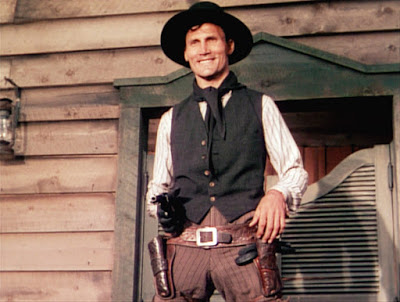
As Richard Slotkin points out in his essay on Shane in his Gunfighter Nation, there is a symmetry to the story Shane. Sturdy farmer Starrett (Van Heflin) and autocratic rancher Ryker (Emile Meyer) are the leaders of their respective camps but both have to give way to their hired men who will decide the outcome of the conflict: Shane will fight for the common man’s rights and hired gun Wilson (Jack Palance) will seek to assert that might is right. Both are professionals. The first appearance of Wilson in the saloon is as dramatic as that of Shane, though darker, more fell. We see him as he enters Grafton’s saloon, dressed all in black to contrast with Shane’s light buckskins, viewed from a low angle so that he seems huge, and as he comes in with measured tread, in a masterful touch a dog gets up and slinks off. Wilson is the anti-Shane and it is crystal clear that the final battle will be between them and them alone. One of the most memorable shots in the film is of Starrett and Ryker exchanging hot words while the camera watches the silent Wilson and Shane sizing each other up for the deadly ritual to come, and smiling slightly.
The choice of Palance was inspired. A stage actor who had made his name as understudy for Marlon Brando in A Streetcar Named Desire, finally taking over the part, he had made his film debut in Elia Kazan’s Panic in the Streets. An Eastern, ‘urban’ figure, he was a most unlikely casting choice for a professional gunslinger. He knew nothing of horses or guns. But he was brilliant, and despite (or even because of) only having sixteen lines of dialogue, he conveyed sadism and menace and indeed pure evil with real steel. One of his few lines is stunningly good. When Ryker says that he will kill Starrett if he has to, Palance quietly replies, “You mean I’ll kill him if you have to.” Ebert says, “He arrives in town on foot, leading his horse – an effective entrance, even if Hollywood lore says that Palance at the time was so awkward on horseback that Stevens put him on foot in desperation.” Palance’s Wilson is catlike, and this is greatly emphasized by the view of him mounting up: Stevens filmed him dismounting (which Palance could just about do) and reversed the footage.

Woody Allen is, surprisingly perhaps, a huge admirer of Shane and he has said:
“If any actor has ever created a character who is the personification of evil, it is Jack Palance. We’ve all read about the size of the horse, how Stevens put Palance on a smaller horse so he’d look even bigger. But when he arrives – the music is great – he’s all in black; he’s so poetically evil. He looks like he’d gladly kill the guys who hired him if they looked at him wrong. He’s just bad news. Serpentine. In our minds, he’s set off against Shane, one particularly good, almost too good to be true, and the other is totally evil.”
Van Heflin, second choice after William Holden – who would have been splendid – turned it down, did a good job as the stolid settler Starrett, tall, broad in the beam, not over-gifted intellectually but basically decent (he was in some ways to reprise that role in 3:10 to Yuma four years later).


As his wife Marian, Jean Arthur was very good indeed. She was another unlikely choice. She had been Oscar-nominated for another George Stevens movie, a comedy, in 1943 but Shane was her big-screen adieu. She was in her fifties yet played a young mother with skill, and her sublimated romance with Shane is marvelously well done. It is said that Katharine Hepburn had been considered for the part; certainly, that would have completely changed the character. The book calls for a person of reticence and restraint. Arthur did that admirably and hers was a nuanced, subtle portrayal. She was always great in Westerns, I think. She went right back to The Iron Horse in 1924 and did 22 silent oaters before being Calamity Jane to Gary Cooper’s Wild Bill in The Plainsman in 1936, and she headed the cast in the fun Arizona in 1940, her last Western before Shane, her final one, for which she came out of retirement.

There were many plaudits for child actor Brandon De Wilde as the Starretts’ son Joey. And indeed he was nominated for an Oscar for the part. Myself, though, I found him too young and too whiny, perhaps because I already had a clear idea in my head from the novel of an older boy, a tough teenager. This is no criticism of De Wilde, for many of these child actors were astonishingly good and you can’t expect more from a boy of ten. I criticize the casting choice rather than the child. TV Rin Tin Tin lad Lee Aaker had originally been penciled in. I always thought Aaker an excellent boy for Westerns (he was brilliant in Hondo the same year as Shane) and it’s a pity he didn’t do it. He was only nine but he would have been a better and gutsier pioneer child, I think.


But the story revolves around the boy and so that casting was vital. As Philip French wrote in his 1973 book Westerns,
“In a rather old-fashioned way, Westerns assume that young people have a lot to learn from their elders and very little to teach them, and that the process of learning is long and painful, that a man must prove himself in a variety of rituals before he can take his place in adult society.”
Nowhere is this truer than in Shane.
The farmers are good, particularly the great Edgar Buchanan as Fred Lewis in a cap and Elisha Cook Jr as feisty bantam Stonewall Torrey. The death of Stonewall is famously done. Stevens had won the Legion of Merit for his work heading up a combat motion picture unit in World War II. He filmed the Normandy landings and had seen death at first hand. He later said that Shane was a Western, yes, but essentially a war film. He knew what gunshot wounds were like and he was determined that there would be none of the usual fake B-Western ‘deaths’ in his picture. Elisha Cook had to be jerked backwards on a wire as he was shot by Wilson, and land flat on his back in the mud. Death by gunfire was inglorious and squalid, shocking and loud, and that’s the way Stevens wanted to show it – the shot is really percussive. Woody Allen again: “There’s never been a shootout in a cowboy movie to equal it, in terms of evil against innocence.”


And I liked Emile Meyer as Ryker, perhaps his finest Western role (of 70). As Paul Simpson points out in his 2006 The Rough Guide to Westerns, in his shaggy mane he looks like an Old Testament prophet. Amusingly, as an ‘old timer’, Meyer was actually ten years younger than Jean Arthur’s ‘young mother’ Marian. The first thing Ryker says is that he doesn’t want any trouble. At several later points during the movie, he tries to be reasonable, at least according to his own lights. He attempts to convince Starrett to come work for him, and later he tries to hire Shane. He is no cardboard cut-out villain. You can see his point of view even if you are, as Stevens wants you to be, on the side of the homesteaders.

Among the extras, two Ladd sprogs feature as ‘little girl’ and ‘little boy’ and Clayton Moore, then in dispute with the producers of The Lone Ranger and being temporarily replaced by John Hart, is a Ryker henchman. Director Stevens’s voice can be heard off-camera shouting encouragement in the saloon fistfight.

For me, though, one of the best actors in the movie had a minor part. It was Ben Johnson (it is perhaps no coincidence that Johnson was a John Ford protégé) as Chris Calloway, the barroom bully bested by Shane who comes to decency. Johnson was one of the finest Western character actors of all time and he was rarely better than in this small part. Everson, mentioned above, estimated Johnson to be the best actor in the cast, and I must say I am tempted to agree. Ben went right back to the rodeo circuit after this picture, before returning to the screen two years later.


Visually, Shane is stunning. As Bosley Crowther said in his New York Times review of April 24, 1953, “Beautifully filmed in Technicolor in the great Wyoming outdoors, under the towering peaks of the Grand Tetons, and shown on a larger screen that enhances the scenic panorama, it may truly be said to be a rich and dramatic mobile painting of the American frontier scene.” Wrter Hughes, manrioned above, reckoned that the Tetons wreathed in cloud resemble the Paramount logo. Maybe.

DP Loyal Griggs rightly won an Oscar for it (the movie’s only Academy Award in the end) and this despite subsequent cropping to fit the new widescreen format that was all the rage. Long lenses were used to bring the Tetons ‘nearer’ to the characters and the Technicolor is superb. The film has to be seen in a theater; even the new large TVs don’t nearly do it justice.

There have been criticisms of the look of it and indeed there is something almost picture-postcard about the film, like a chocolate-box lid illustrating the beautiful West. It isn’t John Ford. It is only really during the tree-stump scene that the characters truly interact with the land; otherwise it is there as a beautiful backdrop. I myself love the Corot-like trees on the way to town. Stevens has been accused of being ‘mannered’ and The BFI Companion to the Western talks of the film’s “self-consciously mythic qualities”. Certainly Griggs and Stevens took ages to frame shots, often reshooting, using miles of film, to the frustration of Paramount, and then spending almost a year editing the results. But in the last resort, Shane is a visual masterpiece.
The chocolate-boxiness is heightened by the Victor Young music which is probably too ‘sweet’ and cloying. Stevens evidently thought so too because he replaced Young’s score for Shane’s ride to the showdown with music previously used in Paramount’s Rope of Sand, and in the saloon before the final confrontation the music is from Ladd’s own crime noir movie The Glass Key. Everson thought the score “incurably romantic”, though Herb Fagen in The Encyclopedia of Westerns calls that criticism “a bit shortsighted” and says Everson “negates [the score’s] overall excellence and impact.” Fagen thinks the music is “beautifully melodic yet dramatically stirring.” As with all else, this remains a subjective judgment, and viewers will make up their own minds.
The film, just under two hours long, has a purposeful, almost languid pace. Film critic Dave Kehr calls it “Overblown, overlong, and overelaborated.” The Variety review of the day said that “Stevens … never rushes the picture or a scene” and added that “This measured, deliberate handling in many of the sequences may seem too slow for the tastes of the more regular run of audiences.” Certainly the action, when it comes, is sporadic, sudden, episodic, almost unexpected, which, I suppose, ‘action’ usually is.
And then the ending. Is Shane dying as he rides away? It’s very possible but Stevens rightly leaves us guessing. The man is slumped over in the saddle. Wounded? Yes, Joey notices blood. Fatally wounded? Remember, earlier, when Ryker taunts him by saying he is “a dead man”, Shane makes the baleful retort, “That’s the difference between us. I know it.” Or is he simply deeply sad at leaving Marian and Joey, sad at the failure of his attempt to hang up his gun and find peace? You sense that Shane always leaves after a showdown. “There’s no living with a killing,” he tells Joey. “There’s no going back from it. Right or wrong, it’s a brand, a brand that sticks.”
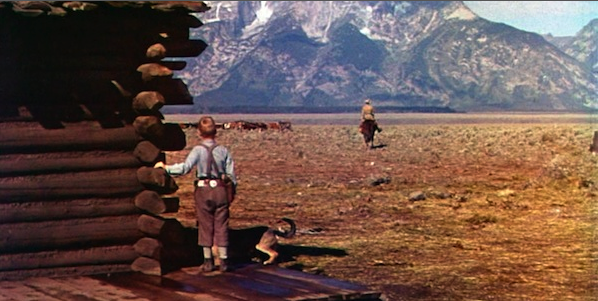
“I don’t like to think that he’s dead,” Woody Allen said, putting into words what many of us hope. ”Just that he’s wounded. I hate to think that he dies in the end. I think they probably are pointing to the fact that he’s dying because, you know, he’s ascending. But I don’t like to think that he’s dead yet.” Shane’s world is dying though, the world of gunfighters and the Old West. He knows it and so do we.
Originally scheduled for 48 days of shooting with a budget of $1.9m, the picture finished after 75 days of filming at a cost of over $3m. Shot July – October 1951, it underwent endless editing and didn’t première at Radio City Music Hall until April 23, 1953. The studio execs despaired and at one point tried to offload it to Howard Hughes but he refused it. When he saw the first cut, though, Hughes changed his mind, but that made Paramount hang on to it – rightly, because it was a big box-office hit, grossing $20m in the first year. Patrick Brion in his guide Encyclopédie du Western suggests that Paramount held the picture’s release back deliberately, to punish Ladd for not renewing his contact with the studio but I tend to think the delay was more the result of the producer/director’s perfectionism.
The critical reception was immediately ecstatic. The Hollywood Reporter called it “one of the great tumbleweed sagas of the decade.” The Motion Picture Herald waxed lyrical: “It has sweep, suspense, authenticity, technical detail, powerful drama. It has Western flavor so real you can taste the dust. It is a Western in the classic tradition which must rank amongst the greats.” Variety enthused, “Stevens handles the story and players in a manner that gives his production and direction a tremendous integrity.” TIME magazine euphonically called it “a celluloid symphony of six-shooters.” The New York Times said the film had “the quality of a fine album of paintings of the frontier.” The New York Post said “it’s only a Western in the sense that Romeo and Juliet is only a love story.” And so on.
It was in fact instantly hailed as a classic. Ben Johnson sure knew that. He said the picture “was made with a lot of integrity. It was so real it was just incredible. It stays with you. I was in it and I still like to watch it.”
It was nominated for six Oscars, winning one. BAFTA, Directors Guild of America, Laurel Awards, National Board of Review, Writers Guild of America and more all lauded it.
It was a monster box-office hit. In fact it was the third biggest grossing picture of the year after The Robe and From Here to Eternity (the latter the picture that beat it out at the Oscars), unheard of for a Western (though the lesser but snazzily 3D The Charge at Feather River ran it close commercially). Michael Coyne, in his book The Crowded Prairie, estimates that when adjusted for inflation Shane was the third-biggest grossing Western of all time.
Later critics have not universally adored it. In The Western Film (1976), Charles Silver said, “[John] Ford sees that progress and history are not necessarily synonymous, while Stevens tries to keep things simple for his audience.” I don’t really agree with that. Dave Kehr says that in Shane “Stevens is aiming to have the last word on a genre: everything aims for ‘classic’ status, and everything falters in a mire of artsiness and obtrusive technique.” That too is perhaps being overly harsh.
Others have been great admirers: Kurosawa, Peckinpah, Leone, Eastwood.
You can pick Shane apart, and some film critics (such as François Truffaut) have done so, but despite its apparently clichéd plot and stylized nature it remains moving, entertaining, beautiful and subtle. And as Fagen says, “Few films have integrated script, narrative, photography, music and drama so successfully.” It is quite clear why many regard Shane as ‘the’ Western.
In 1966 David Carradine was Shane in a not very good ABC TV show which only lasted one season. There has never been, though, a straight remake, as has happened to other great Westerns, such as Stagecoach, say. Clint Eastwood made a homage to Shane which you might call a remake in Pale Rider (1985) with cinematography by the great Bruce Surtees, and this the equal of Shane visually. Eastwood himself in the central role was much stronger than Ladd. Pale Rider is perhaps less subtle and complex than Shane and of course less original but it is in other respects grittier and more ‘Western’.
I would suggest that Shane is a must-read and a must-see, and both are leading examples of the Western genre. Both have real merit and even beauty. The movie is one of the great American films. But neither the book nor the motion picture was the greatest ever example of its kind.

43 Responses
One more excellent (re)writing, thank you ! I full agree on most of your remarks especially the cast. Ladd ‘s lack of presence and power, his fragile appearance, is to me a major flaw (Fonda would have been perfect for sure, matching much closer to the book’s character and more credible when facing Palance – I fully agree with Woody Allen too…) along with an unbearable Brandon de Wilde… Besides, the film is a classic, a kind of catalogue of the western, I am not surprised that Leone was fond of it, as he tried himself to make the same with Once upon a time in the West. Part of the set is still visible a few miles north of Kelly, Wyoming, in the béatifié Jackson Hole valley where it has been exhumed from the vegetation just a few years ago.
Who would you cast in a remake now?
Jeff
Matthew Lillard. Shane should be older, at least trailworn. I thought back in the day Jimmy Cagney could handle it. Walter (at the time) Palance can’t be substituted out of Jack Wilson. Now … Daniel Day-Lewis?
Beautiful not béatifié ! I am wondering if a natural site can be… if not by the pope maybe by Unesco!
I can think of a few places the Pope ought to beatify.
Mostly in New Mexico.
Jeff
Shane’s one of my favorites and I think it’s one of the top 5 in the genre. Brandon De Wilde doesn’t bother me in the part – as a matter of fact I love him to death. I see what you mean about Ladd and outside of this and maybe Proud Rebel I don’t think that he was very good in Westerns either, but I think he was excellent here. Didn’t read the book, but sometimes comparing a novel with a film can be a little like comparing apples and oranges.
Glad you like it. Very many do.
U all are crazy Allan lad was perfect for this movie. No one would of did better . Shane is top 2 best Westerns of all time .
Shane – Hugh Jackman
Starrett – Madd Mikkelsen
Mariana – Jessica Chastain
I agree 100% with Steve Adkins and Thomas Leary:
1. The cast was brilliant. I consider that Ladd played the common man, often dangerous, regardless of whether he was tall or physically strong. Aren’t we all like that? Maybe Stevens gambled on that and was right. He “created” the hero!!! Shane is human; it is what we are; It’s each one of us!!!
2. As for little Joey, I always had great affection for him, he never bothered me. We were the same age when I first saw the film and I really identified with Brandon. I’ve followed him my whole life (short life), including when he, Gram Parsons and Emmylou Harris battled together in music in the early 70s. And if I would propose current actors for a remake, it’s for two reasons: to revive the Shane’s fantastic story and, unfortunately, everyone has already left for good. RIP.
Feedback
You are far from alone. A lot of people love this movie and some regard it as the best ever Western. Fine. It’s a fine film with many great qualities.
Rewatched it one more time again. Surely a great film, great plot and great cast (some reserves on Ladd though) with one of the greatest western villain. But I still cannot stand Brandon De Wilde whining and yelling, especially at the end. It was already my problem at first sight when I was a kid, impossible to identify with him (I surely identified with Shane instead, but I would have probably shot at Brandon…).
It’s my favourite film of all. I’ve read so many times of people’s reservations about Ladd and Wilde, and I don’t think I can convince them I’m wrong but I love them both in the film. In Ladd’s case, I’m not a particularly huge fan outside of this film but I think he brings a mixture of deep, quiet inner strength – but with hints of vulnerability – to this role that really works for it, and a more macho or expressive actor wouldn’t have managed. For me, he’s perfect – but clearly not for everyone! At any rate, I can’t really imagine the film with anyone else in the lead.
Hard to imagine Shane without Ladd, High Noon without Cooper , The Searchers without Wayne, Clementine without Fonda, The Naked Spur without Stewart, The Gunfighter without Peck or The Wild Bunch without Holden. And yet, knowing the history of the film industry generally speaking, many movies could have starred someone else. But a film, to become a classic, owes very much its impact to its cast. Ladd is OK I guess is spite of his lack of build. I like very much Van Heflin and of course Palance and Johnson and Buchanan as well. Meyer is less credible as the ranchers boss and his make up does not help.
Agree with you 100%. Couple of interesting tidbits – supposedly Warren Beatty was so taken with the volume and sound of the gunfire in Shane that he used the same technique (which I believe was firing blanks into a barrel) in Bonnie and Clyde (he was also the producer on that film) – and, in the ’90’s, when the NY Times did a series of interviews with movie makers and their favorite films, Woody Allen (of all people) chose Shane to discuss.
I think Alan Ladd’s casting is wrong for a gunfighter but right for a childhood memory.
Brilliant!
Exciting news for fans of this film:
https://kinolorber.com/product/shane-special-edition
I have to give “Shane” (1953, 3 stars out of 5, not sure if I like it or not) another shot.
My father gave me “High Noon” (1952, my Top 25 of all time, all genres) and “Shane” for my birthday in 2009. (I didn’t ask for either one of them.) Upon first viewing, I liked them both.
Then, when I got seriously into movies in 2015, “High Noon” STUNNED ME ! ! ! –but “Shane” didn’t do much. I enjoyed it somewhat–the Wyoming scenery was beautiful, and I liked Joey calling out, “Shane! Come back!”
Ten years later, it’s time to watch “Shane” again. Jeff wrote a great review above.
“Shane” is on Jeff’s Top 17, and it’s on the Favorite Westerns lists of RR (his #1), Thomas Leary (his #2), Chris Evans, Nicholas Anez (at the top of his list), and Kevin.
And on top of all that, Sam Peckinpah LOVED IT ! ! ! He was inspired by one scene in particular, a scene he identified as a landmark in the Western genre.
“Killing used to be fun and games in Apacheland,” Sam said (in David Weddle’s Peckinpah bio, “If They Move…Kill ‘Em!”). “Violence wasn’t shown well. You fired a shot and three Indians fell down. But when Jack Palance shot Elisha Cook, Jr….things started to change.”
Speaking of Elisha Cook, Jr….
2015 was my first year into movies, and I didn’t know who the man was. When Jack Wilson (Jack Palance) shot Stonewall down, I had no idea what a special actor (Elisha) was playing Stonewall.
Elisha Cook, Jr., almost steals the show as the high-strung Wilmer in the famous film noir “The Maltese Falcon” (1941, 4 stars, fun film, very good, I don’t quite love it).
Even better than that, Elisha gives THE BEST performance as Jittery George in Stanley Kubrick’s great film noir, “The Killing” (1956, 5 stars) ! ! ! !
Marie Windsor (who also performed in “The Killing”) said Elisha was wonderful to work with.
MAN, I’m looking forward to rewatching “Shane” ! ! !
Yes, my #1, but it seems to divide Western fans a bit. Jeff and others whose opinion I respect aren’t too keen on Alan Ladd in the lead role, or on the character of the boy and/or the way Brandon deWilde plays him. I can only say I have no problem with the latter, and I find Ladd (who I’m otherwise not a particularly massive fan of) just right for the role. Beyond that I can’t really explain or justify why it’s such a long-loved favourite other than to say I’ve seen it more times than I can count and it never lets me down…
Enjoy the re-watch!
Shane, more than any Western I’ve seen, is a slow burn that, in its final act, packs an immense emotional wallop. The first two thirds of Shane are languid, idyllic and a bit charming, but don’t necessarily foretell its incredibly intense climax.
Joe Starrett (Van Heflin), Marian Starrett (Jean Arthur) and young Joey Starrett (Brandon De Wilde) are homesteaders on the stark Wyoming landscape. Life isn’t easy for them, but they actually appear to be doing reasonably well. Enough so that the family feels profound attachment to their homestead, and, like a huge stump on the land, stubbornly refuse to yield, even to the threat of violence from a gang of ranchers led by Rufus Ryker (Emile Meyer). The conflict with the ranchers is the lone circumstance denying the Starretts true contentment and peace of mind.
Enter Shane (Alan Ladd), a taciturn drifter with the air of a gunman, who happens upon the Starretts, is invited into their midst, and ultimately joins the side of the homesteaders against the ranchers. Shane and Joey form an immediate bond, and it is Joey’s adulation of Shane that powers the cyclonic emotionalism of the film’s conclusion. Suffice it to say there will be a reckoning between the warring groups, and a gut-wrenching valedictory with Joey and a wounded (mortally?) Shane.
The picture’s key moment is the intrusion of evil in the form of gunman Jack Wilson (Jack Palance) who provokes a pugnacious homesteader, Stonewall Torrey–played by Elisha Cook–to his death in an unequal gunfight. At this point Shane transitions from a leisurely, bucolic spat into a genuine clash between good and evil on a flyspeck on the American frontier.
Torrey’s funeral, pitched on the forbidding landscape, is mournful and truly moving. Torrey’s dog–and animals play a huge role in this film as emotional barometers–joins in the mourning as his master is lowered into the ground. Off in the distance, Jack Wilson chuckles with mirth. Evil incarnate.
Naturally, matters escalate quickly from there. Joe Starrett intends to confront Ryker and his gang over Torrey’s murder. Shane, understanding Joe would surely die in the doing, fights him, ultimately knocking him cold with his gun. Shane assumes Joe’s place and his mission, which is to decimate the Ryker gang and allow the homesteaders to live in peace.
The fight between Joe and Shane, incidentally, is a masterpiece in itself. It’s a brutal, knockdown-dragout affair with a man’s (Joe’s) life hanging in the balance, and the farm animals seem to have some comprehension of what is happening, for they bawl, bray, bellow and attempt to break out of the corrals.
After prevailing, Shane ventures into town and does what he must do. Unbeknownst to him, Joey and his dog trail after him and witness the succeeding gun battle. Joey then reveals his presence to Shane, they say an agonizing goodbye and Shane rides into the sunset. Finis.
This is an emotionally powerful film and watching it is a wringing experience. De Wilde and Arthur, the picture’s pivots of pathos, turn in particularly fine performances. Meyer as Ryker and the marvelous Ben Johnson as Ryker henchman-turned-good guy Chris Calloway, are also excellent.
Shane is widely regarded as quite possibly the greatest Western ever made. Opinions will vary, of course, and a strong case can be made for several other Westerns. However, what cannot be denied is Shane’s prominent place in the great Western pantheon. As long as people watch films, it will remain there.
FINE film ! ! ! Beautiful final scene with Joey calling, “Shane! Come back!”
That final scene, for me, is enough to elevate “Shane” (1953) to 5 stars.
(As I’ve said above, I liked “Shane” and “High Noon” when my father gave them to me for my birthday in 2009. When I got seriously into movies in 2015, I LOVED “High Noon” but didn’t connect with “Shane.”)
Good acting all around–I don’t quite love Ladd’s performance as Shane, but he does well as a quiet, mysterious gunslinger who has seen some harrowing times (though we don’t know the specifics of what he’s experienced).
Van Helfin is very good as Joe.Starrett, a simple farmer with courage, determined to build a family and a community.
As far as EXCELLENT performances go….
Yes, Jack Wilson is QUITE THE BAD GUY ! ! ! ! Kudos to Jack Palance. He delivers the goods.
Elisha Cook, Jr.–FILM NOIR ACTOR PAR EXCELLENCE–is super as the fiery Stonewall Torrey, who’s too impulsive and ultimately too foolish.
I can see why Sam Peckinpah considers Jack Wilson’s gunning Stonewall down a landmark scene in the history of The Western.
And finally, a shout-out to Ben Johnson, who gives an outstanding turn as the crass Chris Calloway, who winds up an honorable character.
“High Noon” (1952) is my #9 Western, and it makes my Top 25 of all time, all genres, HANDS DOWN.
“Shane” doesn’t rank that high, but when I expand my Favorite Westerns list to my Top 17 (to match Jeff’s Top 17), “Shane” might make it.
Thanks to Jeff, RR, and all the guys (Chris Evans, Thomas Leary, Nicholas Anez, Kevin) who encouraged me to rewatch “Shane” because of their enthusiasm for it.
And thanks to Bud, who called “Shane” to my attention when he posted a comment (above) about the new KIno Lorber release.
The funeral scene is DONE BEAUTIFULLY ! ! ! !
What adds to its power is that it’s a witness to all those guys on the front porch of Grafton’s–Mr. Grafton, Rufus Ryker, Ryker’s brother, Ryker’s henchmen, and the leering,.sneering Jack Wilson. The funeral is ESPECIALLY a witness to Chris Calloway ! ! ! !
The heavens declare the Glory of God (Psalm 19:1). The gorgeous Wyoming landscape declares the Glory of God.
Christ’s glory is also declared by a congregation singing His praises–whether at a church service, or at.an outdoor funeral where a group of settlers express love.and respect for the departed one and his family. We see Chris Calloway being transformed–we see it in his face, as the guys at Grafton’s hear the homesteaders sing.
There are many people to commend for the making of “Shane” (1953, 5 STARS, a LOCK for my expanded list of Top 17 Westerns). Right now I want to shine the spotlight on Loyal Griggs for his super cinematography; Van Heflin for a fine performance as Joe Starrett, leader of the homesteaders’ cause; and Ben Johnson for an EXCELLENT turn as Chris Calloway, who goes from crass antagonist to true friend and hero.
While it is certainly true that Shane has never been remade, it has recurred in various forms. One example is the Gunsmoke episode “Zavala,” which aired in 1968.
The episode is an out-and-out tribute to Shane. In this case, however, the action takes place in Mexico rather than Wyoming.
Matt Dillon fills the role of Shane. He is a tough but kind and decent “gunslinger” who appears from out of nowhere and aids a family and a village in need of liberation from villainous elements. In the process, Matt (Shane) develops a tender relationship with a young boy (Manuel Padilla/Brandon DeWilde) who admires him greatly. And like Shane, Dillon even helps the family with various domestic chores and tasks, such as patching a chicken coop. Then, after a violent and cathartic conclusion in which the exponents of evil are vanquished, Matt rides off into the sunset with the little boy shouting his name. It is an archetypal Western mythos and it was also reprised in Clint Eastwood’s Pale Rider.
The episode is exceptionally well done. Padilla is extraordinary as a lonely little boy wise beyond his years. And the incredibly handsome actress Miriam Colon is wonderful as the quiet mother with the big soulful eyes.
This is also one of James Arness’ finest moments. His Matt Dillon is always reticent to show much emotion or tenderness, but he does unbend ever so slightly in this episode. You almost get the impression he thinks how nice it might be to settle down with this woman and boy and become a humble farmer in Mexico.
At any rate, “Zavala” is certainly one of the very greatest Gunsmoke episodes and much of its greatness derives from its source material, which many people believe is the greatest Western ever made.
“Gunsmoke” got off to a strong start with William Conrad on the radio. The very first episode has Matt take a troubled youngster Willie under his wing. Like Shane (this aired in Spring 1952), Matt teaches Willie some of the gunfighter trade. Here I’ll emphatically announce *SPOILER* because you should really try to track this down somewhere for the jolt it gave me. The kid is an incipient Peck’s Bad Boy. But he seems to calm a little under Matt’s influence until he can be re-united with his widowed ma (a pretty-sounding young thing). Matt gets back to solving a murder. He discovers that the murder weapon is missing and, later, that Willie has again slipped his ma’s halter. Dillon dictates a warrant for the arrest of “Will Bonney, also known as Willie, Billy, The Kid.”
Since Homer, Shakespeare and a few others, new stories are mostly reinterpretations of previous existing materials, wether considered a traditional remake or inspired by them. More than likely, we have already seen something similar before. This is maybe especially true in the Western.
Many observers say that Pale Rider is a reworking of High Plains Drifter which is a partial remake of Shane as you noticed. Shane itself is said taking its inspiration from the Johnson County War, etc.
The Western tropes and traditions are making it unique amongst adventure genres, having developed its own conventions.
Frank Gruber codified seven basic plots for The Western. Jeff has developped an excellent article about this theory.
See it here:
https://jeffarnoldswest.com/2021/01/western-novels-by-frank-gruber/
I have a wonderful “Pictorial History of the Wild West” from 1954. It’s the prototype of those Time-Life books bound in fake leather and hawked on the Late Show. This was a cut above, however, in that the authors James D. Horan and Paul Sann had spent a decade prior knocking around the West. They interviewed oldtimers who at least had access to the first version of the legends springing up about these celebrated events. Investigating the Johnson County war, one asked, “Where exactly were Averill and Cattle Kate strung up?” This codger, sixty years on, advised, “You best not be asking questions like that round these parts.”
The problem i have with Shane is i feel under pressure to admire it more than actually enjoy it. It’s almost as if it tries too hard to be a classic. With every single shot it’s clear Shane is a great movie. But I actually like The Proud Rebel more.
I’m ambivalent about a couple of Western classics, too. Stagecoach and The Searchers spring to mind
Eckwood posted, “I’m ambivalent about a couple of Western classics, too. Stagecoach and The Searchers spring to mind.”
Hello Eckwood. When I was so young I hadn’t learned people actually wrote about movies not just watch them one of our Sunday papers published a short history of the western and a list of the 10 best. It must have made a big impression because I can pretty much remember the list. There were 4 or 5 by John Ford (the usual suspects) 2 by Howard Hawks (‘Red River’ ‘Rio Bravo’) ‘Shane’, probably ‘Winchester 73’ and I can’t remember the other one (it might have been ‘The Big Country’.) In those days John Ford was god with Howard Hawks second and the others didn’t really get a look in. But – speaking for myself – these days I find most if not all Ford films unconvincing and lots of others that were ignored or taken for granted at the time more satisfying.
Well, Paul, I’m not one to slate the classics just to be iconoclastic or anything like that–I love Shane, after all!–but I do believe some of them are rather overrated. How that phenomenon transpires may be beyond my ken, although I suppose if a couple of high-tone nabobs at the NY Times or some such locus of critical imprimatur give a stamp of approval, that may get the ball rolling. But like you, I think many superior Westerns have been overlooked. One example from my recent viewing is the Audie Murphy vehicle, Posse from Hell. Another is From Hell to Texas where Chill Wills does terrific work. (Seems to be an infernal theme here…) It’s always a great delight to discover these neglected gems.
Maybe Walsh ? Ford, Hawks and Walsh were highly praised in the 1950s, Mann probably being the 4th musketeer.
I read my first (french) book about westerns in the early 1960s before the spaghetti eruption (cf link). Thanks to it I learned a lot about the western world. Followed by a more difficult one, Lindsay Anderson’s book about John Ford.
The French have written a lot and early about the genre, its the directors and actors and early. Boris Vian famous 1950s writer, musician and entertainer who died in 1959 at only 39 from a heart attack, even wrote a funny and jazzy song “Le Cinématographe”, a tribute to cinema. It tells the story of a young boy who goes to the movies with his father at a time where there is still a piano player close to the screen. He is fascinated by the beautiful actresses and riveting stories and the chapeau tickets too
Growing up, he still goes frequently to the movies (now the Cinemascope) but with a girl : they see westerns with Gary Cooper and Alan Ladd and then they fall in love…
The end.
https://www.ebay.fr/itm/263132909473
And if you are interested in Boris Vian one of the key French guy having introduced american culture (jazz and movies) in France.
https://www.transatlantic-cultures.org/en/catalog/boris-vian-passeur-d-amerique
Here in England I found a specialist bookshop in Charing Cross Road. That would have been about 1970. I bought ‘Horizons West’ by Jim Kitses which studied Mann, Boeticher and Peckinpah. So it would seem the English speaking world was behind the French if you were already admiring Mann in the 1950s. Then I bought Peter Bogdanovich’s book on Ford which was basically an interview. Then ‘Westerns’ by Philip French. I have an idea it was his list of 10 best westerns and it was part of a Sunday Times supplement series celebrating some anniversary of the cinema. Philip French’s angle on the western in his book was that it reflects outside politics. So there is the Vietnam western, the cold war western etc.
I forgot to mention Delmer Daves as one of the top western directors most highly esteemed in France in the 1950s and early sixties. And not the critics were necessarily belonging to the Nouvelle Vague.
To admire and to love are two different things… Such debate, especially about art, is related to the question of subjectivity and time (and mystery…). Art is littered with highlights which cannot seduce or please everyone.
For instance, very few people liked impressionnist paintings when first showcased. They even created scandal. Mona Lisa is universally recognized as a masterpiece. Personnally I prefer by far many other (Renaissance or not) paintings.
Westernwise, I do prefer rewatching The Searchers or Stagecoach or Two Rode Together or any John Ford (or Mann/ Boetticher/Peckinpah/Daves/Wellman/Aldrich/Eastwood/Sturges and a few other “masters” of the genre) films, even with their flaws, better than 95% of Audie Murphy westerns…
From the start, Shane was conceived and made a little like Gone With the Wind was (or Alamo), and it shows (a little too much).
There was no reply button to your last post, Jean-Marie – so I’m doing it here. Witn regards to your inclusion of Daves – yes. I have come to prefer Boeticher, Daves and Mann to Ford and Hawks.
Tough choice but we all change getting older, wiser, more knowledgeable etc.
Films are aging too. Time can embellish memories or the contrary. It is important to rewatch the classics, to revise its judgment,
allowing you to change your mind.
Ford is and will remain the great master of american cinema – as recognized by Orson Welles himself – and not only westerns (he had introduced himself as such).
Hawks is and will remain as a great film maker, but not as good in westerns as in other genres; he made few of them and his Rio 2 and 3 are pretty dire.
Mann, Daves, Boetticher are belonging to the classics with a few others such as Walsh, Wellman, Hathaway… Then you have the likes of (more iconoclastic) Aldrich, Sturges, Peckinpah, later Eastwood who is both. With not much to throw away.
Then there are striking films marking you with a long lasting effect if not eternally, that you keep deep in your memory. They can have been made wether by famous directors or lesser known ones, specialized or not in westerns, sometimes just one (miraculous) shot in a carreer.
High Noon, Shane, The Gunfighter, Hombre, The Shootist, Blood on the Moon, McCabe and Mrs Miller, Heaven’s Gate, Dawn at Socorro, The Man from Del Rio, Johnny Guitar, Lonesome Dove are in this vein. Just to name a few! (I do not want to start again a list of list…)
Excellent post. When I discovered Ford and Peckinpah I found their work really spoke to me. Still does. I find so called ‘minor’ Ford like ‘Wagonmaster’ an American treasure.
I saw “Shane” on a Midnight Movie in my college dorm. I was supposed to be studying, so of course there was incentive to watch just a bit longer. I was first impressed by the film’s meanness (in the sense of rough-hewn, unfinished): the grubby bar at Grafton’s, the exposed town with muddy street. Bearded characters, astonishing in the ‘50s! The Ryker brothers were allowed a sympathetic point of view. And Rufus Ryker (John Dierkes) is perhaps the greatest ambient character in film. By the time the homesteaders sing a pathos rich “Old Paint” at the homely hoedown, I was hooked. I don’t think another movie conveyed the horror of gun violence this well until “Taxi Driver”. Shane’s canter into Grafton’s for the showdown, horns blaring danger, sends shivers up my spine just thinking about it. Alan Ladd’s career remains a mystery to me, but this role justifies it.
(Excuse me, Morgan Ryker for the Dierkes character.)
(Excuse me, Morgan Ryker for the Dierkes character.)
I rewatched Shane recently – it’s been at least 5 years since my last viewing – and I have to agree with our late host, Jeff got it right when he reviewed Shane. It is a classic and an essential work, both the book and the film, but the movie could’ve been even better with different casting. William Holden would’ve been an amazing Starrett (though I do like Heflin, he’s better here than in Yuma) and even though Jeff thinks Cooper would’ve been the ultimate Shane I would’ve loved to have seen Richard Widmark in the role – it would’ve been casting him, at the time, against type since he’d mostly played villains up till his later 50s Westerns. Jeff seemed to tend toward more stoic heroes and I doubt he’d agree with my choice of Widmark. But seeing Widmark as a more tortured, angsty Shane would appeal at least to me – YMMV.
As a kid watching Shane on TV it was never one of my favorites – maybe the 60s Batman TV series parody villain called “Shame” played by the great Cliff Robertson hamming it up mercilessly ruined Shane for me as a movie. But as an adult during my Great Westerns Rewatch I have a better appreciation of the film. It is gorgeous and epic, without the claustrophobic feel of “town” Westerns, heck the “town” is barely even there, one muddy street and a scattering of ramshackle buildings. Jean Arthur surprises me, she wouldn’t be my first choice for an earthy frontier wife and mother, but she’s very good. The rest of the cast is also good, very, very good, filled with character actors who in other productions tend to gnaw the scenery a bit but Steven’s keeps them under control. But it comes down to Alan Ladd as the film’s weakest link – he’s just not quite up to the role, and I don’t mean his height. There are shots where, to me, he looks like he just stepped out of a Hollywood costume party onto the set of Shane, wearing that horrid, fringy buckskin suit that looks a half size too big. He’s good in the quiet moments with Arthur and de Wilde but sorely lacking in “presence”. I really like Ladd in his noir and detective rolls but as Shane, well, he doesn’t have that certain something the best Western actors have. Ben Johnson had it and showed it in this, which is one of his best early films.
Ladd’s appearance aside Shane is a very fine film, iconic and significant and if it looks cliched and a hackneyed today it’s because it did a lot of what became tired tropes first and best. Oh, and Woody Allen couldn’t be more wrong, Shane rides off to die alone as the tragic hero who’s outlived his time, without family or friends, to atone for his sins.