.
Tough guy Rod
.
.
In a year which produced mighty Westerns such as Fort Apache, Red River and The Treasure of the Sierra Madre, towering
examples of the genre all, dear old Panhandle was very much at the lower end of the food chain. Allied Artists was a transmogrification of the Poverty Row studio Monogram. Monogram producer Walter Mirisch had great ambitions and wanted “B-plus” pictures, even, gasp, in color. At a time when the average Hollywood picture cost about $800,000 and the average Monogram picture cost about $90,000, AA’s first release, It Happened on Fifth Avenue (1947), cost more than $1.2m. At the same time, though, movies with low budgets and production values continued. Monogram had a rep for action films and did a lot of cheap Westerns. There was the odd good one but many of them were pretty poor fare, to be honest.
.
.
.
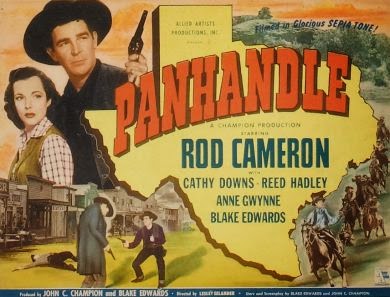
Panhandle was a rather typical example. It starred Rod Cameron. Cameron was 6’4” and rugged, and got bit parts in Hollywood from 1939 on. His very first Western role was as an uncredited cowhand in Paramount’s Lesley Selander-directed Zane Grey tale Heritage of the Desert and he was in the Cecil B DeMille farrago North West Mounted Police, in which he (sort of) fulfilled his boyhood ambition – he was Canadian born – by being a Mountie. He was Jesse James in Paramount’s non-Western but entertaining The Remarkable Andrew in 1942. His first Western lead was in The Old Texas Trail in 1944, not exactly an A-picture, and many oaters followed. He did a series of pretty awful Westerns for Universal with fellow Canadian Yvonne De Carlo (stuff like Salome Where She Danced and Frontier Gal). Panhandle was his nineteenth outing in the saddle and he was used to the gunbelt and Stetson by then. By and large I like Rod in Westerns; though not exactly charismatic, he was a good tough guy.
?
.
.
Like Rod’s first oater, and several others afterwards, Panhandle was directed by Lesley Selander (oddly billed on screen as ‘Leslie Selander’). Mr Selander was definitely one of the better low- and mid-budget Western directors, especially good at action scenes. In a Western career that lasted from 1925 to 1968 he made 184 big- and small-screen oaters, often with good Western stars and all well-constructed, fast-paced and fun. Respect.
The story is about famed gunfighter John Sands (Cameron) whose brother, the even faster Billy, has been killed. As is traditional with heroes as gunfighters, both wanted to hang up their irons and lead peaceful, respectable lives. Billy had in fact become a newspaper editor, and John is now a storekeeper. But we just know that Rod will be obliged to strap on those Colts again, to do a spot of avenging.
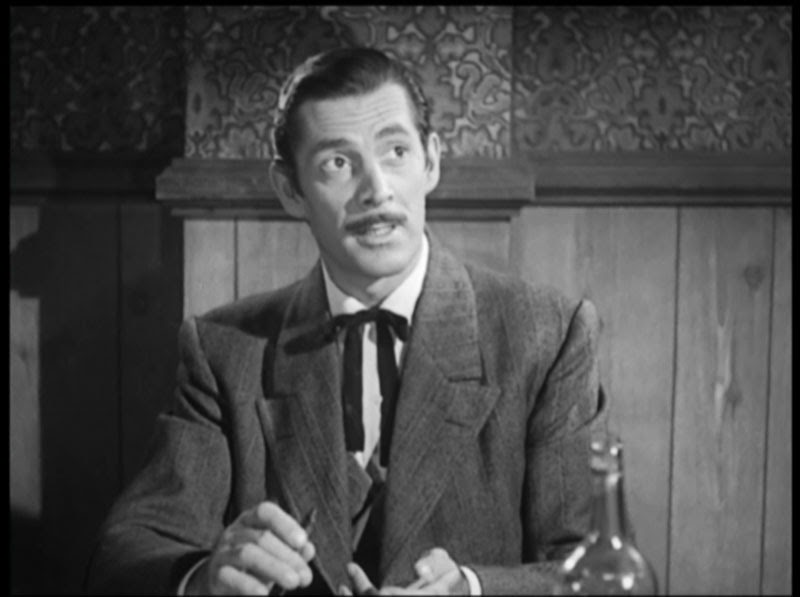
Evil Matt Garson (Reed Hadley) is the crooked town boss in Sentinel and he wants the whole Panhandle as his personal fiefdom. You can tell he is a bad guy because he wears a suit and has a caddish mustache. His boots are pretty damn fancy though. Obviously, for such overlords rarely do their own dirty work, he has ruthless henchmen. One of these is gunslinger Floyd Schofield (maybe named for his Smith & Wessons).
.
.
.
Schofield is played by Blake Edwards, the Breakfast at Tiffany’s and Pink Panther fellow, who was to have such a stellar career as director, producer, and Julie Andrews husband, and whose real name was the rather more colorful William
Blake Crump (he should have stuck with it). What’s more he co-wrote and co-produced Panhandle. Actually, Mr Crump understood the Western: he directed William Holden in Wild Rovers and James Garner as Wyatt Earp in Sunset, both endearing films. In Panhandle he certainly had fun as the gunman. There’s a character named Crump in it, too. Writers may allow themselves these little vanities.
Hadley is good as the mean town boss. Such Westerns were almost obliged to have such a figure. Often they were saloon owners (this one has The Last Frontier as his base of operations) and used sneaky derringers. They almost invariably had mustaches. Although many remember Reed from Racket Squad or Public Defender on TV, he did a lot of Westerns. He was Zorro in Republic’s serial and Red Ryder on the radio. Altogether he made 44 appearances in film and TV Westerns, from 1938 on, and you may remember him as Jesse James (like Rod) in the rather trashy Samuel Fuller-directed I Shot Jesse James (John Ireland was Bob Ford) or as a James again, this time Frank, in The Return of Jesse James in 1950. I thought he was good in the Lippert B-pictures Rimfire and Little Big Horn.
There are, of course, two dames for the hero to hover between, the spitfire rancher Dusty (Cathy Downs) and the glam but still feisty June (Anne Gwynne). It turns out that Dusty had been engaged to brother Billy before Reed heartlessly murdered him.
.
.
.
Well, there’s a good gunfight between Rod and the henchpersons in the rainy street, and then with Reed. And Rod goes off with the beautiful… Well, you’ll have to watch it and see.
Don’t get me wrong, this is far from a top-drawer Western. It’s only really late-40s black & white fodder for the horses. Furthermore, the print is pretty lousy these days. But it does have its touches and it would repay a watch, if you are, like most sensible people, a Western fan.
.
.
It was remade as The Texican by Audie Murphy in 1966, with Brod Crawford in the Reed Hadley part.
.
.


5 Responses
The two minute fight between Cameron and Jeff York gets a mention in the book ‘Classic Movie Fight Scenes’ which was co-ordinated by Dick Crockett and had Cameron doubled by Bob Morgan and York doubled by Terry Wilson. Morgan later lost a leg in a train accident while making ‘How the West was Won’ [1962] while Wilson got a break as an actor and played assistant wagon master Bill Hawks on ‘Wagon Train’ for eight years. Crockett later worked many times with Blake Edwards as stunt co-ordinator on the Pink Panther films.
Good to know!
Reed Hadley 1911 – 1974 is one of these prolific character actors, seen everywhere but hard to put a name on when you are not a pure specialist as he is so quickly in and out his films.
I long confused him with Anthony Dawson, the guy ending badly on Grace Kelly’s scissors in Alfred Hitchcock’s Dial M for Murder…
Born Reed Herring in Petrolia, just in the northeast of Wichita Falls, in northern Texas, raised in Buffalo, NY, he began his actor career on the New York stage in 1936 playing in Hamlet with John Gielgud, because the actor portraying Fortinbras was a no-show. Challenging to get a better start…
Thanks to his deep voice, he had quite a radio career and he was narrator of many films and documentaries.
At one time he held a Top Secret security clearance, due to his work in narrating nuclear weapon training films says IMDB.
You can hear his stentorian tones in countless films. He became a most familiar small screen face on TV in later years.
He played Zorro (some say he was the best silver screen Zorro ever…), Red Ryder (the first on radio), Wild Bill Hickok (in serial and in film), Frank AND Jesse James, Quantrill, even an Indian chief and a movie director……
Most of the time, he was cast as henchman, heavy or more refined villain, gambler or saloon owner-like with a vest and a thin moustache (or beard as Jesse James).
He truly excelled in nefarious individuals, especially in Noirs.
He came also on the right side of the law, but playing rarely sympathetic personnages.
His Sgt. Maj. Peter Grierson (sergeant demoted from major in the Civil War) in Little Big Horn is definitely one of his most remarkable performances.
Many of his films are listed in Jeff’s Index.
FILMS:
– The Great Adventures of Wild Bill Hickok (1938) Mack V. Wright and Sam Nelson – 15 episodes serial
– Zorro’s fighting legion (1939) William WWitney and John English – 12 episodes serial
– Man from Montreal (1940) Christy Cabanne
– Road Agent (1941) Charles Lamont
– Arizona Terrors (1942) George Sherman
– Buffalo Bill (1944) William A. Wellman (voice only)
– The Fabulous Texan (1947) Edward Ludwig
– The Man from Texas (1948) Leigh Jason
– Last of the Wild Horses (1948) Robert L. Lippert
– Panhandle (1948) Lesley Selander
– The Return of Wildfire (1948) Ray Nichols
– A Southern Yankee (1948) Edward Sedgwick and S. Sylvan Simon
– I Shot Jesse James (1949) Samuel Fuller
– Rimfire (1949) B.Reeves Eason
– Grand Canyon (1949) Paul Landres
– The Wyoming Bandit (1949) Philip Ford
– Red Desert (1949) Ford Beebe (voice only)
– Apache Chief (1949) Frank McDonald (voice only)
– The Baron of Arizona (1950) Samuel Fuller
– Dallas (1950) Stuart Heisler
– The Return of Jesse James (1950) Arthur David Hilton
– Riders of the Range (1950) Lesley Selander
– Little Big Horn (1951) Charles Marquis Warren
– The Half Breed (1952) Stuart Gilmore
– Kansas Pacific (1953) Ray Nazarro
– The Woman They Almost Lynched (1953) Allan Dwan
– Gunfight at Comanche Creek (1963) Frank Mc Donald (voice only)
TV :
* The Restless Gun
Episodes:
– The Outlander (1958)
– A Very Special Investigation (1959)
* Wagon Train
Episode: The Sacramento Story (1958) Richard Bartlett
* Bat Masterson
Episode: Dynamite Blows Two Ways (1958)
* The Texan
Episodes:
– The Sheriff of Boot Hill (1959)
– The Taming of Rio Nada (1960)
– Six Gun West (1960)
– The Terrified Town (1960)
* Rawhide
Episode: Incident in No Man’s Land (Jack Arnold)
* The Deputy
Episode: The Shackled Town (1961)
* Hondo
Episode: Hondo and The Death Dive (1967) William Witney
* Custer
Episode: The Raiders (1967) Norman Foster
Whether or not the film is a Western or not is open to debate, but I found it to be a rousing adventure in an “Indiana Jones” sort of way and very entertaining.
Which film !?