 The Western of Audrey Hepburn
No, e-pards, the heading of this post does not have a typo. Audrey Hepburn made but one picture in the noble genre: The Unforgiven. And Jeff Arnold has previously written an admiring post about the film. So why the revisit?
Mainly because The Unforgiven has an off-screen story not mentioned at all in the original post. Partially because that post, like some other articles and books discussing the movie, was dismissive of Miss Hepburn’s performance, which feels like short shrift in light of other events described below. And lastly because friend-of-the-blog Maddy at Classic Film and TV Corner is sponsoring an Audrey Hepburn blogathon.
The Unforgiven shares common ground with the subject of our previous post, Pat Garrett & Billy the Kid. And common ground in both the figurative and literal sense, as both pictures were filmed in Durango, Mexico.
Old friend Emilio Fernández worked on both. For this movie, he was the ‘supervisor of outdoor action’ and reportedly made an on-screen appearance as a marauding Kiowa (I could not find him). The Unforgiven was directed by John Huston; like Sam Peckinpah, he had a distinctive view and a taste for alcohol. Both films were troubled productions; artistic differences and accidents plagued Huston’s movie. And, finally, neither director was involved with his picture’s final cut.
Huston and the production company disagreed over the tone of The Unforgiven. The director was more interested in making a statement about racism; the producers were more interested in making big box office. The producers prevailed. Huston’s engagement flagged during production and he walked away from the film’s post-production.
The production company was that of star Burt Lancaster, Hecht-Hill-Lancaster Productions, with United Artists distributing the picture. The company had made multiple movies, including a sleeper, Marty, which won three Oscars. The Unforgiven was, however, the company’s last film. For this final offering, they made a big picture; its budget approached 6 million dollars.
Of that money, $300,000 was for director Huston, $300,000 was for top-billed actor Burt Lancaster, and $300,000 (or $200,000 according to at least one source) was for the second-billed actor, Miss Audrey Hepburn.
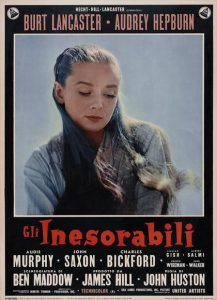 Some 67 years after the film began pre-production (and without access to production records), one can only speculate about the casting of Hepburn as Rachel Zachary, the adopted sister who is revealed to be a Kiowa. Certainly, Hepburn’s star was ascendant, with a surprise Best Actress Oscar for Roman Holiday followed by fine performances in Funny Face and Love in the Afternoon; as production began, her excellent work in the as-yet-unreleased The Nun’s Story probably was generating chatter around Hollywood.
Perhaps the producers saw her as the best fit to play an American Indian woman. More likely, she was signed for additional star power.
As a side note: the casting of white actors in make-up as Native Americans was a definite trope of Westerns into the 60’s. The appearance of such actors can be jarring – or worse – to 21st century viewers. (When screening a Western with family, Mrs. Bud usually asks if Rock Hudson is playing an Indian.) The topic warrants examination, perhaps in a future post, but is beyond the scope of this one.
At least Hepburn had dark eyes. This author has seen too many 50’s Westerns with blue-eyed Indians… including one played by Burt Lancaster. And her makeup was applied with a light hand.
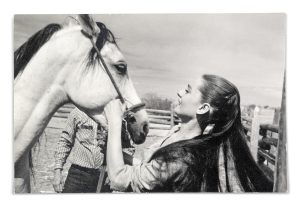
The actress was not an equestrienne. She had little experience with horses. She was, however, committed to her role and elected to ride without a stunt rider. Huston brought in a skilled teacher.
A complicating factor: Hepburn was in the early stages of a long-awaited pregnancy, as yet unannounced.
On 28 January 1959, several weeks into production, the actress was rehearsing for a scene which required her to ride a horse bareback. She rode the white stallion, named Diablo, around a corral for some time and rode well enough that Huston began filming.
Different accounts exist for the subsequent event.
According to Hepburn biographer Barry Paris, a crew member on horseback was told to ride towards the actress and instruct her to return slowly towards the camera. At the approach of the other horse, Diablo stopped abruptly and lowered his head.
According to Huston’s autobiography, “her horse bolted and some idiot tried to stop it by throwing up his arms…”
Whatever the actual circumstance, the result was the same.
Hepburn was thrown over the head of the horse.
The slender actress, who appeared frail at the best of times, landed hard, flat on her back.
Huston, Lancaster, and other horrified crew members ran to the prone Hepburn. Wranglers ran to settle the horses and keep them away from the crowd surrounding the actress.
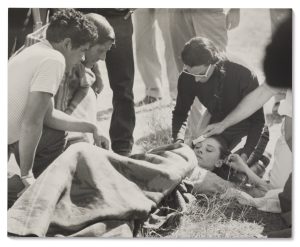 Immediately after the accident
Photo credit: Phil Stern
In excruciating pain, she was taken to a Durango hospital. In addition to a sprained foot and torn back muscles, the actress had four broken vertebrae.
Audrey Hepburn had suffered a broken back.
Fortunately for her, the breaks were clean. Although deeply painful, the injury did not result in paralysis or worse. And the fall seemingly did not impact her pregnancy.
In a neat twist, Marie Louise Habets, the inspiration for the character played by Hepburn in The Nun’s Story, came to Durango to tend to the actress. The ex-nun convinced her to return to Los Angeles to recuperate. She left Mexico on February 2. Production on The Unforgiven halted.
In the hospital, Hepburn kept pictures of her husband, stepchildren – and Diablo.
Said Habets, “She refused all narcotics and sedatives, and never once complained.”
She did, however, feel guilty for holding up the production.
On March 10, the actress was back on set. She did have to wear a back brace for the remainder of her scenes. Perhaps more daunting was that she did have to ride Diablo again. But Hepburn was determined to fulfill her obligation. No special treatment was requested or given. Her scenes on the stallion were completed without incident.
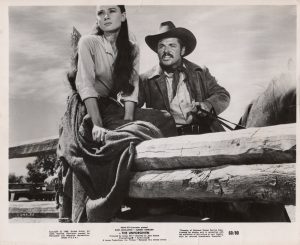
Huston’s ultimate withdrawal from the project, and overall disengagement, disappointed her.
But that disappointment was minor compared to her heartbreak after finally returning from Mexico. In July, Hepburn suffered a miscarriage.
She attributed the loss to the fall.
Given all that occurred, The Unforgiven understandably became a picture the actress preferred to forget.
As for her performance, some felt that she was miscast, including Jeff Arnold.
Co-star Lillian Gish and others thought her talent was not used to its potential.
A number of viewers could not see past the public persona of Audrey Hepburn to accept her characterization as Rachel Zachary. Biographer Paris has an exceptional line:
“Hepburn’s opening line of dialogue… requires her to say “ain’t” for the first time on screen – or probably in her life.”
On-screen, I feel the actress does as much as she can with a thinly-written part. Other shortcomings in the script also do her no favors, particularly a romantic angle in the last act which, despite small hints earlier in the film, feels forced and cringe-worthy in equal measure.
Early in the film, as a young woman in a strong and loving family unit, she brings trademark luminosity. Later, after the reveal and confirmation of her true ancestry, her confusion and anguish are palpable.
Descriptions of her portrayal as “posh” or the like strike me as projections from the performer rather than evaluations of the performance.
Audrey Hepburn’s experience off-screen, though, is the point of this particular post. And whatever one’s assessment of her performance or the movie, Miss Hepburn displayed true grit and exceptional toughness in weathering a harrowing production accident. And those are qualities associated with Western heroes and heroines.
Sources:
Huston, John – An Open Book
Madsen, Axel – John Huston
Paris, Barry – Audrey Hepburn
Spoto, Donald – Enchantment: The Life of Audrey Hepburn

12 Responses
Terrific piece, fellas.
While it is not a highpoint in her filmography, I’ve always admired Audrey for trying something new with this film.
Returning after the accident and insisting on carrying on without complaint/special treatment is typical of that sweet soul. She never wanted a fuss to be made; even during times when it really should have been.
Appreciate you joining in with the celebrations.
Maddy
To me it is a high point because it is unique and I would rank it among one of her best roles
Excellent review of Hepburn’s part in this flawed but fascinating film. She went through so much. Her tales of trying to survive in Nazi occupied Holland during WWII are harrowing. Apparently it was one of the reasons she wasn’t in ‘A Bridge Too Far’. About ‘The Unforgiven’ years later Huston was watching it on TV somewhere and expressed disappointment that he felt he had botched it up.
That Huston said The Unforgiven was the only of his films he actually disliked just proves that an artist is not always the best critique and judge of what he created…
Even if Huston wanted to make a film focused on racism and prejudice (Alan Le May, the author of the book, had also written The Searchers and both have a lot in common…) and Lancaster a box-office success actioneer, (Lancaster will do it again when he will fire Arthur Penn to pick up John Frankenheimer to direct WWII movie The Train in 1964), they both succeed in my opinion as Huston’s themes are intricately linked to the action Lancaster wanted to promote.
I agree.
I knew the story of her accident and miscarriage. There are documentaries about her such as the excellent Coan’s “Audrey” with many relatives interviews including Sean Hepburn Ferrer.
Personnally I have always thougt she was great in Unforgiven and Jeff was unfair to her.
I would go so far as to say that it is one of the greatest western female roles.
Making abstraction of the star is as challenging for the actor as it is for the spectator. Many are going to the movies to watch a star not an actor (“a John Wayne western” for ex) But Audrey Hepburn was a true actress like Marilyn Monroe was, or Marlene Dietrich or Joan Crawford.
Playing a young indian girl was indeed challenging. Debra Paget, Elsa Martinelli and others have played Indian women more or less successfully. At least Elizabeth Threatt was half Cherokee.
About white actors playing natives, Jeff says in his brilliant and indispensable Celluloid Indians 1 & 2, “the movies are (or were) made by whites for whites.”
It took a while before seeing some changes.
Excellent post. Great point about whites playing Indians. I believe Jeff also made the point that there wasn’t a ton of Native actors to turn to at midcentury. Wonderful Native actors like Wes Studi, Graham Greene, Adam Beach etc would be developed later.
I love reading and learning about difficult film productions and you brought us through it brilliantly with this informative article! I can’t imagine how scary that fall from the horse must have been. For Audrey and for the rest of the cast and crew that was there when it happened. This could have ended in something much more catastrophic.
I always thought this movie wasn’t half as bad as people made it out to be. It’s a solid western and it’s interesting to see Hepburn dip her toes in a genre so removed from her usual romcom and romantic drama comfort zone.
About playing Indians I have found back little note (about Godless) wherecI was saying:
Nowadays American Indians are more more played by American Indians… Or Canadians as in the case of Godless where beside of the Shoshone ghost, Alberta’ s Tantoo Cardinal is justly celebrated by Jeff. She was in Dance with wolves, Legend if the Fall (more a melodrama than a pure western) and more recently in Killers of the Flower Moon along with many other excellent “natives”.
Yes, she is an excellent actress. I believe she was in ‘Wind River’ also.
Yes, several Indian actors were cast in Wind River as it is the case in Taylor Sheridan productions