Well, we best get to it.
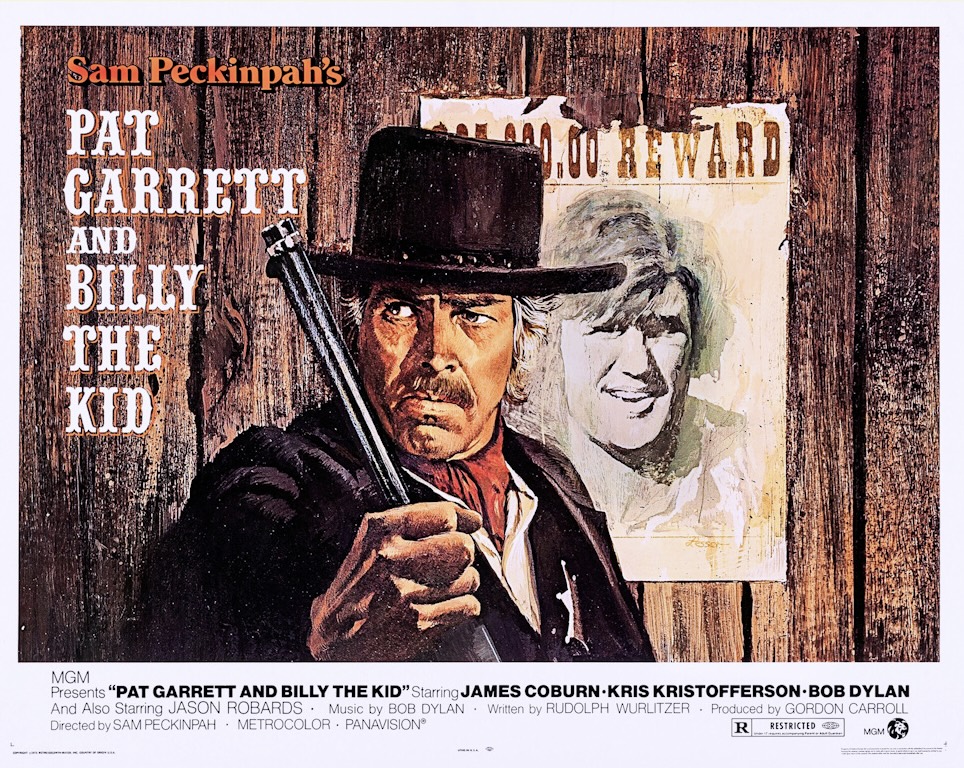
Pat Garrett & Billy the Kid was, arguably, Sam Peckinpah’s last Western. ‘Arguably’ because Bring Me the Head of Alfredo Garcia does have its adherents as a Western due to events taking place in Mexico and in spite of its mid-70s setting. For the purposes of the Sam Peckinpah centenary, however, Garrett is the end of the trail. And a rather tidy ending it is, because PG&BtK ties the threads of various motifs, themes, and activities which occurred throughout the director’s Westerns: elegies to the West as a bastion of freedom and honor; questions of friendship and manhood; sudden, brutal violence; fake deaths for actors, actual deaths for animals; alcohol abuse on set; lack of say in the released version of the movie; and, ultimately, a confusing multiplicity within the filmography.
Although Junior Bonner is now recognized as a low-key artistic triumph for star Steve McQueen and director Sam Peckinpah, the film was not a commercial success. ‘King of Cool’ McQueen was in a box-office slump and his production company took on an adaptation of The Getaway, a typically tough novel by hard-boiled pulpster Jim Thompson. Peter Bogdanovich was originally signed to direct. But as Bogdanovich also took on a Streisand star turn, What’s Up, Doc, and as Warner Brothers wanted to begin that picture immediately, McQueen’s production company parted ways with the director. He and Peckinpah apparently got along well enough on Bonner, so Sam received the directorial assignment.
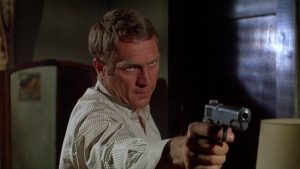
The Getaway was a sleek action machine and broke McQueen’s slump. (As a side note, it too could be deemed a Western by applying the same criteria as for Alfredo Garcia.) Its box office was a rather astonishing 36 million dollars.
In fickle Hollywood, fat ticket receipts raised profiles. Sam’s jumped once again. He had his choice of projects. But, after his attempts with Hogue and Bonner to break free from ‘Bloody Sam’, fickle Hollywood also finally and decisively labeled him an action director.
Success did not agree with Peckinpah. He was at his best striving towards, not standing at, the apex of his profession. Not having something to prove brought out the worst in the director; for Garrett, his prodigious alcohol abuse increased his volatility and decreased his time on-set. Said James Coburn, “He was a genius for about four hours, and then it was all downhill.” Amazingly, given the Major Dundee experience, Peckinpah’s last Western was his most fraught.
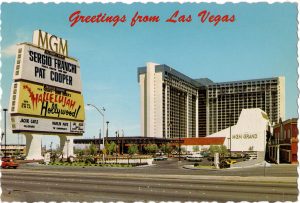
The movie’s studio, Metro-Goldwyn-Mayer, added kindling to the bonfire. Long gone were its days as the ‘Tiffany’ or ‘Rolls-Royce’ of studios. The popularity of musicals had long since wained and the studio raided its catalog for hugely expensive remakes in the late 50s/early 60s. Now cost-cutting and corporate interference were its norm.
Like many iconic American businesses and brand names, MGM had been acquired. Unlike other studios, it was not assimilated into a wholly unsuitable conglomerate; its owner, investor Kirk Kerkorian maintained MGM as its own independent entity, but wanted to leverage the good will associated with its name, and the iconic roaring lion, with a Las Vegas hotel and casino. Well after PG&BtK was released, Kekorian would issue a statement that “MGM was primarily a hotel company”. During the production of Garrett, however, the company’s focus was on the massive MGM Grand hotel under construction in Las Vegas. Corporate assets were diverted to its substantial cost.
For previous friction-filled productions, Peckinpah had squabbled with producers Marty Ransohoff and Jerry Bresler. For his last Western, he expanded his reach. In addition to the now customary on-set skirmishes with the producer, Gordon Carroll for this film, the director waged long-distance war with none other than the head of the studio, James T. Aubrey.
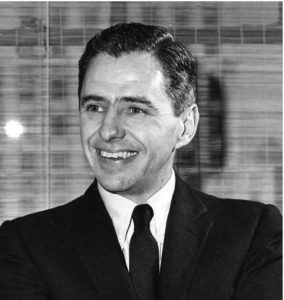 The Smiling Cobra
Like fellow antagonist Ransohoff, Aubrey had a Beverly Hillbillies connection: he was the head of CBS when that show and other mass appeal series like Gilligan’s Island dominated airwaves and rating totals. Aubrey was known for attention to detail, reading scripts and involving himself with production minutia. But the personality of ‘The Smiling Cobra’ could grate, and certain habits and practices were questionable; ultimately, he grated CBS honcho William Paley once too often. Paley fired Aubrey with no explanation.
After some time as an independent producer, Aubrey was hired by Kerkorian to run MGM.
Kerkorian had no interest in MGM assets which did not fit into his vision, and Aubrey acted quickly to dispose of those assets to whomsoever would pay for them. The studio’s heritage was sold in chunks large and small.
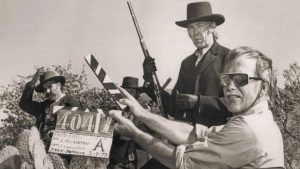
Producer Carroll was responsible for the idea of yet another cinematic version of Billy the Kid’s legend. To write the script, Carroll enlisted Rudy Wurlitzer, whose work on Two Lane Blacktop was well-regarded. (Incidently, Wurlitzer plays the bearded gang member when Billy is captured at Stinking Springs.) MGM agreed to take on the project if a high-profile director was attached to it. And, at that point in time, Sam Peckinpah’s profile was high indeed.
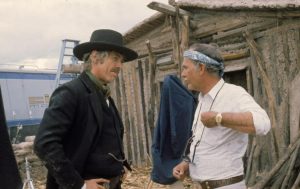
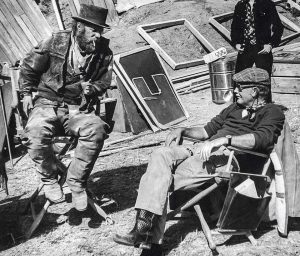 Wurlitzer (in costume) and Peckinpah on set
Aubrey wanted a crowd-pleasing, action-packed Western that would fill theaters and the studio’s coffers alike. With this goal in mind, the choice of Wurlitzer’s script was puzzling, even before Sam irritated Wurlitzer with his multiple revisions and erratic on-set behavior. And Aubrey’s agreement on Peckinpah as director is even more puzzling. Despite his reputation for detail, the executive was either dazzled by The Getaway’s box office take or watched that movie and very little else in the director’s CV. The difference in his vision of Garrett and that of his director became quickly apparent.
Prior to the shoot, the PG&BtK team built a multi-layered cast of Peckinpah favorites and stock company members, character actors familiar to Westernistas, and several ringers.
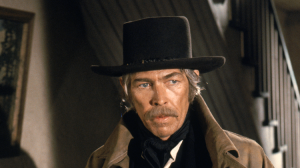
In spite of his grueling Major Dundee experience, James Coburn returned to play Pat Garrett.
Jason Robards signed for his third tour and received fourth billing, even though his role is basically a cameo.
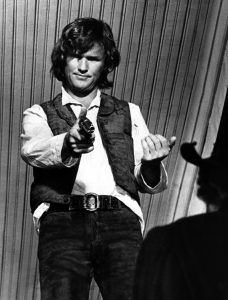
One of the ringers was Rhodes scholar and US Army veteran Kris Kristofferson. Today, Kristofferson is known for a long career as songwriter, recording artist, and actor; when cast, several of his songs had become hits for other artists and he had appeared in two films, but his acting career was very much in its early stages.
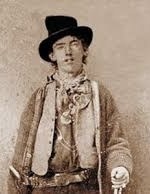
The tall, uncharacteristically clean-shaven Kristofferson bore no resemblance to the actual Billy the Kid. But his work must have pleased Peckinpah; the protean performer appeared in two more of the director’s pictures.
The second ringer? Another musician, none other than Bob Dylan.
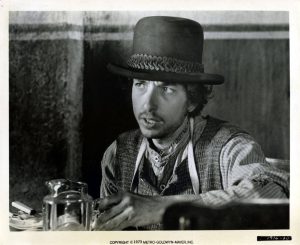 Wurlitzer was responsible for Dylan’s participation. The musician apparently had a strong interest in Billy the Kid, heard about Wurlitzer’s script, and visited the screenwriter in New York City to express his interest in writing music for the project.
But multiple stories exist about Dylan appearing on-screen. One is that when Dylan approached Wurlitzer, he also wanted to act in the picture; another is that Peckinpah, oblivious to Dylan’s cachet, cast him after hearing his music. Later, Peckinpah would claim that MGM pressured him into using Dylan.
The remaining cast is chock-full of familiar faces. Besides Coburn and Robards, other Peckinpah alumni included R.G. Armstrong, John Davis Chandler, Emilio Fernández, L.Q. Jones, Slim Pickens, Dub Taylor, and Chill Wills. Other roles were filled with oater actors galore: Elisha Cook Jr, Paul Fix, Richard Jaeckel, Katy Jurado, Harry Dean Stanton, Barry Sullivan, and a substantial role for Jack Elam, who lasts more than a reel.
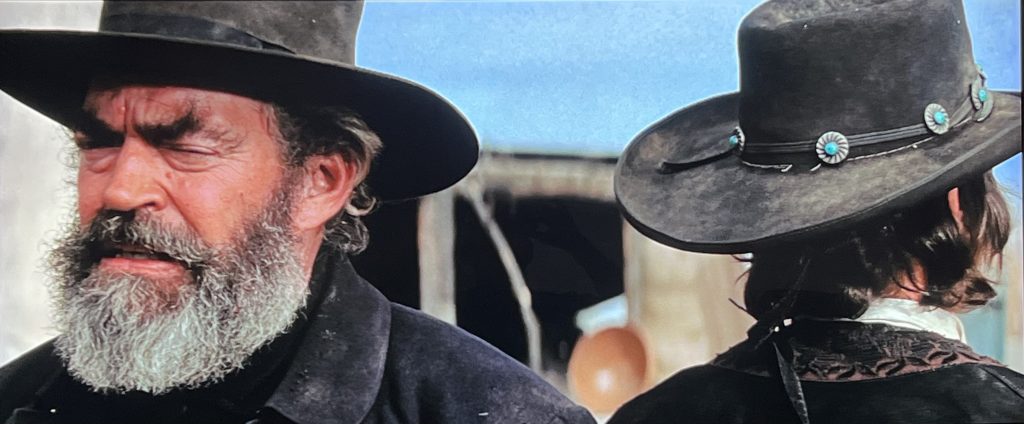 Oh joy, Jack Elam!
Filming was slated to begin at Durango, Mexico on November 13, 1972. But warning signs occurred earlier.
The studio set the film’s budget at 3 million and shooting schedule at 50 days. Peckinpah was happy with neither; after a pre-production battle, the shooting schedule was extended… by three days. The suits also balked at the expense for Sam’s preferred team members. Another struggle ensued before MGM allowed Peckinpah to use a crew with whom he was comfortable.
As production was moving to Mexico, MGM refused to send a camera technician to the location, despite the desert’s blowing dust. Perhaps predictably, a camera had a minor mechanical issue and early shots were slightly out-of-focus. In spite of Aubrey’s appalling directive to use the footage as is, the crew reshot impacted scenes at off-times.
Later, Peckinpah received telegrams from Aubrey demanding fewer camera set-ups and reshoots.
And then there was Sam.
As mentioned in Jeff’s post, the director needed booze to start work in the morning, and consumed it steadily until, by mid-afternoon, he could no longer function. He maintained his fondness for carrying and discharging loaded firearms (Kristofferson claimed later to have taken a pistol from Peckinpah); he also threw knives. Both habits perhaps made his frequent dismissals of hapless crew members even more alarming. Convinced of ill intent towards his picture, he had telephone calls recorded.
Other problems beyond control of the studio or director also occurred.
Torrential storms paused filming for multiple days and the rain was bracketed by intense heat. Influenza laid out both cast and crew; Coburn filmed at least one scene while ill and had no recollection of doing it.
Both events scrubbed precious production days and cost the studio considerably.
The weather, the sickness, the harsh conditions, and Peckinpah’s paranoia and volatility: all made for a toxic environment on-set.
Off-set, Peckinpah purposely and purposefully took decisions and actions specifically to add cost to the production. And, not coincidently, enrage James T. Aubrey.
Petty victories at the expense of the studio chief perhaps amused or gratified the director while on location. But they were not forgotten after filming wrapped and the production team returned to California.
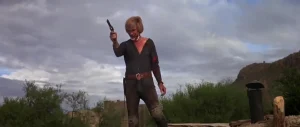
Us old boys oughtn’t be doing this to each other.
The studio’s first move was setting the film’s release date. Sam and the team returned to the studio in February, 1973; MGM mandated that Garrett hit theatres over the Memorial Day weekend. The company needed cash and the Las Vegas hotel was again the culprit.
With less than three months to prepare the movie and its nearly 70 miles of film, six editors were assigned to the project, working nonstop. Peckinpah participated, but less than needed, due to limited focus from constant drinking. Still, a cut was delivered to the studio in mid-March.
Aubrey and the brass thought the delivered movie was a first cut, with additional editing to occur. Peckinpah deemed it near final.
Contractually, Sam was guaranteed two preview screenings of his preferred cut(s). He received those screenings (and the second became particularly important). As for the release cut, however, Aubrey had a different plan.
The studio’s head of production was David Melnick, who ironically enough had revived Peckinpah’s career with Noon Wine. His hope was the director would agree to additional edits in response to reactions from the test audience. But, for whatever reason, the director elected not to attend the first screening. And, when pressed for edits to the screened movie, agreed to cut twelve seconds.
Melnick then authorized a clandestine effort to recut the film to suit the suits’ wishes.
But Sam learned of the skullduggery. After the second, and slightly recut, test screening, he notified his team, who proceeded to launch an audacious and illegal plan.
They stole the reels for Peckinpah’s cut from the screening room.
And, finding that they had missed the movie’s soundtrack, proceeded to steal it later.
Unlike Major Dundee, despite the mad post-production rush and Sam’s decreased capacity, a Garrett cut approved by the director was available for posterity… once MGM was no longer in a position to repossess it. Amazing.
Equally amazing, however, was the extent of Aubrey’s emnity.
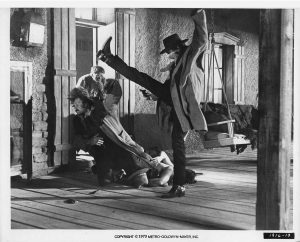
Editor and Peckinpah mainstay Bob Wolfe was invited to a screening of Pat Garrett & Billy the Kid. After the 96-minute version concluded, Aubrey gave him an ultimatum: bring in others on Sam’s team, cooperate on excising 20 minutes from Sam’s preview version, or the studio would release ‘their’ cut as is.
Wolfe and fellow editor Roger Spottiswoode cooperated.
Yet more tussles ensued, the editors versus the studio, with arguments and negotiations ranging from whole sequences to a few feet of film. For this battle, however, Peckinpah was not a participant. Indeed, even though his two colleagues attempted to implement his vision to the extent they could, he had nothing more to do with them.
And then – finally – after a tortuously epic production, Pat Garrett & Billy the Kid was released.
None of the principals in the brawl around Garrett got what they wanted. Not MGM, since the film was widely released in July, rather than Memorial Day weekend, and was not the substantial hit the studio wanted and needed; not Sam, obviously; and not Aubrey, who lost his job when, in October 1973, MGM called a halt to theatrical distribution.
Upon its release, critical reviews were mixed; Jeff’s post summarizes reviews from prominent film critics. Among them, Roger Ebert specifically took note of the six credited editors and connected dots as to the movie’s tumultuous gestation. More importantly, audiences were unimpressed, although Pat Garrett & Billy the Kid ultimately turned a small profit.
Over time, and given the multiple cuts and quantity of footage, different versions of the movie have appeared.
Garrett’s scene with his wife appeared for the first time when the picture was shown on American network television. It was reportedly added so the film filled its time slot after considerable editing to remove profanity and nudity.
In 1988, after the acquisition of MGM’s library by cable television pioneer Ted Turner, the first preview version was televised on one of the mogul’s multiple cable outlets. It became known as the ‘Turner cut’.
In 2005, a DVD was released which included a different cut assembled by Peckinpah authority Paul Seydor.
Finally, Criterion has released a new 50th anniversary cut, assembled by Roger Spottiswoode and Seydor, which builds upon the 2005 effort. The package also includes the rescued/pilfered second preview and the original theatrical release.
None of these versions can be considered definitive. The preview cuts are probably closest, but who knows what Peckinpah would have done, if he and Aubrey had butted heads less and MGM had allowed him more time?
All of which makes Pat Garrett & Billy the Kid a rich source of discourse – opinionated, occasionally combative, engrossing – amongst those intrigued by Sam Peckinpah and his work.
Jeff’s Take
[Pat Garrett and Billy the Kid] was probably, despite certain shortcomings, the best Billy the Kid movie we have had.
The film is melancholy yet unsentimental, elegiac yet not nostalgic, and it is slow and gentle without being plodding.
This and The Wild Bunch were Peckinpah’s greatest achievements… It’s a magnificent, moody, monumental piece – I think.
RR’s Take
As it happens, this was the very first film I ever commented on on this site, back when Jeff was still with us, having then just re-watched it (I’ve seen it several times). This is what I said then, in my reply to his main post on the movie (I have added comments in square brackets below, to clarify my meaning):
“I would love this film, despite or in part because of its flaws, were it not for the chickens scene at the beginning. This [the scene] isn’t just a comment about cruelty [i.e. the film and the filmmakers aren’t just making an artistic statement about the darkness of man etc], it’s actual cruelty by the filmmakers [i.e. it’s not just the characters being cruel within the storyline of the film, it’s Sam and his crew being needlessly cruel in real life, on the set; check out online the recollections from crew members of how the scene was prepared and filmed – knowing these only makes viewing it all the worse]. Peckinpah had already done this with ‘lower’ animals… but in this case it’s particularly spectacularly unpleasant. The rest of the movie is wonderfully melancholic and graceful.”
I think that about says it all, really, and I’m not sure what else to add. I still think the film has an ineffable melancholy and grace to it, once we get past that opening cruelty, it contains numerous of the best scenes in all Peckinpah’s work and I am sympathetic to those who consider it his masterpiece. Certainly I’d take it over The Wild Bunch, any day.
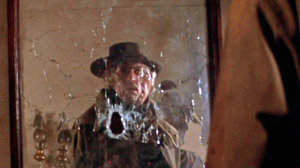
The above account of the production process, with its underlying misunderstandings between studio and director, provides some clue as to why the film, to some, feels overly episodic. Sam’s advancing alcoholism was surely a factor, too, that perhaps both detracted from and added to the movie’s power, depending on your point of view on it: he only being capable of managing the storyline in fits and starts and yet still imbuing across all of them an overpowering sadness, holding everything together – if not as a perfect narrative then as a wonderful mood piece, more poem than prose. As is often the way with alcohol the sadness at times spills into bitterness and even tortured self-disgust, as in Coburn’s shots at himself in the mirror (a Sam motif), and in Sam’s own accusatory (self-accusatory?) cameo. Thanks in part to Coburn’s greater experience and depth as an actor, compared to Kristofferson, Pat is more interesting than Billy, the latter doomed to an early death but the former condemned to a long life… Deep stuff, e-pards…
The recent-ish Blu-Ray is not available to Region 2 Players so my more recent viewings are based on the DVD of circa 20 years ago – which is a pretty good package, all told. I’d agree with most that the Turner 1988 cut wins on points although it’s interesting to flit between versions. I also agree with Bud and others that Slim Pickens’ death scene (great without Dylan singing, outstanding with Dylan singing) is one of the most moving few minutes ever committed to celluloid anytime anywhere – and there are so many other ‘magic moments’ studdded across the running time. The whole film is incredibly moving, for me, despite its obvious imperfections. Just a shame about those poor chickens…
Bud’s Take
Garrett is a picture that I had not seen prior to our work on this piece for the Peckinpah centenary. (I had attempted to watch it at some point prior but stopped the show because of my repulsion at exploding poultry.) Shortsightedly, my viewing started with the picture’s most recent version, the 50th anniversary cut on Criterion; in retrospect, starting with the film as released and moving through the subsequent versions would have provided better insight around which one worked best. Alas.
But the above situation illustrates one of the challenges in attempting an overview of Peckinpah’s last Western. So many versions. So much offscreen turmoil.
Some sources have described Garrett as a series of vignettes with little narrative thread. I don’t agree but – again – the screened version matters. As do one’s expectations. A viewer expecting a rip-roaring shoot ‘em up will be disappointed. The picture has lots of shooting, little ripping or roaring.
Producer Carroll’s quote about the film summarizes it best: “It’s a movie about a man that doesn’t want to run, pursued by a man who doesn’t want to catch him.”
Some moments don’t work.
Billy is a victim of the Santa Fe Ring’s machinations, but he also is an unrepentant killer; the character’s actions before or after do not warrant the crucifixion imagery early in the film. The fascination of Lincoln’s children with the gallows built for Billy is much less impactful compared to previous children in previous Peckinpah pictures actively playing with real and imaginary instruments of death.
A few scenes don’t work, either.
The murder of Paco by Chisum’s men plays like a strained attempt at ‘motivation’, which in fact it was. The scene was a late addition to the original script. And, although the picture’s veritable parade of veteran Western character actors is one of its pleasures, the restored scene with Elijah Cook Jr and Dub Taylor adds little to the main narrative. My delight at seeing Dub was tempered by John Beck tearing at the fringe of hair on his noggin like a frontier Moe Howard, the scene serving only to reinforce Deputy Poe as unlikeable as the two title characters.
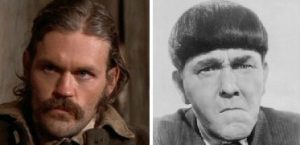 Poe? Or Moe?
But PG&BtK has many more scenes and moments which do work, and work well.
Of special note among the parade of Western and Peckinpah veterans are RG Armstrong and Katy Jurado.
Armstrong completes his Peckinpah trifecta. For the third time with Sam, the actor plays a character who is religious to the point of fanaticism; of the three, Bob Ollinger is his best work (and the previous two were really good). The character’s mixture of piety and violence is chilling.
Jurado has little dialogue but brings a strong presence. Playing a tough woman in tough times, her physicality steals every scene in which she appears… except the last one. And even then, her final close-up clinches the impact of the moment.
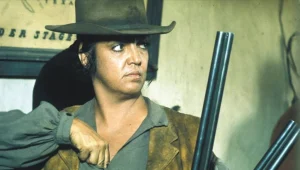
To me, Kristofferson’s singing after his jailbreak is the high point of his performance (in the original script, by the way, not added after the singer/songwriter was cast). I don’t think Billy is terribly interesting, but I also don’t think the part as written provides much opportunity for Kristofferson to make him interesting. He is self-indulgent, through violence if necessary, and seemingly has no sense of consequence or morality. The character is dangerous when someone stands in his way but, with his perpetual half smile, he doesn’t ooze danger. In fact, Coburn’s Garrett feels more dangerous.
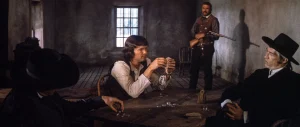
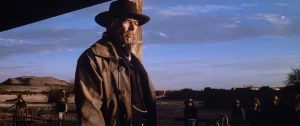
James Coburn gives a magnificent performance. His tightly-coiled Garrett exudes purpose and menace, his cigar punctuating dialogue, and never more so than in the barroom scene with the unfortunately-dressed and comically-profane Chill Wills and Dylan…
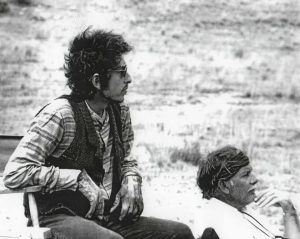
…whose performance is another area with a broad range of opinions. In the audio commentary for the 50th anniversary version, one speaker notes that Dylan’s body language works well for his character, even when his line readings do not. A shrewd observation, and I agree after rewatching several of his scenes. To me, Bob’s least stiff dialogue was reading the labels of ‘airtight’ vegetables.
Dylan also provided the picture’s music. The incidental music is mostly guitar but the sound is occasionally expanded with other instruments including banjo (while Billy and Alias chase turkeys; is this RR’s favorite scene?) and a rather disconcerting flute. Songs featuring Dylan’s distinctively nasal voice also color the proceedings.
As with all things Garrett, opinions differ here as well. I don’t find his instrumental music particularly memorable, but the songs are generally in keeping with on-screen events. And one, the epochal Knockin’ on Heaven’s Door, memorably, heartbreakingly supports one of the finest sequences in the Western genre, or any genre: the death of Sheriff Baker, played by Slim Pickens.
In the category of ‘Best Death in a Sam Peckinpah Film’, my vote would go to Joel McCrea’s in Ride the High Country (probably no surprise to frequent readers). It closes the film and closes an era. But Pickens’ scene ranks a very near second with a different, but no less emotional, impact. In just a few minutes of screen time, Baker is mortally wounded and painfully moves to the bank of the nearby river, on which he had dreamed of drifting in a boat made with his own hands. His wife collapses near him, Jurado’s expressive eyes brimming with tears.
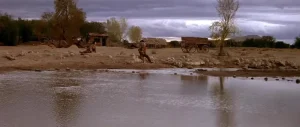 Shattering.
Similar to ‘the walk’ in Wild Bunch, the sequence came together on-set. In the script, Baker’s death receives a perfunctory mention. In the film, Baker’s death is a shattering moment demonstrating the power of cinema.
And, despite Sam’s wishes, I prefer the full vocal version of Dylan’s classic during this moment.
Like Junior Bonner, Peckinpah’s previous Western, PG&BtK is a ruminative character study of a title character, Pat Garrett. But the two characters are markedly different; Pat’s character is a dark mirror image of Junior’s. His darkness colors Pat Garrett & Billy the Kid.
The tone of the earlier film affirms the life and choices of its title character as Junior (and Ace) pursue small and perhaps preposterous dreams; the tone of Garrett does anything but as he pursues and ultimately kills Billy the Kid.
In an intersection of art and life, characters in Pat Garrett & Billy the Kid end their story in a similar fashion as the participants in the drama surrounding it. No one gets what they wanted.
Peckinpah’s final Western is neither an entry-level nor feel-good movie but it is an awfully good one. At the right time, in the right mood, with the right version (for me, the 50th anniversary cut), Pat Garrett & Billy the Kid is well worth the time spent.
Sources:
Mikulec, Sven: “Sam Peckinpah’s ‘Pat Garrett and Billy the Kid’ finally got the respect it deserved”, Cinephilia & Beyond; this article includes a PDF of the script
Seydor, Paul: Peckinpah, the Western Films
Weddle, David: “ If They Move… Kill ‘Em!”
‘Sam Peckinpah’ on Facebook As mentioned previously, this Facebook page is an excellent source of information and images on Peckinpah and his films, actors, and associates; several images in this post are gratefully sourced from the page.

14 Responses
THIS IS GREATNESS. THIS IS GREATNESS. THIS IS GREATNESS. THIS IS GREATNESS.
“Us old boys oughtn’t be doin’ this to each other.”
So says Black Harris (L.Q. Jones) to his old buddy turned adversary Pat Garrett (Coburn), as he rolls across the rooftop–with “Knockin’ on Heaven’s Door” starting to play.
Later in the film, we hear “Knockin’ on Heaven’s Door” again, as Old Man Alamosa Bill (Jack Elam), who agreed to count to 10, has tried (and failed) to pull a fast one on Billy the Kid (Kristofferson).
“That wasn’t 10, Hoss,” Billy says as he kneels over his falled opponent.
“I never could count,” Alamosa Bill says.
Then Alamosa Bill, in his final words, delivers yet another great line: “At least I’ll be remembered.”
With the red-haired family watching, Billy gets on his horse and rides off, as “Knockin’ on Heaven’s Door” continues to play.
“Pat Garrett and Billy the Kid” (1973, my #7 Western, and my #24 movie of all time, all genres) is THE BOMB ! ! ! ! Bleak, brutal, yet nostalgic with loads of poetry shining through.
And I’m the first to admit it’s a chopped-up movie with plenty of flaws. For me, it’s the beauty that emanates out of all the patchwork that makes the film great.
Yes, it’s a bleak film with no heroes. I actually like Billy the Kid–I think Kristofferson is excellent playing Billy, with the perpetual half-smile and friendly personality. I agree, though, he’s a cold-blooded killer who will shoot anybody who stands in his way.
Deputy Bell says, “You wouldn’t shoot me in the back, Billy.” And I’m shouting, “YES, HE WOULD ! ! ! !”
Coburn plays his part well, but Garrrett is utterly detestable. I don’t like him at all. His inglorious exit at the end of the film is fitting. It definitely isn’t The Man in Black (Lee Van Cleef) riding off into the sunset–in my favorite Western, Sergio Leone’s “For a Few Dollars More” (1965, my #2 movie of all time, all genres).
I have a lot more to say, but I can’t right now. Thanks, Bud and RR, for the review.
And if you’re a fan of Westerns, and you haven’t seen “Pat Garrett and Billy the Kid” (5 STARS out of 5), then please do.
I consider the 2024 Criterion Version the best, with the 2005 Special Edition being a close second. And if the Original Theatrical Release is the only version you have access to, then go ahead with that. It’s worth it.
I can’t promise you’ll like “Pat Garrett and Billy the Kid,” but it’s ABSOLUTELY worth watching ! ! ! !
“ELEGIAC.” Jeff uses a better word than I just did, in the above post. Not so much nostalgic. Yes, elegiac. “Pat Garrett and Billy the Kid” is one of the most mournful movies I’ve ever seen–yet it’s LOADED with poetry and beauty ! ! !
I’m going to have to go back and read Thomas Gray’s “Elegy Written in a Country Churchyard” (1751)–a mournful poem, yet filled with a beauty of its own.
Excellent review. You did justice to one of my favorite movies of all time. My favorite cut is the 1988 Turner just wish it had that scene of Garrett getting his doors blown off by this wife. Love the scene with the raft, Chill Wills, and the awesome nature of Slim Pickens with Katy Jurado accompanied by Dylan’s superb soundtrack. Oh and RG Armstrong with Billy!
Yes. As you know, I don’t like The Wild Bunch much. Even though the two films have similar themes the atmosphere couldn’t be more different. WB blazes in the Summer heat, whereas PG&BTK has a more meditative pace and is nothing if not Autumnal…
Yes, there’s an “Autumn” vibe to “Pat Garrett and Billy the Kid.” Well said.
Excellently put. That is hammered home not just by the deaths in the film but also in the dialogue about characters we never even meet and hear about their various demises.
Chris, hopefully my affection for Chill Wills is reflected in my ‘take’. After such a long career, what a fantastic part for him!
I know! Love his part, that whole crazy scene. Dylan reading off the labels. Genius stuff.
I meant to also add the cheating duel, Peckinpah’s cameo, and the spooky end at Pete Maxwell’s place as more memorable moments.
Coincidence, French (Lyon born) author Éric Vuillard has published in January 2026 his new novel, Les Orphelins : une histoire de Billy the Kid (The Orphans : a Billy the Kid story) Actes Sud editions.
After his Tristesse de la terre : Une histoire de Buffalo Bill Cody (Sorrow of the Earth: Buffalo Bill, Sitting Bull and the tragedy of show business, Pushkin Press, August 2016), Vuillard is keeping on looking for history more or less hidden behind the myths, pointing out the travesties of history, looking at its backstage, unveiling its grey areas, the “official” history having been told by the victors and not the vanquished.
Bud, I have a question. Did you think Peckinpah and Kristofferson meant to glorify Billy in that early “crucifixion” scene? That’s what it sounds like you’re saying, but I could be wrong.
I take that as a comedy scene. I don’t think that was meant to glorify Billy at all. We’ve got that raucous music playing, with Dylan perpetually singing “La la la la la la,” and the background “singers” whooping and shouting, with Billy the Kid (Kristofferson) stretching his arms out, and smirking at his buddy turned adversary, Pat Garrett.
I think that’s a CLASSIC moment of comedy ! ! ! !
Let me know if you disagree, or if I’m misinterpreting your comment.
I do feel that Peckinpah purposely directed to Kristofferson to exit the Stinking Springs cabin with his arms outstretched as an evocation of the crucifixion. I also expect that others have a different opinion.
A tragedy does not exclude moments of comedy. To me it is a deliberate provocation of Billy (and of Peckinpah). Billy pretends to be Jesus for the fun of it. But it is announcing that Billy is going to die, being sacrified by and for the powerful wealthy people.
Maybe Peckinpah knew that Billy had met the
Missionary Sisters of the Sacred Heart in New Mexico…
Not directly connected to the crucifixion scene, here is an interesting text on how Bob Dylan was involved in the film, wrote his music and recorded songs for it, his Alias role with Kristofferson, Wurlitzer, Peckinpah, Jerry Fielding, and Dylan’s comments
https://www.stevepaulkc.com/pirate-radio-notes-on-dylan/2023/8/26/put-my-guns-in-the-ground-bob-dylan-billy-the-kid-and-hollywoods-western-delirium