
The great British director Alfred Hitchock was a ubiquitous presence in United States pop culture from the mid-50’s into the 60’s. He was most famous, of course, for his movies. He was prolific during this period and worked with Hollywood’s top leading men and women: Cary Grant, Doris Day, Grace Kelly, and James Stewart, among others.
Films buffs can, and do, argue over the number of films from this period which can be deemed as ‘classic’. While such arguments are ultimately subjective, their existence attests to the quality of the movies.
But his presence extended beyond the cinema. In the middle of the decade, as discussed below, he moved into the new-ish medium of television. In 1956, Alfred Hitchcock’s Mystery Magazine appeared at newsstands and bookstores; although strictly a licensing arrangement, the magazine is still published seventy years later. And later, he was featured as a character in a series of books*.

Alfred Hitchcock Presents debuted in 1955, the same year in which the apparently inexhaustible director released two films, To Catch a Thief and The Trouble with Harry. His company produced the series and, delightfully, Hitchcock introduced and closed each episode. These segments fixed a persona for the filmmaker in the public’s consciousness: lightly macabre and often described as “droll”.
Like so many other shows in 50s television, Alfred Hitchcock Presents was an anthology. Each 30-minute episode was self-contained. The series had no continuity in plot or characters (although some actors appeared in multiple episodes), nor any limitation as far as location or time period. As a result, several episodes featured Western settings, including the one covered by this post.
The connecting threads within the series were narrative devices familiar from the director’s past work. The plots often involved criminal activity, suspense, and/or a twist. Although imprinted with his sensibility, only a handful of episodes were actually directed by Hitchcock. Still, the show and its 60-minute successor ran for 10 years.
Triggers in Leash was the third episode aired in the series’ first season.

Hitch’s introductory segment features the director incongruously handling a six-shooter and noting the episode includes no horses because they couldn’t remember their lines. The episode proper begins with a shot of a window pelted by rain, panning past a shelf with a crucifix and a large cuckoo clock, and settling on a lady at a stove.
The lady is Maggie, played by Ellen Corby. She owns a crossroads stop where saddle tramps and other travelers can rest and eat. Only one person is with her now, though, and that person is Ben, who does odd jobs around the place.
Ben definitely has a comic sidekick look about him; when he starts talking about Maggie’s hotcakes, his position as the piece’s comic relief becomes a certainty.

Casey MacGregor was cast as Ben. IMDB lists a sizable number of appearances for the Glasgow-born actor, but he was uncredited in most of them. He definitely channels Gabby Hayes in his line delivery.
Ben exits to fetch more firewood, but another character immediately enters: Delaney, or Del, played by the future star of Bat Masterson, Gene Barry. He wants to know if Maggie is alone; he’ll remove his rain gear, but not his gun belt.

In fact, he draws on the hapless Ben when the latter returns with the firewood.
The no-nonsense Maggie makes Del assist in picking up the dropped wood, and Ben prepares to leave for town on yet another errand.
Del asks the older man to stay mum about his presence. Maggie tries to ascertain the reason for Del’s jumpiness. But Del isn’t talking.
Ah, but then the door is thrown open and the reason is revealed. A fourth character, Red, bursts into the room. And, joy of joys, he is played by Darren McGavin, with blood in his eyes and an Irish lilt in his speech.
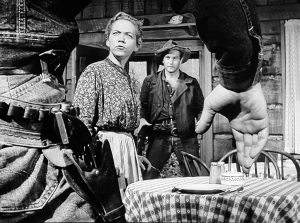
Both men immediately face off, hands at the ready to draw their irons.
Maggie attempts to play peacemaker. She stays between the two men while Red goads Del: calling him yellow, then accusing him of running away and hiding behind a female’s skirts.
 “You’re a dirty, lying coward.”
Maggie learns that Del won a considerable sum from Red at poker; Red was drunk and became incensed when Del decided to quit the game. The two men differ in their account of events, but agree the night ended with violence: Dell hit Red, maybe with a whiskey bottle, maybe with his fist.
Despite Maggie’s efforts to convince them of the absurdity of a gunfight over a card game, neither man will concede. Incensed, she heads to the stove to bang pans. While cooking ham, she coyly mentions that BOTH men could die, since the first to draw will hang… because she will be a witness.
She begins to fry some eggs. The two antagonists begin to ponder the import of her words.
Red smells the food and decides to sit; maybe that will goad Del into drawing his weapon! But Del chooses to sit with him, both men keeping their gun hand at the ready.
Maggie brings plates of ham and eggs to the table.
 “I could’ve sent you to Boot Hill before your hand even touched leather.”
With food in front of them, the men decide to place both hands on the table. Ham needs to be cut, however, and cutting requires two hands; Maggie obligingly cuts the meat for them. With eyes locked, they pick at the food and pick at each other, specifically their quickness on the draw.
We then learn that Maggie’s late husband was a gunfighter with “seven notches on his gun.” The mention of her husband upsets Maggie; she “couldn’t make Charlie listen” – how can she reach these two?
Red has an idea. The men will stand but neither will draw until the cuckoo bird makes an appearance from the clock; that appearance is only minutes away. The two men, now standing, turn to watch the clock.
Maggie moves towards the shelf on which the clock rests. Del threatens to shoot Red should she stop the clock but Maggie just grabs the crucifix, a gift from her husband, “in case of a stray bullet”.
And then all three parties notice that clock has stopped, its minute hand tantalizingly close to the top of the hour. The cuckoo bird will not make an appearance.
Maggie dramatically indicates “the hand of God” has intervened to stop the violence.
Awestruck, Del and Red stare at the clock. Red carefully mentions that he is turning away; both men decide to put aside their differences and return to town. Peacefully.
Although, in his epilogue, Hitchcock wryly notes that both died later that day. Of food poisoning. From Maggie’s cooking.
True to form, e-pards, this plot has a twist. But this post will not spoil it for you.
All in all, Triggers in Leash is a highly entertaining 25+ minutes of viewing, skillfully combining Western tropes such as saloon squabbles, speed on the draw, and showdowns with the Hitchcockian milieu of ratcheting tension. During their confrontation, Del and Red talk about drawing weapons but, contrary to the normal sequence of events in a Western, never do.
The cast wrings every bit of tension from the situation. The three main characters are all played by familiar faces with long and illustrious careers.
 ”I get ‘em comin’, and I get ‘em runnin’.“
Ellen Corby earned an Academy Award nominee for That’s My Momma in 1948. She was, however, probably best known for playing Grandma in The Waltons, a long-running American series from the ‘70s. The indefatigable Corby suffered a stroke late in life but continued to perform.
For Westernistas, Gene Barry is probably best known for his role in Samuel Fuller’s polarizing Forty Guns as well as the afore-mentioned Bat Masterson. But the actor starred in other American television shows, such as Burke’s Law and The Name of the Game, and made frequent guest appearances in others.
For this writer, Darren McGavin was and is a hero for his work as intrepid reporter Carl Kolchak in two atmospheric movies-for-television, The Night Stalker and The Night Strangler, and the follow-up series Kolchak: The Night Stalker. But I also enjoy his performance in a late Audie oater, Bullet for a Badman.

Many more people know McGavin from his role as the ‘Old Man’ in A Christmas Story. In 1955, when Triggers in Leash was produced, McGavin could not have known that he was destined for holiday immortality, his image and gravelly voice a constant fixture on screens throughout December.
So, e-pards, even though Alfred Hitchcock never directed a Western (nor did he direct the Western episodes of his show), Jeff Arnold’s West can happily (if belatedly) participate in the 4th Annual Master of Suspense Blogathon hosted by friend-of-the-blog Maddy. Please click this link to access other posts in the blogathon!
* A Slightly Indulgent Epilogue
I saw no Alfred Hitchcock movies as a young person. Although I dimly recall print ads for Family Plot, his final picture, my parents did not indulge in his films over the air or, later, on videocassette. And neither Alfred Hitchcock Presents nor the Alfred Hitchcock Hour were syndicated with stations near me.
In fact, as a young teen, my ONLY exposure to Alfred Hitchcock was a book series aimed at what is now called the ‘YA -Young Adult’ market: Alfred Hitchcock and the Three Investigators. The premise, you see, is three teenagers in California who become adept at solving mysteries. So adept, in fact, they become improbable protégés of Alfred Hitchcock. The director ostensibly provided an introduction at the beginning of a story and discussed the latest case with the young sleuths at its end.
It was all licensed hogwash, of course, and the introductions were no more written by Hitchcock than by me. But after devouring the Encyclopedia Brown and Hardy Boys series, the Three Investigators were my next stop before tackling Christy or Sayers.
My recollection is that the books were written well enough. And if one accepted the premise that three meddling kids were friendly with a famous (and busy) movie director, then one could also accept that the Investigators were based out of a mobile home nestled into a garbage dump. And that the lead Investigator’s first name was Jupiter and he was a child actor under the stage name of ‘Baby Fatso’.
Anyway, the series was changed after Hitch passed away in 1980: in the mid-80’s, the name ‘Alfred Hitchcock’ was scrubbed from the books. Some sources indicate the publisher made the change to avoid dating the series; others indicate lack of agreement on a new license. In either event, available copies with Alfred Hitchcock as a character exist only in libraries and with used booksellers.
A shame. The fictional version of Hitchcock sparked my curiosity about the real director, curiosity which later led to exploration of his oeuvre. I was probably not the only young reader who followed this path.


15 Responses
Along with Hitchcock’s anthology series The Twilight Zone had at least one if not more “Western” episodes each season. They varied in tone and quality – some quite good and well-acted others, especially the ones played for laughs, not quite so satisfying. I recall one with Lee Marvin as the star being rather good and another where a phony Western Hollywood actor somehow ends up in the “real” West as another one worth watching. As a kid I was never a fan of Hitch’s anthology series when the syndicated reruns seemed to be on at odd times but with most of the episodes all over free streaming services I’ve watched a few and found them very entertaining. I’ll have to look for this one for sure.
There are at least 2 other Alfred Hitchcock Presents episodes related to the genre.
– Outlaw in Town (Season 6, Episode 7, 1960): directed by Herschel Daugherty, it stars Ricardo Montalban as the smooth-talking, charming Texas outlaw Tony Lorca aka the Whistling Kid, who rides into a snowy western town in the middle of a blizzard. and turns the local people upside down because of the reward on his head. With Constance Ford.
– Escape to Sonoita (Season 5, Episode 37, 1960), directed by Stuart Rosenberg can be considered as a modern western even if it is a tense desert-noir thriller. A young Burt Reynolds is involved in a kidnapping across an arid desert. Also with Murray Hamilton, Harry Dean Stanton.
Great stuff, fellas. It’s a fun episode. Ellen Corby absolutely steals every moment.
I have long wondered what a Western film directed by Hitch would have been like. Probably something similar to Anthony Mann’s psychological Westerns. I wish he had tried his hand at it.
Thanks so much for helping me celebrate Hitch.
Maddy
A Hitchcock Western? Like Mann, but much sleeker. I can’t imagine much pitiless landscape or dust and grit (even 50s dust and grit) in a Hitchcock movie.
This one was a really fun watch! Ellen Corby is so good in this. Thanks for surfacing this one.
And while Darren McGavin will always be the Night Stalker, it’s worth noting that he spent 1959-1961 in the NBC (mid)western series, Riverboat (“wagon train on Water”), starring alongside first a baby Burt Reynolds (a famously fractious relationship) and then Noah Beery, Jr, and featuring a huge number of famous guest stars. For fans of the Maverick era of television, it’s definitely worth a watch.
This is great. Glad you found a way to give Hitchcock an entry on the site.
(And I loved those Three Investigators books.)
Along with Sir Alfred, who are the classic greatest Hollywood directors who never ever make any western ?!
Nicknamed “Billie” by his mother (his brother was “Willie”…) who had been captivated by Buffalo Bill’s Wild West Show when traveling as a young girl to New York City, Billy Wilder, as a young boy loved the genre having read the Karl May’s novels and Billy the Kid and Buffalo Bill stories,
Berlin, in the mid 1920s had a New World atmosphere filled up by a wave of “Amerikanismus”, a bottomless love of dancing charleston, cocktail bars, race cars, nightlife and jazz that glimmered in a sea of neon and films.
It was in this climate that Wilder as a young journalist was able to fully embrace his love of pop culture and, most specifically, his admiration for American movies.
He even served as a tour guide for Hollywood director Allan Dwan, who was in Germany for his honeymoon.
But when in Hollywood, he never directed a western saying he was “afraid of horses”.
He did not like to film outdoor anyway.
With his mentor Ernst Lubitsch, an other foreigner, they are two of the greatest directors ever, though.
Josef Von Sternberg never made a western but he was involved in Duel in the Sun, upon Selznick’s request. His primary task was to style and light Jennifer Jones (Selznick’s wife), ensuring she looked exquisitely striking on camera.
He also directed à few scenes for about a week when King Vidor fell ill.
When later asked by Peter Bogdanovich about what he did on the movie, von Sternberg sardonically replied, “I directed one week in King Vidor’s style and then I hung around.”…
From one Von to an other, Erich Von Stroheim never directed or played in a western. He would have been indeed excellent in the role of the german consultant south of the border…
Mitchell Leisen, also known for sophisticated comedies, directed Behold My Wife! (1934), a dramatic film featuring western elements where a grieving man travels west and marries an Apache woman (Sylvia Sidney!) to spite his snobbish family.
Even Preston Sturges shot The Beautiful Blonde of Bashful Bend (see Jeff’s Index).
Leo McCarey made 2 (or 3). Cukor and Mankiewicz 1 (that Jeff hates…)
In Jeff’s treatment of Westward the Women, we learn that “he idea was that of Frank Capra and it would have been interesting to see what he himself would have made of it as director, especially as he intended to cast Gary Cooper in the lead. But in the event Columbia wouldn’t play and he sold the project to Wellman, who would make a superb job of it. The genius director of It’s a Wonderful Life tragically never made a Western.”
Capra loved the West having wandered the Western US hopping freight trains…
What he said himself:
“I always wanted to make a Western. I finally wrote a Western that I thought would make a hell of a story. It was called Westward The Women, about the women coming into the West and what their effect was. But I worked at a studio that didn’t have any horses. So I sold the story to William Wellman. He made it at MGM. It’s been a regret to me that I’ve never been able to make a Western. A man riding a horse across a prairie is poetry in motion.”
Capra’s original story was called “Pioneer Women.”
Orson Welles, who was a great admirer of John Ford, watched endlessly Stagecoach, calling the film a masterclass.
He also said (in a Merv Griffin’s show):
“Clint Eastwood is the most underrated director in the world today. I’m not talking about him as a star. The Hollywood establishment don’t take him seriously, the same way they don’t take beautiful girls seriously.
An actor like Eastwood is such a pure type, a mythic hero star in the John Wayne tradition. Nobody’s going to take him seriously as a director. But someone ought to say it. And when I saw that picture (The Outlaw Josey Wales) for the 4th time, I realized that it belongs with the great Westerns. The great Westerns of Ford and Hawks and people like that.”
He ended by saying “I take off my hat to him.”
Unfortunately, Welles passed away long before he could see more Eastwood’s films and getting an Oscar for Unforgiven.
Not of the same generation, still one of the greatest film director, Stanley Kubrick could have filmed One-Eyed Jacks but after having worked on the project called by Marlon Brando for 6 months decided to leave for Spartacus, called by Kirk Douglas who had fired Anthony Mann. Even if we may have a large tolerance on what defines a western, it might be challenging to consider Spartacus as one…
Capra, Hitchcock, Kubrick, Lubitsch, Von Sternberg (and Stroheim), Welles, Wilder… Does someone think of any other famous American director of the (so called) Golden Age who never made a western!?
The night helping, I suddenly think of Vicente Minelli…! His closest venture to western is Home from the Hill (1960), a melodrama set in Texas (shot in Oxford, Mississippi, and Paris, Texas, long before Wim Wenders thought of his own movie), his cast is very western with Robert Mitchum, George Peppard playing is son. George Hamilton was there, with Eleanor Parker, Constance Ford, Luanna Patten, Anbe Seymour, all with an interesting western pedigree, and not forgetting Ray Teal.
An other melodrama specialist and great Hollywood director (and immigrant as a Dane born in Hamburg), Douglas Sirk, made two: Taza, Son of Cochise (See Jeff’s article) and Take Me to Town. A comedy western starring Ann Sheridan and… Sterling Hayden, “hardly a Western at all”, according to Jeff in his article.
Stanley Donen, an other great one, and very fond of the genre, did make Seven Brides For Seven Brothers (1954).
In spite of its sacred number, Jeff did not even mention him in his (fun and very critical m – he did not like musicals) article where he said “it is cheesy dross”
Obsessed by this essential question, I was still thinking of a major Hollywood director not having made any western and was almost sure to have found an other one with Lewis Milestone but Jeff has included The Red Pony (1949) in his encyclopedia, although he says:
“Jeff Arnold’s West is not really the place to review The Red Pony at all because a Western it ain’t, but still, it does have Robert Mitchum in a cowboy hat, it’s set on a ranch in California in some unspecified ‘olden times’, horses figure large, obviously, and well, why not?”
It would not be the first psychological drama to be considered as a Western anyway and lany westerns are -also- psychological drama.
With Mervyn Le Roy, I was very confident to have found an other one.
But the famous and such prolific and versatile director has directed Strange Lady in Town (1955).
Curiously it does not have the honor of appearing in this blog.
It is set in New Mexico (Nick Adams is appears as Billy the Kid and Ralf Moody as Lew Wallace in a subplot, not sure Jeff was aware of that when he wrote his huge BTK compilation) where Greer Garson is a doctor arriving in town, whose lethods are challenging the local established and more conservative doctor Dana Andrews.
His brother is a Cavalry lieutenant, Cameron Mitchell and his tomboy daughter is played by a young Loïs Smith. Add Pedro Gonzalez Gonzalez and you have many ingredients for a proto-feminist Western seeming again closer to psychology than pure action.
Unfortunately both Dana Andrews and Cameron Mitchell articles have disappeared from the blog.
Great list! I have joked before that in my ideal world, every filmmaker would be entitled to some public funding for their projects but in return they would be required to make a Western and a musical at some point in their careers. We would get some very fun and strange entries.
I want to remark on how important television was to mid-century pop culture. Hitchcock was known to my contemporaries (b.1956) only from TV. Older siblings might report back, secondhand, from one of his movie shockers. (“The birds pecked his eyes out!”)
TV curated classic Hollywood (including Hitch) for a new generation. I’ve chosen the wrong word, there, because they projected the movies irrespective of quality, just frazzled managers feeding content into the maw of the beast. And you watched because it was on, and at least it wasn’t a soap opera. But this was good training. When a real classic aired, dumb kids picked up on the quality and honed their taste. I feel as though YouTube is depriving moderns of their meal because everything is dessert.
As for Hitchcock, never much liked the director. I thought he was sloppy. He’d shoot a chase in which sometimes he’d cut shots of the chased going one direction and the pursuers the other. That’s a collision. And he’d milk suspense from a guy trying to reach something just beyond reach with shots of his desperate, emoting face—and then he’d just reach a little farther. Screw you, Hitch, so it was never really a problem. His TV bits, though, were way funnier than any dramatic show’s except “Dragnet” playing straight.
I would never have expected in my life to read that Hitchcock was … sloppy.
He was a control freak, planning everything in every detail, pre-production being the key of his films with an extensive use of the storyboard, each shot had been thought in advance etc.
He was not good at everything indeed. For instance, directing the actors was not his strongest point.
Some of his last films are maybe weaker and not at the level of his classic masterpieces but I would be curious to know which examples you are thinking of…
It is quite simply that you do not like his style and his way to make cinema.
Hey! Hi, there! (I was feared I might be moseyin’ through a ghost town.)
The pursuit that resembles a collision was in “Secret Agent”. Reaching for keys down a grate happened in “Strangers on a Train”. You’ll be pleased that the third example I usually throw at Hitch got yanked as I typed. I counted it sloppy that Norman Bates could hear his mother scolding from the mansion clear down to the motel. It only just occured to me we aren’t hearing his mother, but his psychosis. (I also forgive, now, the jump-cut close-up to the pecked eyes in “The Birds”. I counted it a rip-off from James Whale introducing the “Frankenstein” monster, but allow it was a legitimate reference.)
Hitchcock described actors as cattle—and the performances he drew reflect that. I also objected to how setbound his productions were. (Likewise, I couldn’t abide the scattered-trees-and-rock set ever recurring in “The Lone Ranger” and “Bonanza” compared to the rugged outdoors of Gene Autry’s Flying A studio. Bringing things back to our Western focus!) The rear projection driving scenes were particularly egregious, but probably state-of-the-art.
I’m not a qualified student of Hitchcock. I only caught “To Catch a Thief” and “North By Northwest” in their entireties this past year. (And in reasonably full theaters. A must!) So, yes, he’s a formidable director and inventor of the spy flick—but long after “Secret Agent”.
North by Northwest, one of it top greatest films in my opinion, includes one of the most famous “errors”: when Eva Marie Saint kills Cary Grant in Mount Rushmore cafeteria, a kid in the background who does not look even at them, is seen plugging his ears with his fingers – before – the shot…
I remember that Peter Lorre in Secret Agent has lost his hat but has recovered it when he arrives upstairs…
In spite of such mistakes, Hitchcock’s films are very efficient.
2 of his best “British” films, The 39 Steps and The Lady Vanishes do have errors as well, Rear Window too.
I guess there is no film without any mistake of that kind whoever is the director.
Stanley Kubrick, also very famous for his quasi pathological extreme attention to detail, cannot help his films to contain goofs. The most blatant is his face’s reflection on an astronaut’s helmet visor…
High Noon (back to western) does have several mistakes, as well as Rio Bravo, Stagecoach or Unforgiven, just to take 4 of the most famous westerns of all times.
Hey, maybe Kubrick’s reflection was his cameo, a la Hitch! We need to go through all his films frame by frame. I’ll take “Eyes Wide Shut”.