Western Songbirds?
Perhaps confusingly, this series of posts do not discuss Vermilion Flycatchers, Curved-Bill Thrashers, or other birds merrily tweeting in the pine trees or cacti scattered across the American West.
 Not the topic
photo credit 1
The topic is a long-time (and ongoing) cross-pollination within American popular culture: performers with successful music careers who go before the camera to make films; and, actors with successful film careers who go behind the microphone to make recordings.
The number of artists who did both is vast. Because this is Jeff Arnold’s West, the performers are narrowed to those who had a substantial role in at least one Western. And who, for reasons discussed below, cut an entire long-play album during the 50’s and early 60’s.
Further, it surveys female artists. The noble genre has a long (and somewhat curious) history of singing cowboys, but not so many singing cowgirls.
Some of these women sing in their Western films. To be clear, none of them sing Western songs on vinyl. The Western side of Country & Western was trending downwards during the 50’s. The songs on their albums are predominantly standards of the American songbook.
The 1950’s are highlighted in this post (and throughout this blog) because of the large number of Westerns produced for theatrical release: more than in any decade before or since. Coincidently, the decade was also a unique time for fans of recorded music. Rapid advances were made in the capture and playback of sound.
Prior to the late 40’s, recordings were constrained by physical limits of the discs on which sound was captured. This constraint naturally impacted the playback of the recorded sound: the mass market medium for playing recordings at home was a slab of shellac which spun at 78 revolutions per minute. A standard 10-inch record stored 3-4 minutes of music, while a costlier 12-inch stored up to 10 minutes.

Long-form works such as classical symphonies required multiple records. These works, as well as collections centered on a single artist or theme, were sold in a package with the records’ sleeves sandwiched between a front and back cover: a record ‘album’. The use of album as a colloquialism for packaged recordings persists to this day.
The adoption of magnetic tape in the late 40’s expanded the quantity of sound which could be captured: entire movements of long-form works could be recorded rather than 10-minute segments.
This innovation spurred the invention of the long-playing unbreakable record, the ‘LP’. With an LP, a listener could play more music, up to 20-25 minutes, without having to flip or change the record.
In addition, the hardware for playing records became more sophisticated and affordable. Middle-class families could purchase high-fidelity systems, the ‘hi-fi’, to spin those long-playing records with their 12-inch jackets.

Due to the above factors, LPs were generally marketed to adults: classical, original cast recording of Broadway shows, well-known vocalists singing the classic American songbook, and such. Recordings of new-ish pop, blues, R&B, country, and the incipient rock ‘n’ roll were generally consigned to singles for play on radio and jukeboxes.
That dynamic changed, of course, in the early-to-mid 60’s. LPs by rock acts previously collated singles; roughly coincidental with the British Invasion, focus changed to albums and releasing individual tracks from an album as singles.
But rock’s transformation of the music industry is beyond the scope of this survey.
First on the spindle: a trio of redheads, all with records released in 1957.
Maureen O’Hara
O’Hara had a long film career, was a favorite of John Wayne, and was featured in many Westerns. But in the 50’s, she decided to try her hand at singing. To that end, she worked with a vocal coach and then recorded Love Letters from Maureen O’Hara.
 photo credit 2
The art department of mighty RCA Victor created a mighty appealing jacket. The record within, however, is less appealing. Bob Thompson wrote decent arrangements and O’Hara certainly hits the notes. But her voice is heavy and her vocals seem mannered, more suited for art songs than American popular songs. Jeff Arnold previously dismissed her singing over the credits of The Deadly Companions (“She warbles… in her second-class operetta voice…”) The actress deserves more credit than given by Jeff, but this record is a lesser offering.
O’Hara did cut an album of Irish songs later. She presumably was more comfortable with that genre, but I’ve yet to hear the recording.
Rhonda Fleming
One of Fleming’s earliest roles was in Abilene Town with Randolph Scott. Her best-known Western performance is in The Gunfight at the OK Corral, but she was a Western mainstay throughout the 50’s. Although first an actor, she did sing as well: one of her first major roles was in A Connecticut Yankee in King Arthur’s Court, in which she sang both solo and in a duet with no less than Bing Crosby. In the late 50’s, she developed a nightclub act and appeared in Las Vegas and Palm Springs.
Curiously, she only recorded one solo album, for Columbia.

The jacket art befits the ‘Queen of Technicolor’, highlighting her red hair and green eyes to striking effect. It is classy pop, combining then-current songs with those from the great American songbook, and performed over arrangements by the estimable Frank Comstock.
His contribution warrants a brief discussion of the importance of the musical backings on a vocal album. When performed on stage or screen, songs are an aural and visual experience; the backing music, and the arrangement of that music, can be less prominent. On record, a purely aural experience, the music should support song and singer but the arrangement of the music can and should enrich one’s listening using dynamics, tone colors from solo or combined instruments, interaction within the orchestra or backing band, and so forth.
Nelson Riddle was the pinnacle of the arranger’s art, followed closely by Billy May and Gordon Jenkins (all three, not so coincidently, had long associations with Frank Sinatra). Frank Comstock was not quite at the level of these musicians, but he was good, and his arrangements on this record are consistently interesting.
Fleming has a wide vibrato in places, and certain words and phrases give her trouble (I’m surprised a retake wasn’t called after her somewhat awkward handling of the final lyric in Baby, Baby All the Time); but her extroverted vocals are solid overall. And huge props to Fleming and Comstock for the chutzpah to include an up-tempo version of I’ve Got You Under My Skin: Sinatra and Riddle cut the definitive version a year before.
A worthy effort. The lack of a follow-up is surprising.
Tina Louise
Unlike O’Hara and Fleming, Tina Louise studied singing (as well as acting) before her break in movies. She also cut her one-and-only vocal album early in her career. At the time, she had several television and theater credits; the largest was fifth billing in Li’l Abner, a moderately successful Broadway musical. This record was released well before her roles in two Westerns, Day of the Outlaw (a JAW favorite) and The Hangman.
It was initially issued by Concert Hall records, a smaller company which was mostly known for releasing classical and opera recordings by lesser-known orchestras, often German, and occasionally sourced from radio broadcasts. But they did dabble in recording pop and jazz.
 photo credit 3
But the recording was somehow acquired by Urania Records, another small outfit. Urania issued the record twice, in ‘58 and ‘59, with the same cover image except for its name and logo.
Surprisingly, one of the Urania releases is in stereo! Stereo recording was uncommon when Louise was originally in the studio; it was probably even more rare for smaller companies which presumably had budget constraints.
Even more surprising are Louise’s accompanists on the date. Jim Timmens is named as the arranger, but the orchestra includes four jazz musicians of note: Hilton Jefferson on alto sax, Buddy Weed on piano, Tyree Glenn on trombone, and Coleman Hawkins on tenor sax.
 Coleman Hawkins, 1960
photo credit 4
Jefferson, Weed, and Glenn were all distinguished musicians with lengthy careers. Hawkins, however, was a titan of improvised music; his facility with the instrument is credited with bringing the tenor saxophone to jazz prominence. He also adapted to the times, subtly updating his playing as the music evolved from swing to bebop, but always maintaining his burly tone.
Booking Hawk and his jazz cohorts as her backing band seems like quite a coup for the young singer/actress. But Hawkins was very prolific in the studio at this stage of his career and did accompany several other, albeit more established, vocalists on recordings. All four musicians have the opportunity to play obbligatos and solos over the course of the album, adding to the slow-burning sultriness of Louise’s interpretations.
But that’s not all! Even before Time for Tina hit the stores, Concert Hall released another record featuring young Miss Louise. But she doesn’t sing a note.
 photo credit 5
While Louise (obviously) appears on the jacket, and penned a portion of the liner notes, the actual music is a collection of classical “music she herself enjoys most in her most romantic moods…. arranged in the shimmering style that brings new excitement to old Favorites of Continent.”
Well then.
Having not heard the recording, I cannot comment on its ‘Portrait in Hi-Fi’.
Leaving aside Miss Louise’s continued cachet in American pop culture, the combination of singer, accompanists, and music makes Time for Tina an engaging late night or date night listen.
Jane Russell
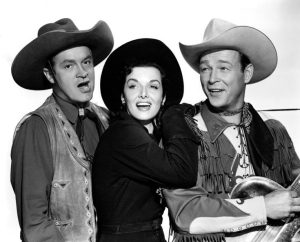
Russell first achieved notoriety through one of Jeff Arnold’s bête noire films, The Outlaw. But, her filmography includes other, and considerably better, Westerns. Like Fleming in Alias Jesse James, she made a Western comedy, The Paleface, with Bob Hope; the picture was successful enough to warrant a follow-up, Son of Paleface. But the connection to Hope would not be the only link between the two actresses.
In spite of Howard Hughes’ crass attempts to focus all attention on her bosom, and Jeff’s general disdain, Russell had talent well beyond her measurements: she was a decent enough actress with a wry comic touch. And she could sing! Russell had a strong voice and interpretive talent. In the late 40’s, Columbia released a 4-record album of 78’s; in 1958, MGM Records released her only solo LP.
 photo credit 2
Interestingly, she also performed and recorded in a gospel quartet. All these years later, the influence and popularity of gospel quartets in the US is difficult to imagine. The Blackwood Brothers, for example, filled auditoriums, sold piles of records, and greatly impressed a young Elvis Presley.
In Jane Russell’s quartet, Beryl Davis and Connie Haines (who sang with the Harry James and Tommy Dorsey bands) were the mainstays. Della Russell completed the quartet in the early 50’s.
This version of the quartet cut sides which were released on a Coral EP.
D. Russell then left, but J. Russell, Haines, and Davis remained and recorded as a trio for Capitol.

Later, the group again became a quartet with the addition of… Rhonda Fleming. The reconstituted quartet recorded additional tracks for Coral.
Ultimately, all of the quartet recordings were collated onto one LP using the ‘The Four Girls’ as the group’s name.
 Fleming, Russell, Haines, Davis
photo credit 6
Despite being a discographical mishmash, with some songs featuring Della Russell, others featuring Fleming, this album is a polished, enjoyable, and toe-tapping listen. Some buyers, however, possibly experienced some level of remorse; at barely 19 minutes, Make a Joyful Noise is an LP in name only.
Dinah Shore
Shore began her long career as a singer, one of the few of the era without a strong tie to the big bands. She had multiple pop hits for RCA and Columbia in the 40’s and 50’s, pleasant, innocuous, and highlighting the singer’s natural warmth.
On-screen, Dinah was more of a television personality than movie star; she only appeared on the big screen a few times. But, critically, one of her appearances was in a Randolph Scott picture, Belle of the Yukon (one of the few Scott movies which Jeff Arnold did not enjoy). That role, plus her marriage to oater icon George Montgomery, earns her a place in this post.
Early albums were of the bundled 78 variety. But as the market for LPs expanded, so did Shore’s catalog: albums from Columbia were collections of singles, while RCA’s offerings alternated between collated singles and tracks recorded specifically for LP. All are pleasant enough.
Then Shore signed with Capitol, the pinnacle of pop music for adults in the 50’s and early 60’s. She proceeded to record four LPs, each in a different musical style, which are easily the best of her career and deserve to be better known.
 photo credit 2
Wasting no time, Capitol paired Shore with crack arranger Riddle and a conventional strings ‘n’ swing orchestra; Dinah, Yes Indeed was released in 1959. In a wink to Dinah’s earlier efforts, Riddle includes a backing chorus on several songs. Even though such choruses usually stop swing in its tracks, Riddle and Shore keep the music moving. Another sly touch is the inclusion of Sentimental Journey, which is, of course, Doris Day’s signature song.
One track is a medley of four songs; Yes Indeed! interpolates another. Shore negotiates the lyrical twists and turns with aplomb.
On some songs, Dinah stretches her voice to its absolute limit. Throughout the record, she plays with the beat. Overall, the singer seems to have a fine old time.
 photo credit 2
For her second Capitol release of 1959, Somebody Loves Me, Shore teamed with André Previn. The young German was something of a prodigy in the 50’s, writing music for film soundtracks and recording both jazz and classical chamber albums. Later, he became a prolific orchestral conductor in concert halls and on LPs. (With five marriages and ten children, he was prolific in other ways as well.) Previn wrote plush string and woodwind orchestrations to support a collection of classy songs, including another medley.
Shore’s honeyed voice nestles into the arrangements; she sings beautifully. The title song, the last track on the album and also the best, anticipates the singer’s subsequent encounter with Previn, as the lush strings are cut by his moody late night piano.
 photo credit 2
Shore next collaborated with bandleader Red Norvo on Dinah Sings Some Blues with Red, also released in 1960. The goateed musician was born in Beardstown, Illinois, a river town known as much for its watermelon and cantaloupe as Norvo; he was another jazz artist who gracefully made the transition from swing to bop. Besides playing marimba, vibes, and xylophone, Norvo knew a bit about working with vocalists. He was married to vocalist Mildred Bailey and co-led a successful swing band with her; in the late 50’s, Norvo was bandleader during a Sinatra tour of Australia.
Norvo’s regular quintet plays behind Shore, augmented with a trumpet on some songs, and a muted trumpet choir on others. Dinah fits easily into the small jazz band, even wordlessly vocalizing (not quite scatting) at one point.
 photo credit 2
Previn and Shore then re-teamed in 1961. The result, titled Dinah Sings, Previn Plays, is an intimate record, delivering “songs in a mid-night mood” as promised by the jacket. Previn reduced his forces to only a trio and played the piano himself. He brought no arrangements to the sessions; he and Dinah worked out the songs in the studio. With no massed strings or brass or reeds providing cover, it is the most ambitious recording of Dinah Shore’s career. The piano and rhythm section swing lightly behind her assured vocals. A triumph.
These records were not, of course, the end of Shore’s career on record. She cut two more records for Capitol, one in which the Tennessee-born singer takes on songs associated with the American South, the other a stereo re-recording of old hits. She then moved to Sinatra’s Reprise label, which was Fort Apache for adult-oriented vocalists resisting rock music’s takeover of the record business; that signing resulted in one album. Thereafter, she only occasionally went into the recording studio.
A note on availability: most of the above are available on streaming services, although premium versions are required to hear full albums in their entirety. Some songs and complete albums are also available on Youtube.
For those fellow travelers who favor physical media, one can certainly hunt at shops and e-sites specializing in used records and compact discs. The industrious Japanese reissued all of the records mentioned above on CD except the Fleming and gospel albums, albeit in expensive limited editions.
Assuming this series does not incite a revolt among JAW readers, it will feature Abbe Lane, Julie London, Lizabeth Scott, and other Western cross-pollinators. Alas, Dorothy Malone never cut a record.
Photo credits
1. Dan Weisz, wildlife.foothillsclusters.com
2. author’s collection
3. who2.com
4. Burt Goldblatt/CTSIMAGES
5. stuffnobodycaresabout.com
6. discogs.com

23 Responses
I won’t revolt, LOL. I’m always interested in what Bud and RR have to say. This is probably mostly Bud writing this article, but I could be totally wrong.
I’ve been jammin’ the last few days to The Temptations (“I Know I’m Losing You,” TV performance with Dennis Edwards taking the lead vocal, MAN he’s got some PIPES ! ! !) and Freddie King (“GOIN’ DOWN” ! ! ! !). I don’t think they ever sang in any Westerns–though I can picture Freddie King’s music being used in a Western or two–and I’M SERIOUS ! ! ! “Goin’ Down” being used in a slow-burn vengeance Western–yes, I can see that.
With women being the focus here….
1970s disco queen Donna Summer (loved her when I was kid) sang country music early in her career, before she became famous. I don’t know any details about that, and I haven’t heard any country songs she recorded. I recall seeing a picture of her in a cowboy hat, and I couldn’t believe it.
She was later born again (as was I), and sang gospel music, and I am THRILLED that she’s my sister in Christ ! ! !
So it leads me to wonder if Donna Summer ever sang for a Western, and/or played any kind of acting role in one.
With Bud and RR exploring and expounding on the topic of Western Songbirds, maybe they can answer.
This is a wonderful topic. I’ll steer the conversation west, but first let me praise Bud/RR’s musical insight. I’m a believer that ideas exist in the cosmos beyond human thought, and seek out receptive humans for their own amusement. The great rock critic Dave Marsh just died. It appears the ideas released from Marsh back into space may have landed on Bud and RR.
Jeff Arnold declared “The Magnificent Seven” the greatest Western theme in a post I can’t recall. Mr. Arnold was opposed to Top Ten lists on principle. (The list his nephew coaxed from him, though, is welcome for Arnold’s peerless expertise.) I propose to list the Top Ten Western themes—movies and television—just to get the ball bouncing.
The greatest Western theme was “How the West Was Won”. The main title stands alone the winner, with its staccato, blaring, soaring assault. Alfred Newman’s composing was supported by a vocal preamble before the Cinerama curtains parted. The Ken Darby Singers delivered a folk and chorale medley, equally as convincing as The Weavers and The Mormon Tabernacle Choir!
I’ll alphabetize the remaining nine as not to slight Mr. Arnold’s “Magnificent Seven” as far down the list as I (dis)regard it. (I mean, disregard a Top Ten theme…) “The Big Country” “Blazing Saddles” “The Good, the Bad & the Ugly” “The Hallelujah Trail” “Hang ‘em High” “High Noon” “The Magnificent Seven” “Pat Garrett & Billy the Kid”.
I’m short one number because I want to include an interior theme from TheGB&U. I believe it’s called “The Golden Cavern”. It has turned up as the theme in Modelo beer commercials.
Of course Mag7 became the Marlboro cigarette theme. The superior (more Aaron Copland) “Big Country” also got a commercial. There was an obscure aspirin ad in the ‘70s. Duke Wayne(!) looks us pilgrims straightaway and says, “Monument Valley. A terrific place to be. ‘Les’n ya got a headache…”
“Blazing Saddles” features Frankie Laine. The definitive Western voice was in fact a lounge act on the comeback trail. “Rawhide” is the greatest TV Western theme. Before BSad he had another parody theme for “Rango”. Not the big screen cartoon, but the Tim Conway show that ran a lone season. (I liked it! Conway is a Texas Ranger who bumbles his way to victory each week, forcing the tough as nails Ranger captain to allow, “Ya done good, Rango.”) These two Frankie Laine themes are certainly Top Ten. But I need space because the great TV themes are more crowded. And these I will rank so I can kick off “Back in the saddle…” and conclude with “…happy trails.”
1)“Gene Autry” 2)”Here Come the Brides” (This has to be the first season instrumental version. They ruined it with lyrics.) 3)”The Rebel” 4)”The Virginian” 5)”The Travels of Jaimie McPheeters” (Great show. Kurt Russell is Jaimie and various Osmond Brothers populate the wagon train and handle vocals.) 6)”The Rifleman” (The music is over the closing credits, but the opening ‘Theme for Rifle and Horns’ is essential.) 7)”Maverick” 8)”The Wild, Wild West” 9)”The Lone Ranger” (This has to be the Saturday morning cartoon, which really put the spurs to William Tell and placed the kettle drums front and center. Good stories too, gothic.) 10)”Roy Rogers”
My personal favorite western theme is a ‘Cheyenne’ by the Sons of the Pioneers. The TV version is too peppy. The Sons of P really wring the melancholy from the lyrics by slowing it down to the clip-clop of a trailweary hoss. There’s also a twangy guitar with Harrisonesque fills. Sublimely regretful.
(And a footnote: The surf tune ‘Wipe Out’ is actually Western. From the bloodcurdling war cry through the Injun tom-toms, it’s depicting a massacre, likely Custer.)
Excellent idea but the songs are one thing and the music score is an other in my opinion.
Some scores are conceived as a whole by a composer (Ennio Morricone is the best example). More often, the score is an addition of various sources (The Wild Bunch).
Then you have to differentiate the original songs, created especially for a film (Do Not Forsake Me, Oh My Darlin’, My Rifle, My Pony and Me, Knockin’ on Heaven’s Door, Gunfight at the O.K. Corral, The Green Leaves of Summer, Saddle the Wind and The River of No Return songs, etc., from traditional folk, or gospel songs and hymns used in it…
Or even multiple times.
The famous De Guello for instance has been used in Rio Bravo and at least half a dozen of films on Alamo.
Garryowen is heard in several Custer films, Shall We Gather at the River? in a lot of westerns such as The Searchers, The Last Bunch (one of the best global soundtrack in my opinion mixing Jerry Fielding original score and traditionals, american and mexican) but also in Hang ‘Em High or Jeremiah Johnson.
Leaning on the Everlasting Arms is magnificently used in The Night of the Hunter and several times heard in 2010 True Grit including a poignant Iris DeMent’s cover.
And do not forget the TV !
Rawhide (one more Frankie Laine’s!), The Big Valley, The Virginian…
An other endless and exciting theme!
Wonderful! Separating vocal and orchestral themes opens up new material for discussion. And scores overall, and songs within the body of a film, are two more topics.
I overlooked musicals entirely. Calamity Jane’s ‘Deadwood Stage’ certainly qualifies among my favorites.
Thanks for “The Night of the Hunter” mention—a genuinely eery movie, and that hymn contributed mightily.
I don’t suppose the Ken Burns documentary about the American Civil War made much headway in Europe. But it had a haunting fiddle theme, ‘Ashokan Farewell” that also eluded my TV list. Moreover the tune got some radio play. I always heard the deejay introduction as ‘A Shrug and Farewell’. And that mistake placed the end of “The Searchers” in mind’s eye.
Ken Burns documentaries are well appreciated in France where the franco-german TV channel Arte is broadcasting them.
I had thought of Julie London indeed but her Man of the West song (written by her husband, Bobby Troup) has disappeared in the film’s final editing.
She also sings in Saddle the Wind.
Any other ?
I can’t help.
But tell me if Dusty Springfield’s “The Corrupt Ones” theme isn’t a cowboy ballad through and through. (The show is a spy piffle.)
Excellent, fascinating article. Sure wish Dorothy Malone HAD cut a record. Sigh. Surprisingly Stanwyck didn’t either.
As I have said before Maureen’s LP has a tremendous cover. Nice one on the Rhonda Fleming too.
Julie London shot a second-billed Western each of the last three years of the ‘50s. (One with Coop!) She was a major recording star. And her album covers meet your criterion. Check out especially “Julie Is Her Name”, “Lonely Girl” and “Calendar Girl”. That last shot an entire cheesecake calendar—with a thirteenth month gatefold! You can locate “Calendar Girl” to purchase online. But I promise you none have the gatefold.
Ms London dismissed her singing talent. Indeed she had a querulous little voice, breathless. Marilyn Monroe sang oxygen-deprived ditties simulating orgasm. With London it was a question of having the wind knocked out of her by life. The Beat Generation didn’t refer to rhythm. They were beat in the sense of defeated, broken.
Julie London’s efforts will be included in a future post.
I do not want to be picky after such a huge effort to publish a quite original text but:
1. French is a gendered language, Since Bête is feminine, the adjective agrees in gender. Hence noirE.
2. Décolletage has nothing to see with décolleté…!
“Bar turning is a precision machining process that uses automatic lathes to cut away material from a rotating metal or plastic bar to create detailed, cylindrical parts.”
We may argue on how cylindrical are the suggestive parts protected (hidden seems by far too excessive) by a neckline or cleavage though as some of the records’ sleeves are rather inspiringly explicit…
I’ll resume my reading later of this fascinating article that only lacks the sound (or links to some of the songs).
The missing ‘e’ in noire is now corrected-the entire phrase was copied to ensure the correct accent marks but the copy missed the final e.
As for décolletage, the word has become an American euphemism used when referring to a woman’s bust with a racy or risqué implication. But I have exchanged it for ‘bosom’ in the interest of clarity.
I was primarily joking you know…!
I wasn’t sure, to be honest. But typos are MY bête noire, and that missing ‘e’ was definitely a typo.
Mirth, nor sarcasm, convey themselves very well in flat print.
In the excellent lawyer thriller “Presumed Innocent”, our protagonist Harrison Ford sneers at the former colleague tasked with convicting him on circumstantial evidence. Ford snarls, “Yeah I killed her! You’re right, you’re always right!” A witness reads the outburst to the jury from a transcript. “…I killed her…you’re right…”, with inflection as flat as the page he’s reading.
In a circle as congenial as this, mirth should always be assumed.
MAN, I’m out my league when it comes to the finer points of music. I can see that Bud and RR have a good knowledge of music, as do the guys commenting here.
And I have a clear memory of Bud talking about his love of music last October (in the “Classic Blog Movie Association Profile”). On the subject of Ken Burns, his “Jazz” docmentary (2001) is EXCELLENT ! ! ! I’ve been watching the DVD’s off and on the past few months. (And his series on “Muhammad Ali” is SUPER DUPER, and his series on “Hemingway” is great. They’re both from 2021.)
I remember Julie London singing “Saddle the Wind” (1958), and it was beautiful. I saw parts of the movie on late-night TV a number of years ago–I’m going to have to order “Saddle the Wind” and see it in its entirety. (And Rod Serling wrote the script. Wow.)
I know Rhonda Fleming as gorgeous Laura in the John Sturges film, “The Gunfight at the O.K. Corral” (1957, 5 stars). She was good, though I think Jo Van Fleet steals the show as Neurotic Kate. I didn’t know Rhonda sang–I don’t remember her singing in “Gunfight at the O.K. Corral.” Correct me if I’m wrong.
I DO remember Linda Darnell as tragic Chihuahua singing in John Ford’s “My Darling Clementine” (1946, 5 stars). She sang “Ten Thousand Cattle” and “The First Kiss is Always the Sweetest.” MAN, has she got some pipes ! ! !
I’ll have to read this article again when I get a chance. It’s been an education.
Douglas’ Doc was probably as “neurotic” as JVF’s Kate…!
Be sure to watch Burns documentaries on The Civil War, Vietnam War, WWII, Country Music, National Parks, The Revolution, Dust Bowl, Huey Long, Mark Twain, Lewis and Clark, Thomas Jefferson, Benjamin Franklin, and Baseball among others. Plus the American Buffalo. All excellent.
“The Revolution” got me back in his corner. The outcome was a close call. And what a sustained ordeal! The war, I mean. YouTube has so degraded our attention span that the show’s pace has been impugned.
I have bones to pick with “Jazz” and “Baseball”, however. Burns had the temerity to sort jazz pioneers into authentic or poseurs. Moreover, Cab Calloway wasn’t authentic enough! And, per Burns, baseball was never played west of the Adirondacks nor south of the Polo Grounds.
And here I thought this would be about singin’ cowboys! Maybe in a future post?
Great account of some lovely ladies with various amounts of vocal talent – including Dinah Shore is a bit of sandbagging but worth it to bring out the unfortunately (somewhat) current obscurity of her discography.
The formidable Coen brothers did a show called “Hail, Caesar!” It’s a paean to postwar Hollywood. Several productions are going on at the mythical studio, each saddled with creative problems or the peccadillos of the stars. The studio “fixer” has to deal with the latter, and the resident Thalbergs solve all the production difficulties.
The wonderful thing is that the Coens mount these half-dozen movies as mini-productions, wonderfully detailed, and as diverse as a Biblical epic and an Esther Williams-ish aquatic musical! One of the threads is a singing cowboy who gets cast against type in a drawing room potboiler. The horse opera comes off without a hitch, but the mannered soap opera—
Well, see it to find out the fix.
(I believe most “bad acting” is really weak scripting. Just say your lines like you thought of them and you’ve done a day’s work. “Hail, Caesar!” casts George Clooney’s character as a centurion who attends the Crucifixion. He’s kind of a doofus in the first place, and he looks foolish hanging with the sethands in his armored skirt. But then he takes his mark in the scene, and damned if he doesn’t transform into a plausible Roman, and a formidable actor! If I don’t believe in “bad acting” I can’t believe in “good”. But I believe in stars. They shine.)
As for wholesome, commercial (literally, Chevrolet!) Dinah Shore, she does a convincing “Whatever Lola Wants”. Foul temptress!
In his article about music in western, Jeff had developped an important portion of it about the likes of Gene Autry and Roy Rogers here
https://jeffarnoldswest.com/2023/09/western-film-music/
This was a treat to read, Bud. I eagerly await the next instalments of this series.
Thanks for the intro to Jane’s career as a singer! I didn’t know about that. I’m off to track down some of those albums.
One of my favourites is Julie London(love her in Man Of The West).
Maddy