.
.
Formulaic 60s Wayne Western
.
.
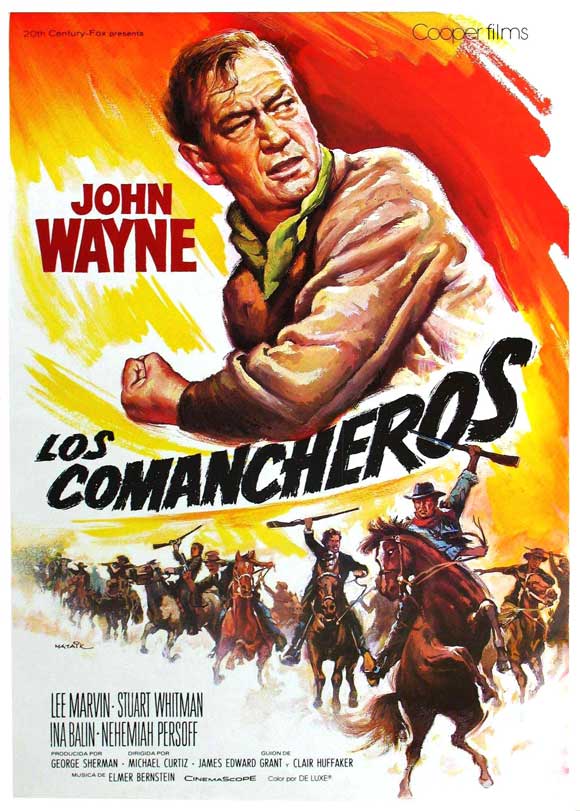
Big Fox budget; Michael Curtiz to direct; beefy, muscular theme by Elmer Bernstein; large panoramic Utah locations, buttes and mesas, photographed by William Clothier; Clair Huffaker and James Edward Grant screenplay from a Paul Wellman novel; Wayne stock company supporting cast; this movie has all the hallmarks of a majopr John Wayne Western.
It starts as an 1840s costume drama with the ladies in elegant dresses and the men in tail coats but as soon as Wayne appears in his usual garb (no concessions whatever to the 1840s) of pinky red cavalry shirt, leather vest and gunbelt, exactly as he appeared in dozens of other Westerns set at any period you like, it goes out to ‘Texas’ where Duke is Ranger Jake Cutter and the action starts. The plot has ne’er-do-well New Orleans gambler Paul Regret (Stuart Whitman, who must have owned shares in Brylcreem), a part written with Cary Grant in mind, teaming up with Capt. Cutter to go undercover into Indian lands to thwart some dastardly Comancheros. In the book, Regret was the central character but for the film Cutter’s part had to be inflated, of course. Well, it was Duke.
.
Don’t you think Wayne looks like Harry Carey Sr? Duke would be honored, of course.
Perhaps it was deliberate.
.
Spanish Doña Pilar Graile (Ina Palin, in her first of two Westerns) flits from Mississippi river steamer to the Comancheros’ lair (it’s not clear why) and flirts with Regret and Cutter both.
.
.

Horseface. Poor Jack, what indignities he had to suffer.
.
Jack Elam is in it (he is a Comanchero, natch, named Horseface – poor Jack) but only for the length of time it takes to blink. Ditto Edgar Buchanan, as, obviously, an amusing judge of dubious probity, Thaddeus Jackson Breen.
.
.

Judge Edgar (left)
.
It was the last film of veteran cowboy actor Guinn ‘Big Boy’ Williams, who died shortly after its completion. Curtiz’s younger brother Gabriel has a bit part. It was Bob Steele’s 176th appearance in a Western; respect!
The best part is Lee Marvin as the partially-scalped Tully Crow. But most regrettably, Wayne is obliged to shoot him after only one reel, just when his character was getting interesting.
.
.

Tully Crow
.
They all have Winchester lever-action rifles and Colt Peacemaker six-shooters in the 1840s, which is advanced. The Comancheros are just like pirates in other films. There is a big, sub-Hondo battle with endless Indians being mown down as if at a fairground shooting gallery when the heroes win the prize.
.
.

That’s the trouble with these Comanchero camps.
They keep you hanging around so long.
.
The trouble is Michael Curtiz. It was his last film as director and he wasn’t good at Westerns. I love Casablanca but he didn’t understand oaters. He did 11 in all and the ones with Errol Flynn are quite fun – Dodge City, especially. But you probably can’t do Francis of Assisi and The Comancheros in the same year and expect them both to work (though there could have been some interesting crossover… No, just being facetious). To be fair to the poor man, during much of the shooting, he was seriously ill (he died of cancer shortly after the film’s release) and on any Waynr picture Duke would have had in any case major input to the direction. First choice had been Budd Boetticher; now that would have changed everything.
.
5 Responses
I have no quibble with your review except for the caption under the picture with Edgar Buchanan and John Wayne.The scene comes from McClintock! And it likely would have been a different picture had Budd Boetticher directed the film, judging by his iconic films with Randolph Scott.
Your remark about Boeticher is thought-provoking. I think it would have been interesting to see the over-sized Duke of the 60s and 70s sometimes reined in by a director with a talent for character-driven ensemble pieces. These later films were such a showcase for Wayne that even big-name co-stars were over-whelmed and the support come across as not more than hangers-on.
I can’t let that dig at Michael Curtiz go.
When Rob Reiner died, critics pointed out that his string of brilliant films—“..Spinal Tap”, “Harry [&] Sally”, “Princess Bride”(!), “A Few Good Men”—bore no stamp of the director, no signature. Each was a masterpiece on its own unique terms. (I think Ron Howard also has that quality.)
I’m often annoyed by auteuriste flourishes when they distract you from experiencing the tale and remind you it’s a movie. Here’s slovenly Alfred Hitchcock besetting Grace Kelly with a strangler. She stabs him with a scissors with her skinny, oxygen-deprived arm because it’s the storyline, never mind that Hitch couldn’t stage it convincingly. Here’s perpetual tourist John Ford running his slideshow of Monument Valley when he was hired to shoot a Western.
I am supremely impressed with a director that can get out of the damn way of his own picture. (Ford famously ruined many a take from “How the West Was Won” when his elbow turned up in the corner of the panoramic frame!) Michael Curtiz directed “Captain Blood” and “Casablanca”—quite some range. He was especially adept at directing Errol Flynn. Flynn hated him, for constantly pricking his ego. Bette Davis, who felt much the same, recalled seeing “..Elizabeth & Essex” decades later and being astonished how good Flynn was. He blows her off the screen. (Nothing she’d ever concede.) Curtiz?
Want more range? Curtiz directed “Yankee Doodle Dandy”, “Mildred Pierce” and “King Creole”. Honest to god, a good Elvis movie!
Here’s one more to treasure hunt—it’s obscure, alright—“Trouble Along the Way”. It’s a John Wayne flick, modern-set (1953). Wayne is a football coach bringing a squad of ringers to save a small Jesuit college. He’s also raising a teenage daughter, and runs afoul of child protection-marm Donna Reed. Well, I think you can predict the story arc here. But Curtiz plays the rom-com out to the brink of conclusion … and substitutes an ending faithful to the characters. It’s a little jarring. A minor masterpiece. They didn’t like it at all in 1953.
It is true that Jeff has, if not prejudices, but at least some fixed ideas or foibles (like everybody else I presume) even some favorite targets for which he can be very mean or funnily sarcastic.
For instance, he does not like Michael Cimino’s Heaven’s Gate, Marlon Brando (in westerns), Karl Malden (“he overacts, as usual, and never convinced as a Westerner” or “he came close to ruining any number of movies”, Maureen O’Hara (“prima donna-ish and overacting though beautiful” or “I have never been a Ms O’Hara fan. I’m sure she was a very nice person in real life and all but in Westerns” or “completely unconvincing”…, Samuel Fuller (“trashy”).
Of Michael Curtiz he says : “Westernwise, in my view, he hadn’t quite got it”, “none of the eleven Westerns he directed was really good. They had pzazz and they nipped right along. But Curtiz oaters just weren’t convincing as true Westerns.”
No doubt in my opinion that Curtiz is one of the greatest Hollywood directors of the Golden Age.
He was prolific, efficient, versatile, excellent in various genres and types of movies (Have you seen The Kennel Murder Case (1933) starring William Powell and Mary Astor and a very truculent Eugène Pallette !?).
I do not see why a guy able to make excellent adventure and action movies would not have been able to make (good or “true”) westerns.
And he did. He made his mark. With style. Of his own. Even if his films did not evince a specific directorial style.
Love him or hate him (actors, producers, screenwriters, crews were squarely divided) he was truly a moviemaker and a bullying taskmaster with a poor english.
Even if he drove himself as hard as anyone, it did not endear him to his crews, particularly when he worked them 20 hours a days or without lunch breaks. (Curtiz was not hungry, so why should anyone else be?)
His biography by Alan K. Rode, Michael Curtiz, A Life in Film is a must-read.
Among the contemporary jack of all trades directors, I would also add Steven Soderbergh.
Now we’re back to the topic of What Is a Western?
I grew up on the syndicated Westerns, half-hours of great fistfighting and hard riding and tight, surprisingly complicated plots. They always ended with a decisive duel/brawl.
As I grew into a later bedtime I was exposed to the network Westerns. These were better mounted (I’m talking about expense; the cheap Westerns were still staged more energetically) and longer*. But I was disgusted with the amount of talking, and feelings, and talking about feelings! Often the ‘issue’ didn’t even have a violent solution! Another shortcoming of the hourlong Westerns was that the heroes had jobs and lived someplace. That meant that things can’t evolve (barring offseason cast changes). The rule of episodic drama is a return to square one by the (happy) ending for series continuity. The half-hour heroes were off to some fresh town to clean up between epidodes. That means Matt Dillon couldn’t even clean up Dodge! In fact “Gunsmoke” portrayed Dodge City as having already been tamed, much as Mayberry under Sheriff Taylor. Matt increasingly had to ride into the prairie to find some truly desperate hombres to best.
Perhaps the bloated network Westerns should lose their designation. They were really just modern police or teacher ‘issue’ shows plopped down in the prior century. (Often the topic of juvenile delinquency turned up!)
To my mind the action Westerns were the true Westerns. At least, truer. The showdown is an irreduceable component. It certainly appealed to my juvenile self. At that, the network Westerns were often represented ‘adult’ Westerns. Humanists want to believe ‘You have to be taught to hate.’ I’m afraid it’s closer to our true nature.
*If the hourlong Westerns were slow and padded, the 90-minute ones were unbearably so. Your typical “Virginian” would often show a ‘chase’ conducted at full plod. The bad guys would ride past a tree and around a boulder. The good guys would arrive at the tree. They’d check the ground for ‘sign’. They’d point in the direction (we assume) of the boulder, and trot off camera. The bad guys cross a dry creekbed. The good guys arrive at the boulder. Check for ‘sign’. The bad guys pass a cactus… Moreover, depending on how deep into the running time we are, the good guys would arrive back at the Shiloh ranchhouse and announce, “Got ‘em!” or “Got away…”