.
.
A strong 50s Western from Fred MacMurray
.
.
As a juvenile Western fan in the 1950s and 60s I had a problem with Fred MacMurray wearing a gun. To me he was the absent-minded professor and whenever I saw him I could only think of flubber. So the very idea of him ridin’ the range and getting into gunfights was totally preposterous. As the (many) years have passed, however, I have gradually re-evaluated MacMurray’s sixteen oaters, from his first, The Texas Rangers in 1936, to 1959, when he did his last three, Good Day for a Hanging (released January), Face of a Fugitive (May) and The Oregon Trail (August), although Oregon Trail was in fact pretty weak. I now think he was really rather good in them. Tough and craggy-faced, he came across as a hard man, but with a streak of decency in him – the ideal make-up for a Western hero.
.
.

Fred escapes from custody
.
Face of a Fugitive was directed by Paul Wendkos for Columbia. Wendkos had been hired by Harry Cohn on the strength of The Burglar, a 1957 low-budget noir, and Fugitive was his first big-screen Western, and indeed his only one until the very uninspiring Guns of the Magnificent Seven sequel in 1969. One wouldn’t put him in the top rank of Western directors. Still, with MacMurray he created an atmospheric film with a somber note to it and quite a bit of toughness.
.
.

.
David T Chantler and Daniel B Ullman wrote the screenplay from a Peter Dawson story, and it isn’t bad. Although Chantler was not a Western specialist, ‘Peter Dawson’ was in fact Luke Short’s brother and wrote in a similar way (praise indeed). Ullman was an enormously experienced hand at penning oaters, for the big and small screen, having started work on the Randolph Scott picture Return of the Bad Men in 1948 and contributing to a total of 219 Westerns right through to Wyatt Earp: Return to Tombstone in 1994. The story opens with a man (MacMurray) manacled to a lawman but the prisoner then escapes with the aid of his younger brother (Ron Hayes) and comes to a town where he is unknown – for the moment, until the wanted posters with his picture get there. Of course he meets a beautiful woman, a redhead widow (Dorothy Green) and with her and her little daughter (Gina Gillespie) they form a kind of family unit, as so many Western heroes did before and since. We all know that being nice to animals or children in the first reel established the hero’s goodness regardless of his outlaw status.
.
.
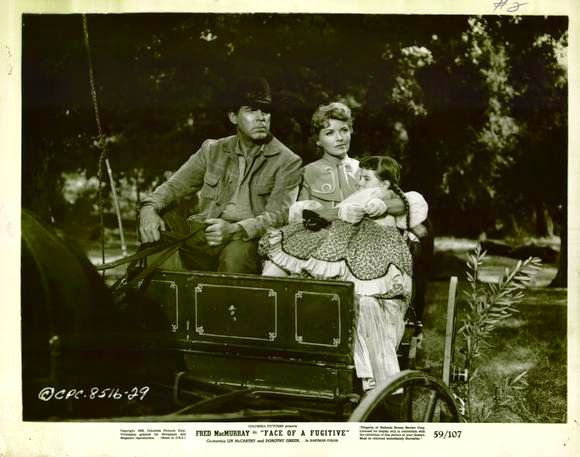
Family unit
.
There’s a proper train, some nice Jamesown, California locations shot in “Eastmancolor by Pathé” with Wilfred M Cline behind the lens, and a (rather dark) Jerry Goldsmith score, so that’s all good.
There’s a ruthless rancher, of course, the kind who wants the whole valley, you know how they do. “Nobody’s gonna take my land away from me,” he says. “I’ll kill the man who tries.” Actually, it isn’t his land at all but he thinks it is. He is played by Alan Baxter (despicable in any number of pictures and Jesse James in 1941) and he has the obligatory henchpersons in the shape of, in particular, a young James Coburn. Actually, for such a small part Coburn is electric and his entry to the dance is stunning.
.
.

James Coburn noticeably good, even in a small part
.
The brave young sheriff who is determined not to let the arrogant rancher get away with it, and who is backed up by steely Fred, is played by Lin McCarthy, who was a stalwart of TV Western shows of all kinds but this was his only big-screen Western. He isn’t bad, in fact, and it’s a pity he didn’t do more. Fred’s redhead widow is the sheriff’s sis, which is a bit awkward. The Fred/sheriff relationship is a little like that between Henry Fonda and Anthony Perkins in The Tin Star.
.
.
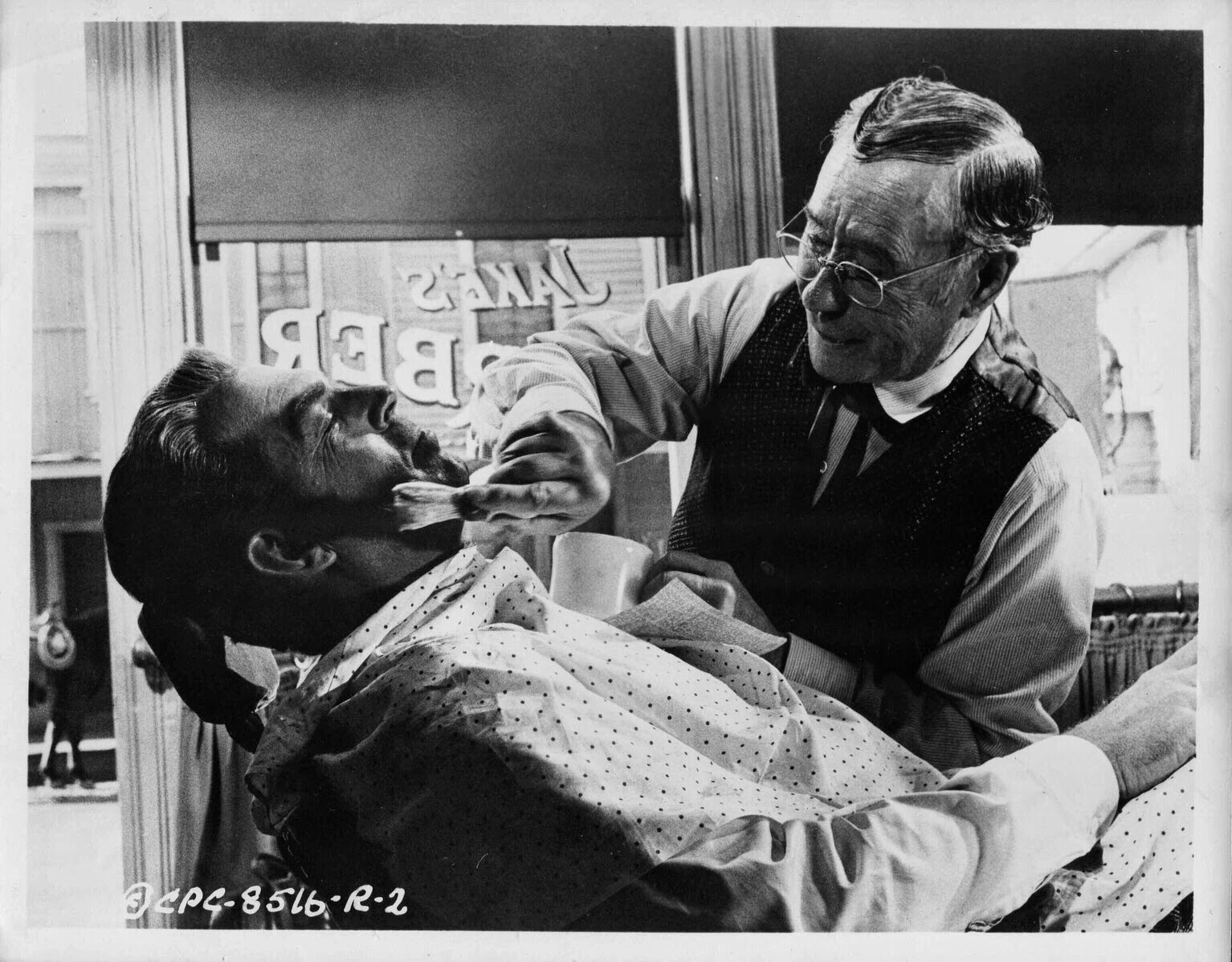
Fred gets a shave from Paul E Burns
.
During Fred’s first-reel escape, the lawman in question draws a boot derringer and manages to hit the younger brother fatally at over 100 yards, on a horse, which is pretty good going. Still, plausibility isn’t one of the main qualities we expect from Westerns. Actually, the death of the boy, “You dumb punk kid,” as Fred affectionately calls him, is handled rather movingly.
The fistfight in the saloon is well done, and benefits from the somber music accompaniment, and there’s a good final bit in a ghost town, although the stunt doubles are rather obvious (except for Coburn, I think). I liked the out-of-tune mechanical piano set going and then gradually winding down.
Face of a Fugitive is in fact a rather good 50s Western and I recommend it.
.
12 Responses
Hi Jeff,
I have just seen this western (new release Sidonis Calysta) and I have the same idea about MacMurray: he isn't a real western hero. Nevertheless he did a good job in 'At gunpoint' and 'Quantez', two of my favorite MacMurray westerns.
Greetings
Bart
Yes, Fred was perhaps not at the very top of the list of Western leads. Still, I have gradually re-evaluated my opinion of him over the years and now I think he was actually quite good in the genre.
Jeff
You are absolutely right. What I meant was that he doesn't look like a western hero, he looks more human, more vulnerable. I think that's his strength as an actor in westerns…
Bart
Yes. Well put.
Jeff
Just discovered this blog, I don't know if it is still active. Fred MacMurray has been one of my favorite actors for as long as I can remember. The thing I always admired the most about him was his versatility. He started out with light frothy comedies and musicals, then went into film noir, westerns, Disney movies, then into television. He was successful in all. I wonder how many actors can say that. Personally I always found him to be eminently believable and any role he undertook. Face of a Fugitive he is one of my favorite westerns. The supporting cast is full of familiar faces, though they may not be Hollywood's elite – Coburn excepted of course. MacMurray's character is a typical Western hero, and though the movie may not be particularly well known or well received by many, it is still a very good Western. I am glad others appreciated as well. Valerie
Hi there
We're active, alright!
Inasmuch as our position on the counch watching Westerns permits, that is.
You are not alone in your Fred fandom.
Thanks for your comment.
Jeff
Thanks to you Jeff I have spent my whole afternoon watching Quantez, Day of the Bad Man and Face of a Fugitive…! Fred MacMurray is excellent in all three – I need to see some others..- and truly deserves all our consideration as a leading western actor, bringing his cynical, weary, doomed character close to William Holden's, one of my favorite american actor. Okay probably not on the top 15 as, unfortunately for him, he did not play for the leading directors as he did in the noir with Billy Wilder for instance. From Double Indemnity to Disney, what a career ! JM
That's what I call a great afternoon!
Jeff
This one is very much worth watching. I knew Fred MacMurray only from My Three Sons, The Apartment, and a few Disneys from the 70s. Never would have pegged him as a Western hero, but he gives a very good account of himself in Face of a Fugitive. Stolid, steely and stoic as a Western man should be, but also radiates some dangerousness.
Now the main reason I purchased this film on DVD is because of the presence of James Coburn; this is his second feature film. Coburn doesn’t disappoint as the top hand of a greedy rancher who will stop at nothing to retain every parcel of land he considers his own. Coburn’s role is fairly extensive and he improves the film’s quality.
Jerry Goldsmith’s score is unusually good. Film music from the late 50s and early 60s was often rather evocative–modernistic, angst-ridden and wistful, and I think that accurately describes the music for Face of a Fugitive.
Lastly, although this picture has its fair share of violence and brutality, it is also strikingly idyllic and tender at times, reminding one of the section of Shane before all hell broke loose.
This film isn’t a masterpiece, but it is an attractive jewel of the Western genre.
Illinois born Fred Mc Murray (1908-1991) was a very good western actor but he never met his John Ford like Wayne, Anthony Mann like Stewart or Budd Boetticher like Scott.
None of his westerns, as good as they are for a very few of them, and even made by reputable directors, reached the famousness of a Shane or High Noon ever. Nevertheless Fred Mc Murray holds his rank in the western galaxy thanks to his own persona and a handful of good films such as Face of a Fugitive, one of his best.
What Jeff says about him:
“He wasn’t bad, even if he didn’t much care for the genre. He rode surprisingly well and had a certain toughness about him, though his menacing walk-down was spoiled by a slightly splay-footed gait.”
And
Fred once said: “The horse and I were never as one”. He was nevertheless very good in oaters, I think, especially if the role required a decent but tough hombre called to duty.”
Surprisingly Jeff did not make a Murrayrama which would have been well deserved.
But you will find a text in Jeff’s blog for several of his oaters (a term taken in a broad sense as some are rom-coms or timber adventures) listed below and marked with !!!!
– !!! The Texas Rangers (1936) King Vidor
– The Trail of the Lonesome pine (1936) Henry Hathaway
– Rangers of fortune (1940) Sam Wood
– The Forest Rangers (1942) George Marshall
– Smoky (1946) Louis King (modern western)
– Never a dull moment ! (1950) George Marshall
– Callaway Went Thataway (1951) Melvin Frank and Norman Panama
– !!! The Moonlighter (1953) Roy Rowland
– !!! The Far Horizons (1955) Rudolph Maté
– !!! At Gunpoint (1955) Alfred Werker
– !!! Gun for a Coward (1957) Abner Biberman
– !!! Quantez (1957) Harry Keller
– !!! Day of the badman (1958) Harry Keller
– !!! Good day for a hanging (1959) Nathan Juran
– !!! Face of a fugitive (1959) Paul Wendkos
– !!! The Oregon trail (1959) Gene Fowler Jr.
Fred also guest-starred in the opening episode of the TV Cimarron City” in 1958.
Day of the Badman is on my list of Western DVDs to purchase.
Unlike Jeff, I like Barbara Stanwyck. After ‘Double Indemnity’, I had high expectations for ‘The Moonlighter’, which paired her again with MacMurray. But I found it dull.
I enjoyed ‘Quantez’. Kino-Lorber has issued it on a sharp-looking blu-ray. MacMurray is good and so is Dorothy Malone.
‘Gun for a Coward’ is on my to-be-viewed pile of discs.